When the COVID-19 pandemic hit the world like a wrecking ball in 2020, the Philippines, like many countries, scrambled to protect its citizens. Enter the era of the Community Quarantine—a term that has since become deeply embedded in Filipino life, vocabulary, and memes.
This guide explores the ins and outs of the Community Quarantine classifications used in the Philippines during the height of the pandemic. We’ll cover what each classification meant, how they evolved, and how Filipinos adapted—often with humor, heart, and resilience.
Whether you’re a student researching public health, a policymaker doing a retrospective, or someone trying to make sense of what the heck MECQ stood for, this is for you.
The Birth of Community Quarantine in the Philippines
When the World Shut Down
On March 15, 2020, Metro Manila was placed under a “Community Quarantine”—a phrase that, until then, had rarely been used in everyday conversation. Within weeks, the entire island of Luzon followed. Soon after, different regions in the country adopted their own measures based on local outbreaks.
The term wasn’t just about staying indoors—it became a legal framework, a policy instrument, and, quite frankly, a cultural phenomenon.
What is a Community Quarantine?
A Community Quarantine is a set of movement restrictions and health protocols applied to a specific geographical area (barangay, city, province, or region) to control the spread of a contagious disease—in this case, COVID-19.
It varied in severity—from total lockdowns to more relaxed versions allowing for essential economic activity. The key was to balance public health concerns with economic and social sustainability.
The Four Major Community Quarantine Classifications in the Philippines
The Inter-Agency Task Force for the Management of Emerging Infectious Diseases (IATF-EID) introduced a tiered system to classify quarantine levels. These were:
A. Enhanced Community Quarantine (ECQ)
Nickname: The Hard Lockdown
This was the strictest form of Community Quarantine, typically implemented when cases surged uncontrollably.
Key Features:
- Stay-at-home orders for everyone except essential workers.
- Suspension of public transportation.
- Closure of most businesses except those offering basic necessities.
- Strict checkpoints and border controls.
Impact: ECQ saved lives, no doubt. But it also froze the economy and caused massive disruptions, especially for daily wage earners.
Pro Tip: During ECQ, LGUs often provided “ayuda” (financial or food aid). Always keep your barangay IDs and quarantine passes updated.
B. Modified Enhanced Community Quarantine (MECQ)
Nickname: ECQ Lite
A slightly loosened version of ECQ, the MECQ allowed limited movement and the resumption of select industries.
Key Features:
- Some businesses could reopen at limited capacity (e.g., BPOs, manufacturing).
- Public transport remained suspended in many areas.
- Curfews and checkpoints still enforced.
- Religious gatherings and school operations remained suspended.
Why It Matters: MECQ served as a transitional phase, giving local governments breathing space while still maintaining control over the virus’s spread.
C. General Community Quarantine (GCQ)
Nickname: The “New Normal” Lite
Once the curve was “flattening” (or at least wobbling in the right direction), areas transitioned to GCQ.
Key Features:
- Most businesses allowed to operate at 50–75% capacity.
- Limited public transport resumed.
- Curfews relaxed.
- Offices reopened with skeleton staff.
- Minimum public health standards strictly enforced (face masks, face shields, distancing).
Fun Fact: GCQ was where Filipinos perfected the art of face shield fashion.
D. Modified General Community Quarantine (MGCQ)
Nickname: Semi-Normal
This was the most relaxed form of Community Quarantine. Most of the economy reopened, albeit with precautions.
Key Features:
- Almost all establishments could operate.
- Public gatherings were allowed within capacity limits.
- Intrazonal and interzonal travel permitted.
- Still required: masks, distancing, and hand hygiene.
Golden Rule: MGCQ wasn’t a free pass. Vigilance was still necessary, especially in densely populated areas.
Beyond the Acronyms: Special Measures & Adjustments
Granular Lockdowns
LGUs (Local Government Units) were given power to implement localized Community Quarantine protocols based on real-time outbreaks. Barangays, streets, or even single buildings could be locked down.
Why it worked: It minimized economic disruption while aggressively containing the virus.
Alert Level System (2021 Onward)
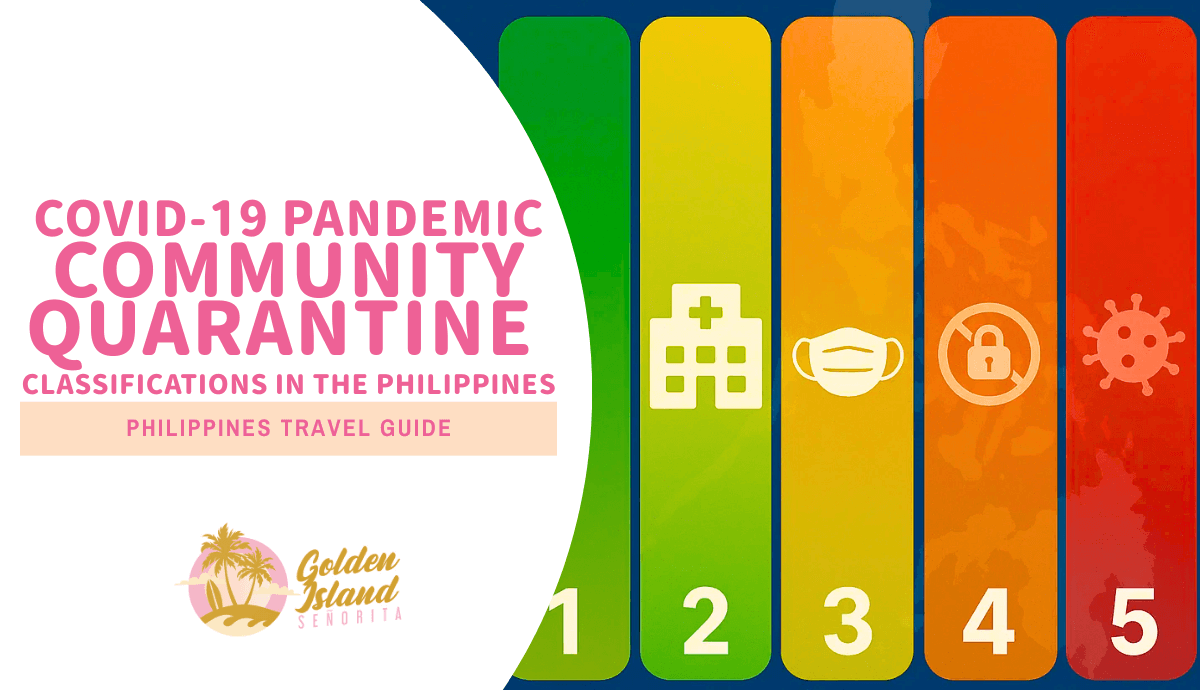
Certainly. The Philippine government implemented a COVID-19 Alert Level System (Levels 1 to 5) beginning September 2021, replacing the older community quarantine classifications like ECQ, MECQ, GCQ, and MGCQ. This shift was made to streamline the country’s pandemic response under a more granular, risk-based framework that balances public health with economic activity.
Here’s a comprehensive expert-level explanation of the COVID-19 Alert Levels 1 to 5 in the Philippines:
Alert Level 1 – Minimal Restrictions
- Transmission Level: Low to no COVID-19 transmission.
- Healthcare Capacity: Adequate.
- Activities Allowed:
- 100% capacity in all indoor and outdoor establishments.
- Face-to-face classes, offices, mass gatherings permitted.
- Safety Protocols: Mask-wearing encouraged indoors (may be optional in some settings).
- Goal: Full reopening with continued minimal health protocols.
Alert Level 2 – Low Risk
- Transmission Level: Slight uptick, but under control.
- Healthcare Capacity: Slight strain, manageable.
- Activities Allowed:
- Indoor venues at up to 50% capacity (for fully vaccinated individuals).
- Outdoor venues at up to 70% capacity.
- Movement Restrictions: Vulnerable populations (seniors, unvaxxed minors) advised to limit movement.
Alert Level 3 – Moderate Risk
- Transmission Level: Community transmission with increasing cases.
- Healthcare Capacity: Moderate strain.
- Activities Allowed:
- Indoor activities at 30% capacity (vaccinated only).
- Outdoor activities at 50% capacity.
- Restricted Sectors:
- Bars, karaoke, indoor contact sports, funfairs not allowed.
- Travel & Movement: Limited; curfews may be imposed.
Alert Level 4 – High Risk
- Transmission Level: Sustained community transmission.
- Healthcare Capacity: High strain.
- Activities Allowed:
- Indoor operations limited to 10% capacity for essential services.
- Outdoor activities allowed up to 30% in non-high-risk settings.
- Strict Restrictions:
- High-risk individuals must stay at home.
- Interzonal travel restricted.
Alert Level 5 – Critical Risk
- Transmission Level: Uncontrolled spread.
- Healthcare Capacity: Overwhelmed.
- Equivalent to: Former Enhanced Community Quarantine (ECQ).
- Activities Allowed:
- Only essential activities (e.g., food, medicine, emergencies).
- Total Lockdown Measures:
- Strict stay-at-home orders.
- Checkpoints and mobility controls enforced.
Regional Differences: A Patchwork of Protocols
Different areas experienced different Community Quarantine levels at different times. This sometimes led to confusion, especially for travelers and OFWs.
For example:
- Metro Manila was in ECQ while Cebu was in MGCQ.
- Davao had localized lockdowns even while under GCQ.
- Boracay opened under MGCQ with strict testing and booking requirements.
Pro Tip for Travelers: Always check with LGUs and the Department of Tourism for the latest quarantine and entry protocols before traveling.
The Human Side: How Filipinos Coped
The Rise of Quarantine Passes
No Community Quarantine was complete without those precious laminated cards. Families often designated one “warrior” to do grocery runs, proudly waving their barangay-issued pass like a golden ticket.
Work From Home Revolution
While many suffered job losses, some industries adapted to remote work, forever changing the landscape of employment in the Philippines.
Zoom fatigue became real. So did “kamustahan” video calls that lasted 3 hours.
Bayanihan Spirit
In true Filipino fashion, people came together:
- Community pantries sprouted across neighborhoods.
- Volunteers distributed relief goods.
- Frontliners were celebrated as heroes.
The heart of the Filipino—resilient, generous, and creative—shone brightest during the darkest times of Community Quarantine.
Challenges and Criticisms
Not everything was smooth sailing.
Inequality and Accessibility
Lower-income communities bore the brunt of restrictions. Many couldn’t afford to stay home, and ayuda distribution often became inconsistent.
Confusion and Communication Gaps
Ever-changing guidelines created chaos:
- One day: face shields mandatory.
- Next day: only in malls.
- A week later: face shields scrapped.
Many citizens were left scratching their heads or relying on social media rumors for updates.
Mental Health Crisis
Isolation, unemployment, and fear took a toll. The Community Quarantine amplified an already fragile mental health system.
Fortunately, telemedicine and mental health hotlines became more accessible over time.
Lessons Learned from the Philippine Community Quarantine Experience
1. Flexibility is Key
The ability to shift from ECQ to GCQ to Alert Levels showed the need for adaptive governance in crisis situations.
2. Communication Must Be Clear
Public health information should be simple, timely, and consistent. Future health crises demand better communication strategies.
3. Invest in Health Infrastructure
The pandemic revealed the need to strengthen the healthcare system—especially in provincial areas. Better funding, facilities, and staff support are non-negotiables.
4. Empower Local Government Units
LGUs know their communities best. Giving them tools, autonomy, and funding leads to faster, more contextually appropriate responses.
Where Are We Now?
As of 2020, the Philippines has moved past the emergency phase of COVID-19. The Community Quarantine classifications are no longer active, replaced by long-term health preparedness strategies and vaccination programs.
However, the legacy of the Community Quarantine lives on—in policy, memory, and cultural references.
Moving Forward: The Future of Pandemic Preparedness
The experience with Community Quarantine offers a roadmap for the future:
- Early Detection & Rapid Response: Invest in testing, contact tracing, and digital tools.
- Balanced Interventions: Future quarantines must be nuanced—saving lives without crippling livelihoods.
- International Cooperation: Pandemics don’t respect borders. Regional coordination (like with ASEAN) is essential.
Pro Tip: Quarantine isn’t just about disease control—it’s about managing people, economies, and hope.
Conclusion: What the Quarantine Taught Us
The Philippine Community Quarantine system wasn’t perfect—but it was an earnest, evolving attempt to protect lives. It taught us about governance, compassion, and the power of collective action.
From ECQ to MGCQ, from face shields to vaccines, Filipinos have endured and adapted with grit and grace.
So the next time someone asks what a Community Quarantine is, you can proudly say: “It’s a Filipino survival story, full of acronyms, creativity, and a whole lot of heart.”
