
10 Best Rainy Day Filipino Food to Cozy Up With
You know that feeling when the first drops of rain hit your roof and your stomach immediately sends an urgent memo to your brain? Something like: “Hey, it’s raining. Please deploy soup immediately.” If you’re Filipino, that memo arrives with a very specific list of demands — steaming bowls, simmering broths, chewy noodles, and enough comfort to make you forget that your tricycle got soaked and your slippers are basically snorkeling gear now.
Rainy day Filipino food is not just a category of cuisine. It is a love language. It is a warm hug in a bowl, a blanket you can eat, and a reminder that storms are actually wonderful if you have the right thing bubbling on the stove. Filipino food, in general, has always had this magical quality of meeting people where they are — celebrating with them during fiestas, nourishing them when they’re sick, and, yes, absolutely showing up for them when the clouds refuse to go home.
Whether you’re watching the rain from a foggy window in Baguio, listening to thunder roll over the Visayan hills, or waiting out a Metro Manila flash flood with zero plans to move, there is a rainy day Filipino food that was made exactly for this moment.
What makes Filipino food so uniquely suited to cold, wet, grey days? It’s the layering. The patience. The way a good Filipino broth is never rushed, because the best things in Filipino cooking — and in life, honestly — take time, low heat, and a willingness to let flavors bloom slowly. It’s also the generous use of aromatics like ginger, garlic, and onions that turn a simple pot of water and protein into something that smells like home, warmth, and every good memory you’ve ever had in a kitchen.
So grab your ladle, put on your coziest daster (or pajamas — we don’t judge here), and let’s count down the 10 best rainy day Filipino food that will make you actually look forward to typhoon season. Well, almost.
Table of Contents
🥣 Chicken Sopas
Province of Origin: A beloved staple across Luzon, particularly popular in Manila and the surrounding Tagalog regions.
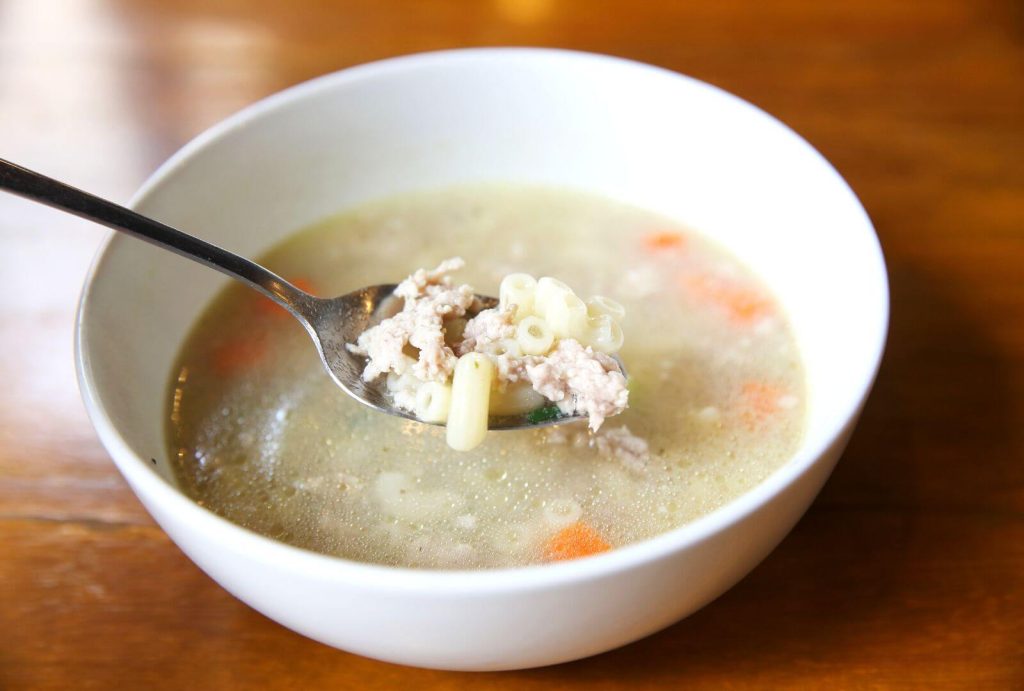
If rainy day Filipino food had a president, Chicken Sopas would win by a landslide — and it would campaign entirely on the platform of “I am warm, I am creamy, and I will never let you down.” No attack ads needed. Just a steaming bowl and a spoon.
Sopas is the Filipino take on macaroni soup, but don’t let the humble name fool you. This dish is a luxurious, milky, slow-simmered bowl of elbow macaroni cooked in a savory chicken broth that’s been enriched with evaporated milk (or fresh milk if you’re feeling particularly fancy that day). It’s loaded with shredded chicken, sliced hotdogs — because Filipino food puts hotdogs in everything and we are not sorry about it — plus carrots, celery, and cabbage. The result is a soup that tastes like your lola made it specifically to cure whatever ails you, including the particular ailment of being stuck inside while rain hammers the zinc roof.
Why is it perfect for rainy weather? Because it wraps around your insides like a weighted blanket. The creaminess soothes your soul, the carbs fuel your noble desire to stay horizontal all day, and the steam fogs up your glasses in the most satisfying way imaginable. Classic rainy day Filipino food that proves simple, affordable ingredients can be absolutely extraordinary in the right hands.
The real secret to a great Sopas is patience — letting the broth reduce just enough to concentrate the flavor before the milk goes in, and not skimping on the black pepper. A heavy hand with the pepper is what separates a good Sopas from a life-changing one.
🦴 Bulalo
Province of Origin: Batangas, the proud and unapologetic beef capital of the Philippines.
If Sopas is the president of rainy day Filipino food, then Bulalo is the queen — regal, rich, and requiring absolutely no apologies for being extra. This is the dish you make when the rain is really committing, when you can hear thunder in the distance and the wind is doing something theatrical with the curtains.
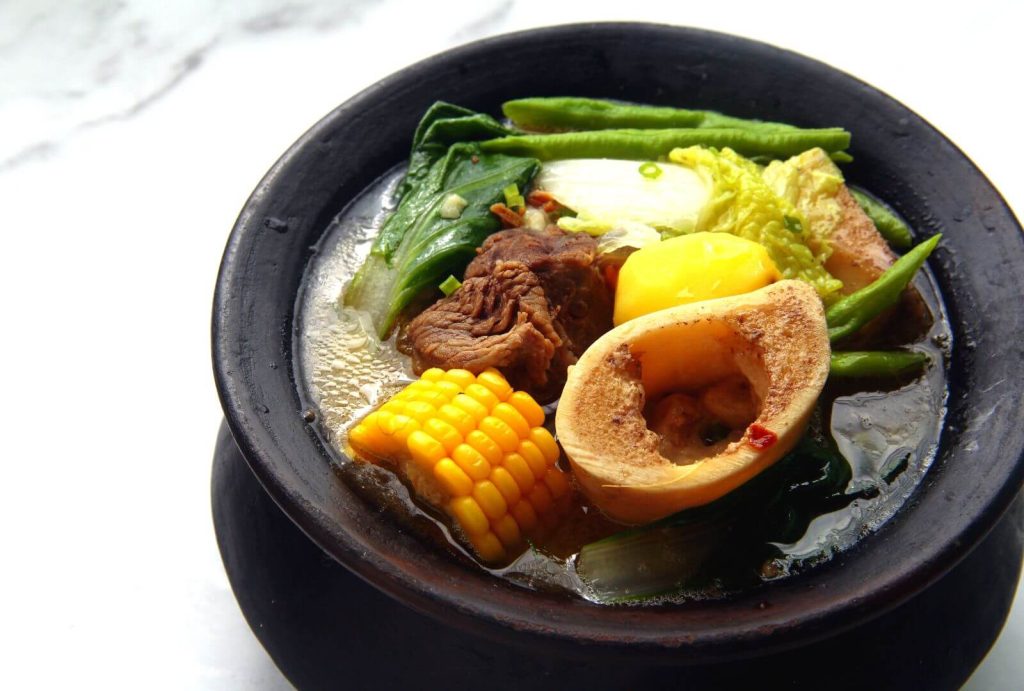
Bulalo is a slow-cooked beef bone marrow soup that Batangas has been perfecting for generations. The star is a massive beef shank with the bone still in, simmered for hours (sometimes up to four) until the collagen breaks down into a broth so deeply flavorful and silky it feels like someone distilled pure umami into liquid form. Accompaniments include corn on the cob, cabbage, pechay, and sometimes potatoes — all bobbing cheerfully in that golden, glorious soup like they’re thrilled to be there. And honestly? They should be.
The real party trick is the bone marrow itself. You scoop it out with a long spoon, mix it with a little fish sauce and calamansi, and spread it over steaming white rice like the world’s most indulgent, most sinful butter. It is practically illegal how good this is, and yet no one has been arrested. A triumph of the legal system.
On a rainy day, Bulalo is the kind of rainy day Filipino food that makes you feel like you’ve earned your coziness. It takes hours to make — or you can find it at any of the famous Bulalo restaurants along the highway in Tagaytay and Batangas, where the cool mountain air makes every sip hit even harder. Filipino food has a genius for matching geography with flavor, and Bulalo is perhaps the best example of this gift.
🧄 Arroz Caldo
Province of Origin: Filipino-Chinese roots, widely adopted and deeply beloved across all regions of the Philippines.
Arroz Caldo is the dish your nanay or lola would conjure whenever you were sick, cold, or just having a rough go of things — which means it is also the perfect rainy day Filipino food for days when the sky itself is clearly having a rough go of things and needs to cry about it for six hours straight.
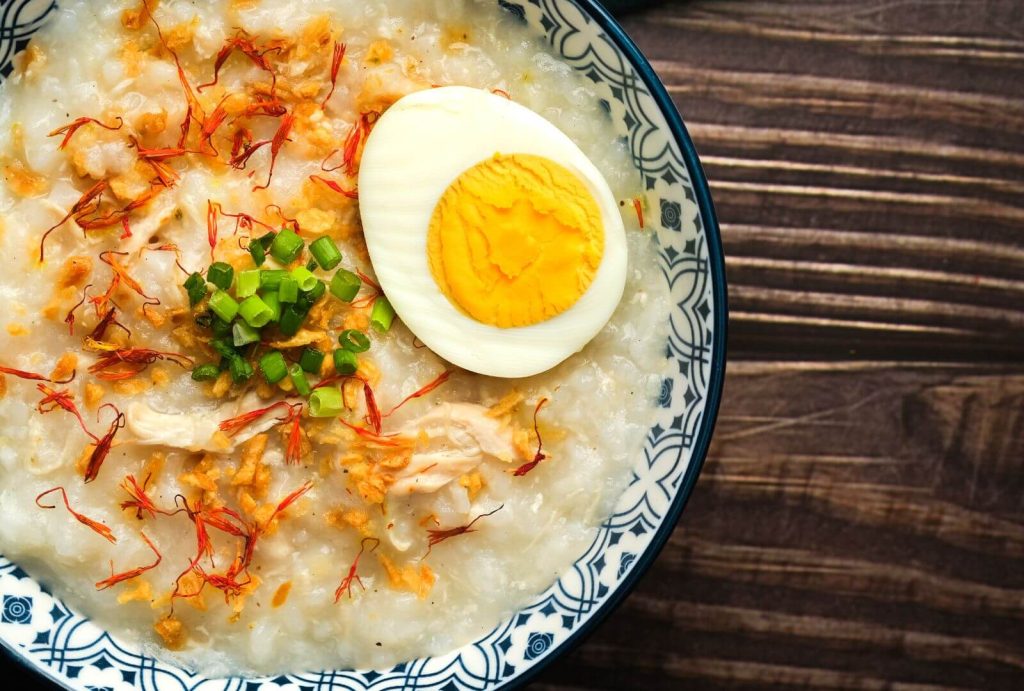
This Filipino congee — and yes, it proudly wears its Chinese congee heritage alongside its Spanish name, because Filipino food is never not doing something interesting historically — is made with glutinous rice simmered low and slow with chicken, ginger, garlic, and onions in a fragrant, yellow-tinged broth. The turmeric (or kasubha) gives it that golden glow that makes it look like a bowl of edible sunshine, which is exactly what you need when there is no actual sunshine anywhere.
It’s topped with fried garlic, sliced spring onions, a generous drizzle of toasted garlic oil, a squeeze of calamansi, and fish sauce to taste. Sometimes a soft-boiled egg joins the party and everyone agrees it should have been invited sooner. The result is thick, porridge-like, deeply warming, and deeply rooted in what Filipino food does best: turning modest ingredients into something that feels genuinely healing.
The ginger is the real hero here — it does that wonderful, slow-burn thing where it warms you from the inside out, as though your stomach has its own little fireplace. As rainy day Filipino food goes, Arroz Caldo is less a meal and more a medicinal experience that happens to taste absolutely incredible. Your body will thank you. Your lola will feel it in her bones, wherever she is, and smile.
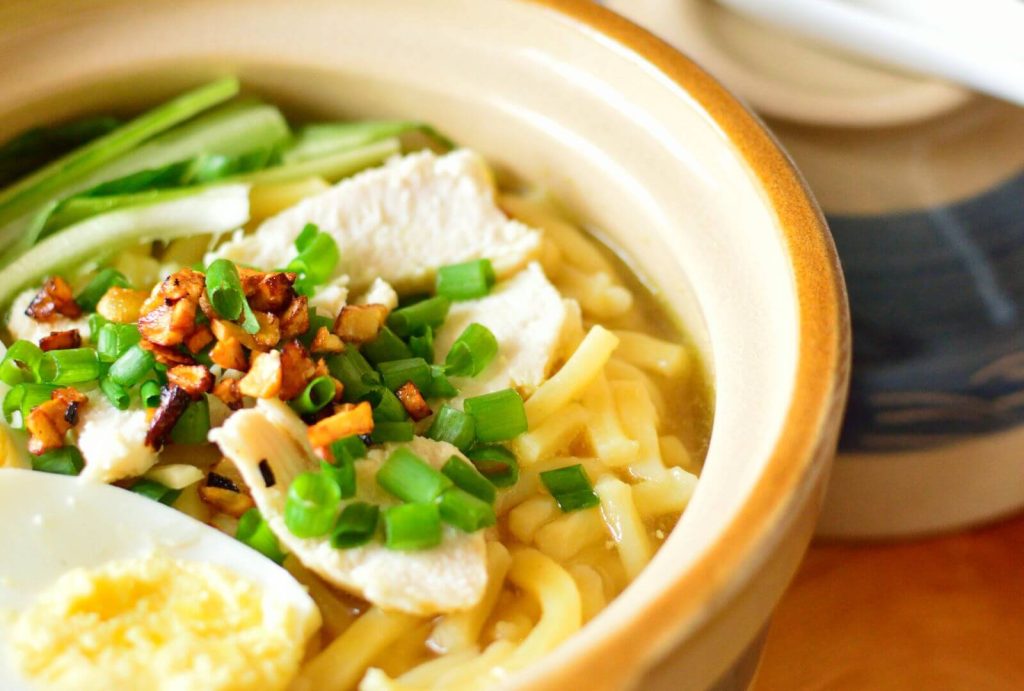
🍜 Chicken Mami
Province of Origin: Filipino-Chinese heritage, popularized in the noodle shops of Manila but beloved from Aparri to Jolo.
Noodle soups are the universal language of rainy day comfort, and Chicken Mami is the Philippines’ most fluent, most charming dialect. This is the Filipino food you find in a carinderia with plastic stools, a hand-written menu on the wall, and an auntie behind the counter who has been making this exact broth for thirty years and knows something most fancy restaurants don’t.
Chicken Mami features fresh egg noodles swimming in a clear, savory chicken broth, topped with sliced or shredded chicken, kikiam (that cheerful fish-and-pork roll in the orange sauce), a hard-boiled egg, spring onions, and sometimes fried garlic for that irresistible crunch. The broth is clear but not thin — it has depth and warmth and a faint sweetness that makes you wonder what the secret is. (The secret is always time and good bones.)
It’s lighter than Bulalo, quicker to make than Arroz Caldo, and deeply satisfying in the way only an honest, unpretentious bowl of noodle soup can be. The slippery egg noodles, the clean umami broth, the tender chicken — it all comes together into something that feels both energizing and comforting at the same time, which is a genuinely difficult balance to achieve. Filipino food pulls it off routinely, as if it’s no big deal.
As rainy day Filipino food, Chicken Mami hits a sweet spot: it’s not so heavy that you immediately need a nap (though a nap is always a noble and dignified choice on a rainy afternoon), but substantial enough to warm you through every extremity, right down to your cold toes. Add a dash of patis, a squeeze of calamansi, and some chili oil if you’re feeling bold, and you have one of the most satisfying storm-weather meals in existence.

🥮 Ensaymada and Tsokolate
Province of Origin: Ensaymada traces its roots to Majorca, Spain, but was perfected over centuries in Pampanga; Tsokolate is deeply rooted in Tagalog and Visayan traditions and proudly grown from Philippine cacao.
Sometimes rainy day Filipino food isn’t a soup. Sometimes — and this is important — it’s a buttery, cheese-crowned pastry and a thick, steaming mug of hot chocolate, and you need to sit with that truth and accept it fully and without reservation.
Ensaymada is a soft, spiral-shaped bread made with an enriched dough — eggs, butter, and milk — that gives it a tender, pillowy crumb that tears apart like a dream. It’s topped generously with softened butter, fine sugar, and a snowfall of grated cheese (typically sharp cheddar, which creates the iconic salty-sweet combination that defines this pastry). Filipino food has always been comfortable playing with the salty-sweet spectrum, and Ensaymada is one of its most elegant experiments.
Filipino-style Tsokolate, made from locally grown tablea — those small, rustic discs of roasted and ground cacao — is thick, dark, not-too-sweet, and frothed into a glorious foam using a batidor, a traditional wooden whisk that you roll between your palms like you’re summoning something ancient and wonderful. Because you are.
The combination of flaky-buttery-cheesy ensaymada dunked into or sipped alongside a rich, earthy mug of tsokolate is the rainy day Filipino food equivalent of wrapping yourself in a cashmere sweater while someone reads you your favorite book. It’s indulgence that feels completely earned. This pairing is especially celebrated in the cooler highland regions — Tagaytay, Baguio, Bukidnon — where the rain arrives with a genuine chill and Filipino food responds with exactly this kind of warmth. Pure, unpretentious, borderline spiritual joy.
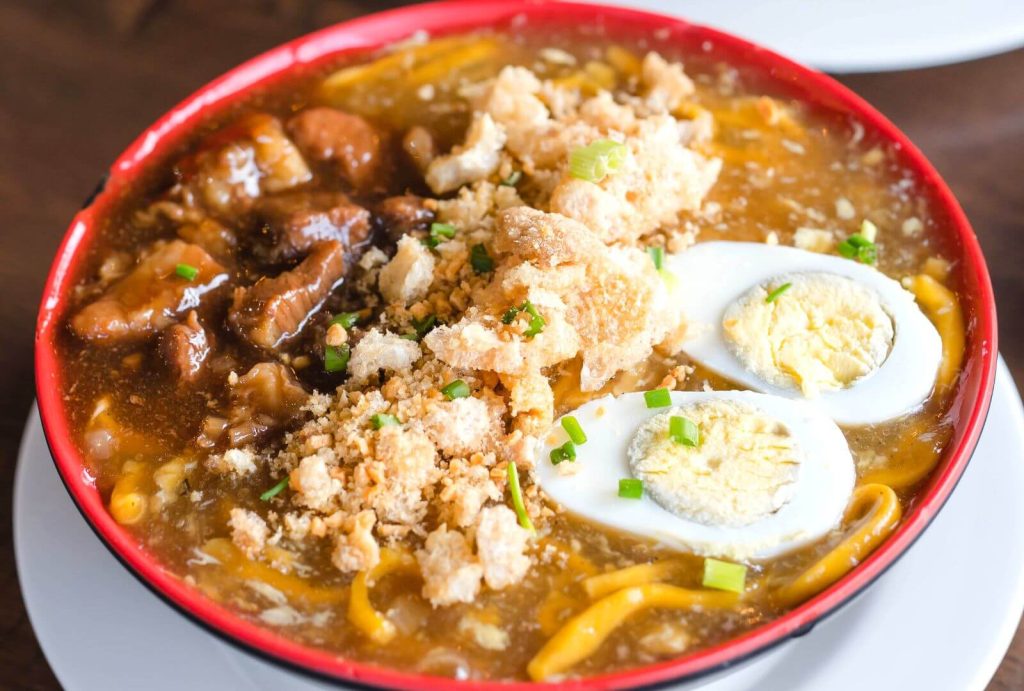
🥚 Batangas Lomi
Province of Origin: Batangas — yes, Batangas appears twice on this list, and we respect the absolute hustle.
Batangas Lomi is not merely a noodle soup. It is a statement. It is Batangas arriving at the rainy day Filipino food conversation, straightening its barong, and saying, “You thought our Bulalo was something? Hold our beef. No, literally — hold it.”
Lomi is a thick, starchy noodle soup made with fresh, fat egg noodles in a viscous, glossy broth that’s been thickened with cornstarch and beaten egg — giving it a slick, almost saucy consistency that clings to every noodle with absolutely zero apology. It’s packed with additions: kikiam, tender pork slices, liver, chicharon for crunch, and sometimes misua or other ingredients depending on which carinderia you’ve stumbled into and whether the owner feels like being generous today.
The broth is deeply savory, slightly sticky, and wildly satisfying in that very specific way that only the most committed Filipino food achieves. This is not food that plays it safe. This is food that commits.
What makes Batangas Lomi the true champion of rainy day Filipino food is precisely that thickness. It clings. It coats. It stays with you. Unlike lighter soups that might leave you eyeing the pantry an hour later, a proper bowl of Lomi fills you so completely and keeps you warm so thoroughly that you will feel it well into the next rainstorm. Locals insist the only acceptable accompaniment is puto — soft, steamed rice cakes — and we are absolutely not here to argue with Batangueños about their own iconic dish. They are correct about most things culinary.
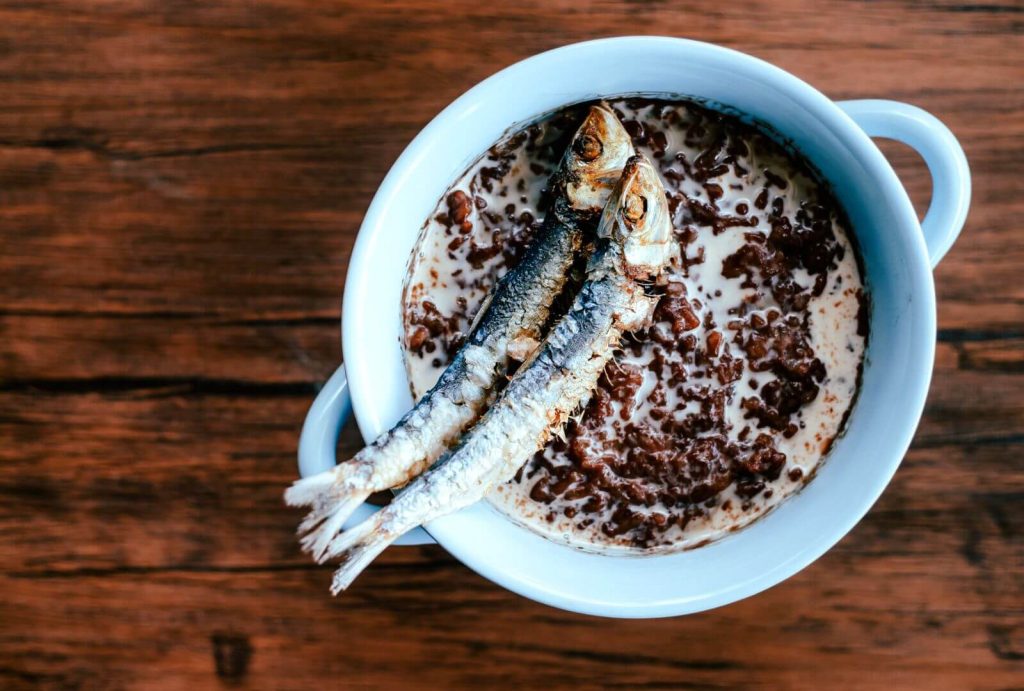
🍫 Champorado
Province of Origin: Brought to the Philippines through the Manila-Acapulco galleon trade with Mexican roots; now a cherished, irreplaceable staple of Filipino food culture from Batanes to Tawi-Tawi.
Rain plus chocolate plus rice equals one of the most iconic and emotionally resonant examples of rainy day Filipino food that Filipinos have been getting absolutely, magnificently right for several centuries. Take a moment to appreciate how far ahead of the curve that is.
Champorado is sweet chocolate rice porridge made by cooking glutinous rice with tablea — those same roasted cacao tablets used to make tsokolate — until everything melds into a thick, deeply chocolatey, wholly comforting porridge that smells like a childhood Saturday and tastes like being loved. It’s sweetened with sugar and served with a generous swirl of condensed milk or evaporated milk on top, which melts slowly into the chocolate and does something genuinely beautiful in the process.
Here’s the legendary Filipino food twist that first-timers find utterly baffling — until they try it, after which they require a moment of quiet reflection: Champorado is traditionally eaten with tuyo, dried salted fish, fried crispy. The sweet, warm, creamy chocolate porridge against the intensely salty, pungent, crispy tuyo creates one of the most divisive and ultimately genius flavor combinations in all of Filipino food. It is the sweet-salty contrast taken to its most logical, most chaotic, most brilliant extreme. Love it or find it deeply confusing — either way, you will be thinking about it for weeks.
On a grey, drizzly morning when motivation is scarce and the rain has been going for approximately six hours, Champorado is the bowl of rainy day Filipino food that turns the entire day around. Your inner child will not just send a thank-you note — they will write a full testimonial.

🍋 Sinigang
Province of Origin: The Tagalog heartland, with fiercely beloved regional variations stretching across the entire archipelago.
If Filipino food had to elect a single ambassador to represent its soul to the rest of the world, Sinigang would be a very serious candidate. It has the depth, the complexity, the emotional range, and the absolute confidence of something that has never once questioned whether it belongs at the table — because it has always known that it is the table.
Sinigang is a sour, tamarind-based soup, and the sourness is not a quirk or an accident — it is the entire point, the organizing principle, the thesis statement of the dish. That sharp, lip-puckering, glorious acidity cuts through the fat of the meat (pork belly, beef short ribs, shrimp, salmon belly, milkfish — your choice, all valid, all wonderful), wakes up every single one of your taste buds simultaneously, and creates a broth that is simultaneously bracing and comforting, invigorating and soothing. Filipino food loves a paradox, and Sinigang delivers several per bowl.
It’s loaded with vegetables: water spinach (kangkong), eggplant, daikon radish, long beans, tomatoes, and taro (gabi) that slowly dissolves and thickens the broth with starchy richness. The vegetables here are not an afterthought — in the best versions of this dish, they are the soul of it.
The warmth of the broth hits first. Then the sour. Then the savory. Then the gentle heat if you’ve added siling haba. Then you’re pleasantly sweating and reaching across the table for more rice, which is the universal signal that Filipino food is doing its job correctly. As rainy day Filipino food, Sinigang is the rare option that genuinely energizes rather than sedates — it makes you feel sharp and alive and grateful. Though the second bowl will absolutely put you horizontal. No judgment whatsoever.
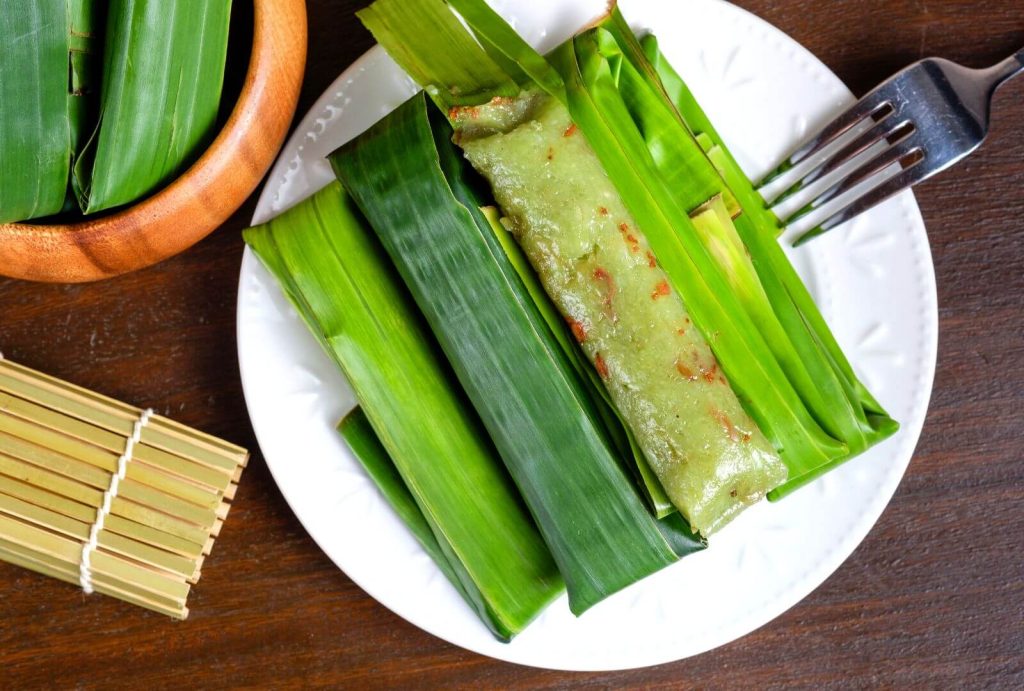
🫔 Suman and Kapeng Barako
Province of Origin: Suman appears across the entire archipelago in dozens of regional forms; Kapeng Barako is the fierce, bold pride of Batangas and Cavite.
Another beautiful entry in the rainy day Filipino food category that proves comfort doesn’t always arrive in a bowl — sometimes it arrives wrapped in leaves, and that is even better, because unwrapping it is its own small ritual of joy.
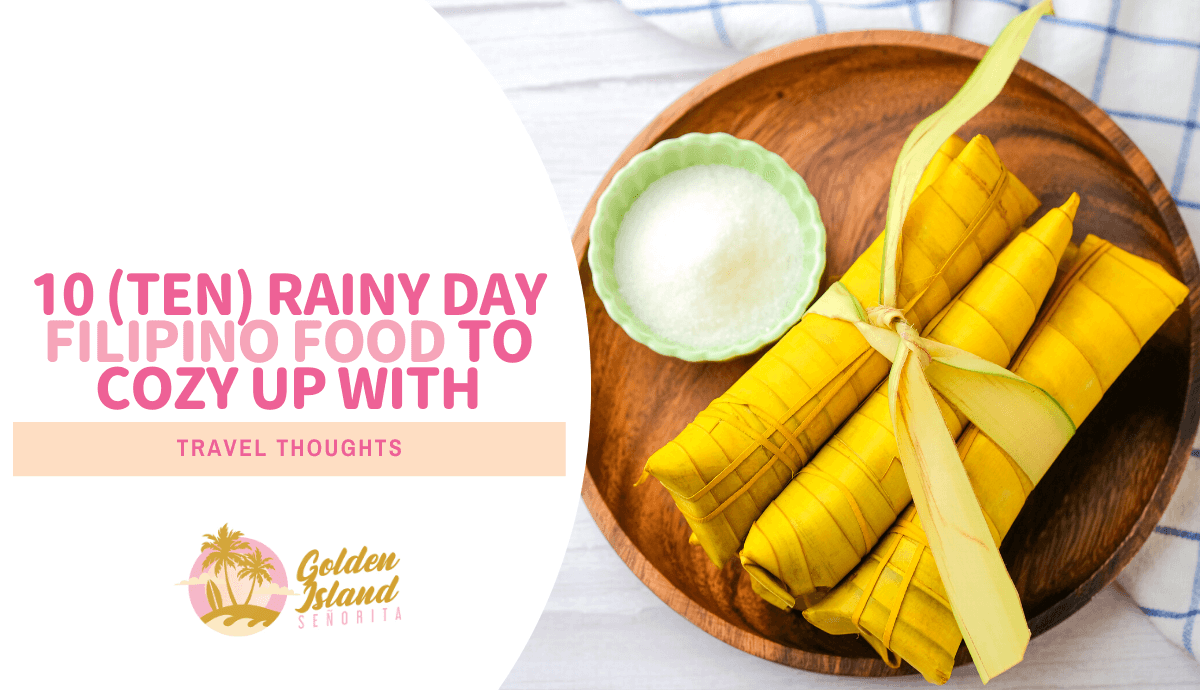
Suman is sticky rice (or cassava, or other grain and root crop bases depending on which region you’re in and what your lola’s lola preferred) cooked low and slow with coconut milk and a little salt, then wrapped lovingly in banana leaves or buri palm leaves and steamed until dense, chewy, faintly smoky from the leaves, and completely irresistible. The leaf wrap is not just decorative — it imparts a subtle, grassy fragrance that is part of what makes Filipino food so deeply tied to land and place. You taste the region in every bite.
There are dozens of regional Suman variations across Filipino food — Suman sa Ibos from the Visayas, rolled in palm leaves into a tight cylinder; Suman Cassava, soft and yielding; Suman Latik, topped with coconut caramel that drips darkly over the sides. Each one is its own argument for the richness and diversity of Filipino food tradition. Eaten plain or with a sprinkle of brown sugar, a spoonful of latik, or a side of ripe Carabao mango, it is simple, grounding, and quietly magnificent.
Kapeng Barako, meanwhile, is the bold, full-throated Liberica coffee that grows in the highlands of Batangas and Cavite. It is stronger, more intensely aromatic, and more assertively flavored than your average cup — the kind of coffee that wakes you up not with a gentle nudge but with a firm handshake and a look that says “we have things to do today, despite the rain.” Brewed strong and drunk with raw brown sugar, it fills a room with a scent that makes everything feel manageable.
Together, Suman and Kapeng Barako form the rainy day Filipino food pairing for the contemplative soul — the person who wants to sit by the window, watch the rain blur the world outside into impressionism, and feel deeply, entirely, contentedly at peace. This is Filipino food as meditation.
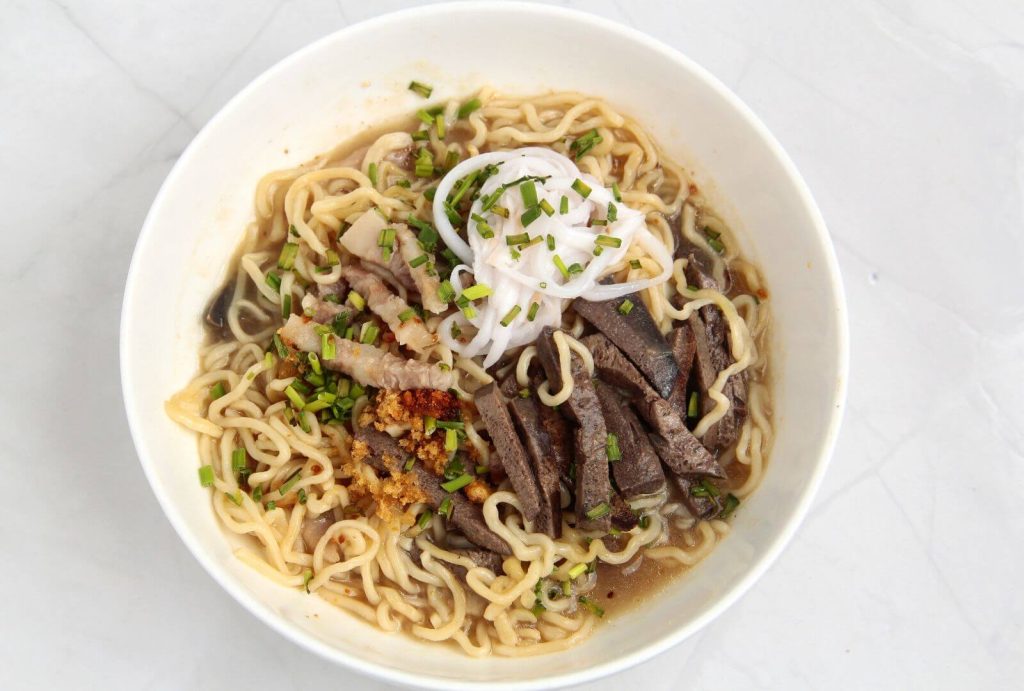
🐖 La Paz Batchoy
Province of Origin: La Paz Market, Iloilo City, Western Visayas — born in a market stall and destined for greatness.
We close this list with what might be the most layered, most complex, most deeply soul-satisfying entry in the entire rainy day Filipino food canon. La Paz Batchoy is the finale this article deserves — the dish that reminds you, in case you had somehow forgotten, exactly why Filipino food occupies such a permanent, irreplaceable place in the hearts of everyone lucky enough to grow up eating it.
Batchoy was born in the La Paz district of Iloilo City, inside a market, which is exactly the kind of origin story Filipino food loves: humble beginnings, real ingredients, genius born of practicality. Thin, delicate egg noodles sit in a rich, clear pork-beef broth that has been simmered for hours with pork organs — liver, intestines, heart — until the broth is so deeply savory it almost seems impossible that it came from the same ingredients you can find at any palengke in the country.
It is topped with chicharrón crushed directly over the bowl at the last possible moment (preserving the crunch, which is a point of honor), a raw egg cracked tableside to cook slowly in the residual heat of the broth, sliced tender pork, and a generous scatter of spring onions. Some vendors add bagoong — fermented shrimp paste — to deepen the flavor further, and if your vendor does this, consider yourself blessed.
The chicharrón is the masterstroke. It softens gradually in the broth, releasing rendered fat that enriches every sip, while still maintaining enough structure to provide a texture contrast with the silky noodles. This is rainy day Filipino food as genuine philosophy: every texture considered, every flavor balanced, every element in conversation with the others. It was made by people — market vendors, home cooks, generations of Ilonggos — who understood intuitively that a cold, wet, difficult day deserves the very best you can possibly offer it.
La Paz Batchoy is Filipino food at its most generous. And on a rainy day, generosity is everything.
Final Thoughts: Rain is Just the Universe Telling You to Eat Better
Let’s be honest with each other: the Philippines is not a country that struggles to find something delicious to eat on any given day of the week. Filipino food has never needed a special occasion to be extraordinary. It just is, quietly and constantly and without fanfare, one of the most satisfying, most creative, most soulful food traditions in the world.
But there is something genuinely magical that happens when the clouds roll in heavy and dark, the rain begins its percussion on the rooftop, and every Filipino kitchen instinctively, almost magnetically, pivots toward broth and warmth and everything that makes life feel like an embrace. It’s as if the rain unlocks a specific mode in Filipino food culture — a deeper, slower, more generous mode where the goal is not just nourishment but restoration.
Rainy day Filipino food is more than sustenance. It is memory in edible form. It’s the smell of your lola’s kitchen when you were seven years old and the rain meant no school and the whole day stretched out ahead of you like a gift. It’s the sound of a pot bubbling and the anticipation of that first sip that makes the entire world feel smaller, warmer, more manageable. It is proof — concrete, delicious, irrefutable proof — that Filipino food, at its heart, is an act of love. Every broth simmered for hours is love. Every garlic fried golden is love. Every bowl placed in front of someone on a cold, wet day is love.
Filipino food does not just feed you. It holds you. And on a rainy day, being held is exactly what you need.
So the next time the weather app shows that little grey cloud — or worse, that ominous red typhoon signal you’ve learned to respect — don’t sigh dramatically. Don’t scroll through your phone looking for delivery options. Instead, pull out your trusty palayok, check your pantry for tamarind mix or tablea or a good bone-in cut of beef, text your friends and family to come over and not bother with an umbrella, and remember: you live in a country that looked at rain and decided it was an opportunity to make the best food on Earth.
The rain is not the problem. The rain is the invitation. Filipino food is the answer. And the answer, as always, is absolutely worth waiting for.
Now go make some soup. The rain isn’t going anywhere — might as well enjoy it properly.
Think I missed something? What are your favorite Filipino (or non-Filipino) cold-weather food? Let me know by commenting below!

Polly Amora
Polly Amora is the señorita behind GoldenIslandSenorita.Net. A corporate warrior by day, and a perpetual explorer by heart. She is a lifelong learner who is very outgoing, speaks four languages, loud & outspoken, and loves to have adventures in the mountains, on the beach, and in the city. You can throw her anywhere, and she'll handle it like a pro. Ice cream and bourbon are two of her weaknesses.




18 Comments
advent14
I love a good soup or stew on a rainy day! These all look delicious