

Love Bombing as a Romance Trap: How Scammers Build False Intimacy
TRIGGER WARNING: This piece covers the mechanics of romance scams and the emotional impact of manipulation. We understand that these topics can be distressing, especially for those who have experienced similar situations. Please prioritize your well-being while reading.
| DISCLOSURE |
|---|
| The insights I’m sharing here come from a deep-dive dating app experiment I ran specifically for this series. While the methods might seem a bit unconventional, I want to reassure you that this was done with the best intentions to uncover how these platforms really work. To keep things safe and anonymous, I didn’t use any of my own personal info or devices. I used separate tools—like burner phones and prepaid SIMs—and a completely fictional profile with third-party photos to ensure total privacy. This project kicked off in October 2023 and wrapped up in November once the “Love Scammer” blocked me. After almost a week of sorting through data and another five days of writing, |
Bonjour, lovers! Welcome to the third part of the LOVE series! So far, we’ve talked about what Love Scams are, and what it means to be “catfished.” The 3rd part of the series is what we call “The Grooming Phase.“
The Grooming Phase is not about love; it is a clinical process of lowering your defenses so that you stop thinking critically and start thinking emotionally.
Grooming is the process of normalizing the abnormal. It is the “slow boil.” A scammer knows that if they ask for money on day one, you will block them. So, they spend weeks (or months) “grooming” you to reach a state where you believe they are the most important person in your life.
And how do they do that?
Simple…
“Love Bombing”
In this post, you’ll learn about:
- Love Bombing
- Why Do Scammers Do It?
- How Love Bombing Works
- What Are the Forms of Love Bombing?
- Who Are Vulnerable to Love Bombing?
- The Reality of Love Bombing Statistics
- Why Smart People Fall for It
- A Real-Life Experience of being Love Bombed
- Psychological Tactics Used in Love Bombing
- The Emotional Impact on Victims
- What to Do If You’ve Been “Bombed”
In the digital age, the search for connection is natural, but the tools we use to find love—dating apps, social media, and chat platforms—can also be exploited by malicious actors. One of the most effective and dangerous tactics in their arsenal is love bombing.
Love bombing is not just “being overly nice”; it is a calculated psychological strategy used to overwhelm a target with affection, flattery, and attention. The ultimate goal for a scammer is to bypass your critical thinking, create a false sense of security, and establish a rapid, intense emotional bond that makes it difficult for you to spot the red flags of a scam later on.

What is Love Bombing?
According to Cambridge Dictionary:

According to Cleveland Clinic:
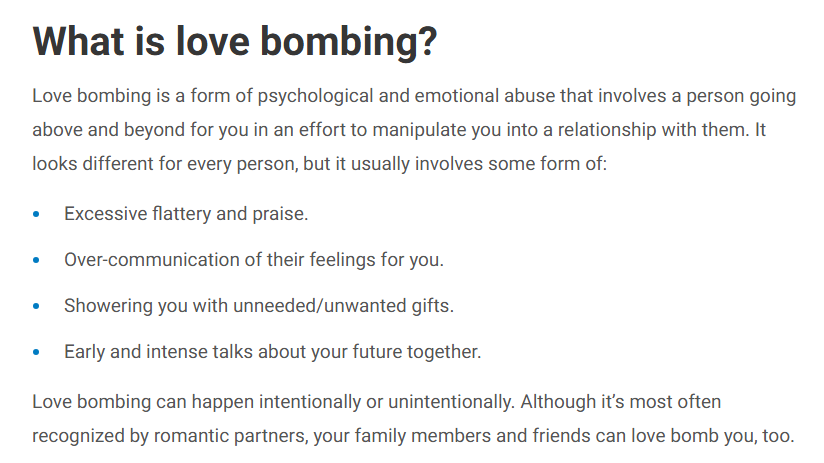
At its core, love bombing is the practice of showering someone with excessive displays of affection and attention to gain control over them. It acts as a “grooming” process. When you meet someone online, you expect a gradual pace of getting to know one another. A love bomber flips this script, trying to accelerate intimacy to an unnatural speed. It creates a “dopamine high” that keeps you hooked, making the person seem like the “perfect match” who arrived just when you needed them.
Why Do Scammers Do It?
Scammers use love bombing for three primary reasons:
- To Fast-Track Trust: By establishing a deep emotional connection quickly, they create a “trust cushion.” You are less likely to question a request for money or personal data from someone you feel intimately “bonded” with.
- To Create Obligation: By showering you with intense affection and attention, they trigger the psychological principle of reciprocity. You feel that because they are so “invested” in you, you owe them your attention, your trust, and eventually, your resources.
- To Isolate You: By becoming the center of your universe, they effectively replace your support systems, making you more dependent on their validation.
How Love Bombing Works
Love bombing works by flooding someone with intense affection, attention, and admiration, often at a very fast pace. It starts with the love bomber showering the victim with compliments and making them feel special and unique. They might say things like, “I’ve never met anyone like you!” or “You’re the one I’ve been waiting for.” This rapid emotional connection can feel incredibly flattering and fulfilling, especially for someone who may be feeling lonely or seeking validation.
As the relationship progresses, the love bomber continues to maintain this level of affection, sending daily messages, making constant calls, and reinforcing feelings of closeness. This steady stream of attention makes the victim feel adored and emotionally attached, often causing them to develop a deep sense of dependence on the relationship. The love bomber may also create a sense of urgency, sharing personal struggles or crises that seem to require the victim’s support, which can create a bond and further deepen emotional involvement.
Over time, the victim might start to believe they’ve found their perfect match, especially if they feel isolated or vulnerable. The overwhelming positivity and affection can cloud their judgment, making it harder to see any red flags. In essence, love bombing works by triggering feelings of happiness and connection, which make the victim more susceptible to the manipulator’s control, often leading to emotional or financial exploitation down the line.
What Are the Forms of Love Bombing?
Love bombing takes various forms, all of which are designed to overwhelm and manipulate the victim through excessive affection and attention. Below are the common forms of love bombing that scammers (and even toxic individuals) often use to build false intimacy and emotional dependence:
1. Excessive Flattery (The “Soulmate” Trap)
- The Form: They describe you in terms that are too perfect, too soon. They claim to have never met someone like you.
- Example: “I’ve been searching for someone like you my whole life. You are the missing piece I didn’t know I needed.”
- The Reason: To inflate your ego and make you feel uniquely understood, lowering your defenses.
- What to do: Slow down. Gently say, “That’s very kind, but it’s a bit early for such big words. Let’s take some time to really get to know each other.”
2. Future Faking
- The Form: Planning a shared future (vacations, living together, marriage) after only a few days of chatting.
- Example: “Once I finish this project, I’m flying to you, and we’re going to spend the whole month in Bali. I’ve already been looking at villas.”
- The Reason: To create a false reality you are invested in, making it harder to walk away.
- What to do: Focus on the present. If they bring up the future again, pivot back to the conversation at hand: “I prefer to focus on the here and now. Let’s enjoy our current conversation.”
3. Constant Communication Pressure
- The Form: They require immediate replies and become distressed or passive-aggressive if you are offline for a few hours.
- Example: “I haven’t heard from you in three hours. Is everything okay? I feel like I’m dying without hearing your voice.”
- The Reason: To establish a pattern of dependency and monitor your availability.
- What to do: Set clear boundaries. “I have a busy schedule, and I won’t always be available to chat instantly. I’ll message you when I have downtime.”
4. Premature “I Love You”
- The Form: Professing love within days or even hours of connecting.
- Example:“I know it sounds crazy, but I think I love you. My heart has never felt like this.”
- The Reason: To hijack your emotions and guilt-trip you into reciprocating.
- What to do: Address the intensity immediately. “That is a very big thing to say. I am not at that stage yet, and I am not comfortable rushing our feelings.”
5. Vulnerability Dumping
- The Form: They share a tragic, deeply personal, or traumatic story early on to force “intimacy.”
- Example: “I haven’t told anyone this, but I’ve been through so much pain. Only you seem to really understand me.”
- The Reason: To create an artificial “trauma bond” that makes you feel protective of them.
- What to do: Be empathetic but detached. “I’m sorry you went through that, but I think it’s important we get to know each other’s light side before digging into the heavy stuff.”
6. The “Us Against the World” Narrative
- The Form: Creating a sense of exclusivity where it’s only the two of you who “get” each other.
- Example: “Everyone else in my life is so superficial. You’re the only one who really sees the real me.”
- The Reason: To isolate you from your friends and family, who might otherwise spot the scam.
- What to do: Maintain your outside relationships. Keep talking to your real-life friends and family about your life. If the person pushes you to hide them, that is a massive red flag.
7. Over-the-Top Generosity (The Setup)
- The Form: They offer to send you gifts, pay for your subscriptions, or send money early on.
- Example: “I want to treat you. Let me send you money for your phone bill so we can text more easily.”
- The Reason: To create a sense of debt so that when they inevitably ask for money later, you feel obligated to help.
- What to do: Refuse all financial exchanges. “I really appreciate the gesture, but I have a strict policy about money in relationships. Please don’t send anything.”
8. Mirroring
- The Form: They suddenly share all your niche hobbies, political views, and life goals.
- Example: “Oh my god, you love that obscure author? That’s my favorite too! It’s like we’re the same person.”
- The Reason: To validate your ego and trick you into thinking you are “soulmates.”
- What to do: Ask specific, probing questions about their supposed interests that require deep knowledge. If they are faking, they will struggle to provide meaningful answers.
9. Ignoring Boundaries
- The Form: They push past your “no,” even for small things like video calls or personal questions.
- Example: “Why won’t you video chat? Don’t you trust me? I thought we were close.”
- The Reason: To test how much control they have over your decisions.
- What to do: Stand firm. If they cannot respect a small boundary (like “I don’t want to video chat yet”), they will never respect a large one. If they persist, block them.
10. Excessive Jealousy/Possessiveness
- The Form: They get upset if you mention friends, work, or other interests.
- Example:“Who were you with all day? Why are you prioritizing your friends over me?”
- The Reason: To keep you focused entirely on them and eventually control your schedule.
- What to do: Call it out immediately. “It makes me uncomfortable when you demand an account of my time. I value my autonomy.”
11. The “Rescuer” Complex
- The Form: The scammer presents themselves as a hero who can “fix” your life. They focus intently on your problems or complaints, promising to solve them immediately.
- Example: “You hate your job? Don’t worry, once we are together, I’ll take care of you. We will leave all this behind and start fresh.”
- The Reason: They want to make you feel like you are in a state of crisis so that you view them as your only savior.
- What to do: Maintain perspective. A stranger online cannot solve your life problems. Respond with, “I appreciate the thought, but I’m quite capable of handling my own life decisions. I prefer partners, not rescuers.”
12. The “Crisis” Urgency
- The Form: They frequently manufacture “emergencies” that require your immediate, high-priority attention. This forces you to drop everything to support them, creating an artificial sense of “closeness.”
- Example: “I’m having a terrible panic attack/family crisis and you’re the only person I can talk to. Please, don’t leave me alone right now.”
- The Reason: To bypass your logic and force a deep emotional response through fear and urgency.
- What to do: Set a firm boundary. “I’m sorry you are going through a hard time, but I have other responsibilities. Please reach out to your local support system or a professional if you need help.”
13. Weaponized Secrecy
- The Form: They share a “dark secret” very early on and insist that you keep it from your friends and family, framing it as a test of your “bond.”
- Example: “I can only tell you this because I trust you more than anyone. Don’t tell your friends—they wouldn’t understand us like we do.”
- The Reason: This is a classic isolation tactic. They are creating a “secret world” that alienates you from your real-life support network.
- What to do: Never agree to keep secrets about a romantic interest from your friends or family. Say, “I’m not comfortable keeping secrets from the people I trust. If you can’t be open, I think we should rethink our communication.”
14. Grooming for “Exclusive” Platforms
- The Form: Almost immediately after matching on a dating app, they insist on moving the conversation to a private, less monitored platform (WhatsApp, Telegram, etc.) and demand you delete the dating app.
- Example: “That app is for losers. Let’s delete it and just talk on WhatsApp so it’s just us.”
- The Reason: They want to move you off the platform where they might be reported or banned, and into a space where they can manipulate you without oversight.
- What to do: Stay on the original platform until you are 100% comfortable. “I prefer to keep things on the app until we’ve met or known each other much longer. If that doesn’t work for you, I understand.”
15. The “Miracle” Arrival
- The Form: They claim to be “fated” to be with you, often citing weird coincidences or the idea that they were “looking for someone just like you” at the exact moment they found you.
- Example: “I was literally writing a list of qualities for my dream woman last night, and then I saw your profile today. It’s fate.”
- The Reason: To make you feel that the relationship is “destined” or “meant to be,” which makes the prospect of rejecting them feel like fighting against destiny.
- What to do: Ground the conversation in reality. “That’s quite a coincidence, but I don’t believe in fate. I prefer to build connections based on getting to know the actual person.”
Who Are Vulnerable to Love Bombing?
People who are emotionally vulnerable or in need of connection are more likely to fall victim to love bombing. Here are some specific groups who are particularly susceptible, along with why they may be targeted:
- Individuals Going Through a Breakup or Divorce: Those who have recently experienced the end of a relationship may feel lonely, rejected, or unsure of their self-worth. They are more likely to seek validation and attention, making them prime targets for love bombers who offer quick emotional fulfillment.
- People with Low Self-Esteem: Individuals with poor self-esteem or a lack of self-worth may be drawn to excessive praise and attention. They may find comfort in the overwhelming affection of a love bomber, mistaking it for genuine care and recognition.
- Lonely Individuals: Those who feel isolated, whether due to geographic location, social anxiety, or personal circumstances, are more vulnerable to the rapid emotional connection offered by love bombing. The promise of deep, fast love can be irresistible to someone longing for companionship.
- People Seeking Emotional Healing: Someone recovering from emotional trauma, such as the loss of a loved one, financial hardship, or personal struggles, may be more open to the intense affection offered by a love bomber. They may find solace in the attention and empathy that seems to fill the void left by their pain.
- Older Adults or Widows/Widowers: Older individuals, particularly those who have been widowed or are living alone, may be more susceptible to the allure of affection from someone who offers companionship and care. A sense of desperation for connection can make them more trusting of someone who showers them with attention.
- People Who Desire a “Perfect” Relationship: Those who have idealized notions of romance or dream of a fairy tale relationship may fall for love bombing, believing that intense, immediate affection is a sign of true love. These individuals may overlook red flags in the hopes of finding their “perfect match.”
- Those with Limited Social Support: Individuals who don’t have a strong network of friends or family might be more open to a relationship that offers constant communication and affection. A love bomber’s attention can quickly fill the emotional gap left by a lack of support.
- Naive or Trusting Individuals: Some people, particularly those who have a positive view of humanity, may not expect manipulation or deceit in relationships. Their inherent trust in others makes them more likely to believe in the authenticity of love bombing and overlook signs of manipulation.
The Reality of Love Bombing Statistics
| Metric | Finding |
| Prevalence among App Users | 78% of dating app users report having been love bombed. |
| “I Love You” Timeline | 70% of respondents have had a new partner profess “I love you” within the first month of dating. |
| Pressure to Have Sex | 52% of women have felt pressured to have sex with someone who had been love bombing them (compared to 30% of men). |
| Financial Vulnerability | 28% of dating app users admit to having lent money to a new romantic partner within just a few months. |
| Feeling Suffocated | 65% of dating app users have felt “suffocated” by a partner who wanted to spend too much time together too early. |
Source: Shane Co. – The Love Bombing Survey (2022)
Why These Numbers Matter
These statistics highlight that love bombing is often a systematic effort to bypass your boundaries. When you see that nearly 8 out of 10 dating app users have experienced this, it confirms that if you are feeling overwhelmed, you are likely not overreacting—you are recognizing a pattern.
The fact that over half of women report feeling sexual pressure after being love bombed underscores the dangerous transition from “excessive affection” to “coercive control.” Scammers use the false intimacy they’ve built to make you feel like your “no” would hurt them or destroy the “beautiful connection” they’ve fabricated.
Beyond recognizing the red flags, it is crucial to understand the psychological mechanisms behind love bombing. Many people find themselves trapped because they mistake the scammer’s manufactured intensity for a “deep, fated connection.”
Here is essential information to help you navigate the reality of love bombing, recover if you have been targeted, and differentiate between genuine excitement and manipulation.
Love Bombing vs. Genuine Excitement
It is important not to become cynical. Healthy, enthusiastic new love exists, and it is natural for people to be excited when they meet someone they really like. However, the pace and respect for boundaries are what differentiate a healthy spark from a manipulative trap.
| Feature | Healthy Excitement | Love Bombing |
| Pace | Gradual; grows as trust builds. | Fast; “hits the ground running.” |
| Boundaries | Respected; “No” is accepted without guilt. | Pushed; “No” is seen as a challenge. |
| Integration | You meet their friends/family eventually. | They try to keep you in an isolated bubble. |
| Consistency | Stable affection; doesn’t fluctuate wildly. | Extreme highs followed by sudden, cold lows. |
| Focus | Mutual; interested in your life/dreams. | Centered on you, but primarily to gain control. |
The “Dopamine Hangover”
When a love bomber abruptly pulls back affection—usually right before they make a significant request, like asking for money or sensitive information—you will likely experience what psychologists call a “dopamine crash.”
- The Science: During the love bombing phase, your brain is flooded with dopamine and oxytocin, the “bonding” chemicals.
- The Crash: When they withdraw attention, your brain panics, trying to find ways to get that hit back. This is why many victims of scams will compromise their own values (e.g., sending money) just to “fix” the relationship and make the person like them again.
- The Reality: The “person” you are missing never really existed. You are grieving a fantasy character designed to exploit your biology.
Why Smart People Fall for It
There is a dangerous stigma that only “gullible” people get scammed. This is false. Love bombing works precisely because it hacks into universal human needs: the need to be seen, to be understood, and to be valued.
- Cognitive Dissonance: You may find yourself making excuses for them (“They’re just busy,” “They’ve had a hard life”). This is your brain struggling to reconcile the “perfect person” you met with the “manipulator” you are now suspecting.
- It’s Not Your Fault: Scammers are professional manipulators. They use scripts, psychological triggers, and social engineering. If you fell for it, it is a testament to your capacity for empathy and love, not a failure of your intelligence.
The Aftermath: The “Discard”
Be aware that if a scammer fails to extract what they want (money, data, or access), they will often switch tactics from “love bomber” to “aggressor” or simply vanish (the “ghosting” phase).
- The Aggressor: They may threaten to release private photos or information if you do not comply. Do not pay. Paying once will only guarantee they return for more. Report the situation to the appropriate authorities or the platform support team immediately.
- The Discard: They may simply block you, leaving you confused and hurt. This is not a reflection of your worth, but a sign that you were merely a“project” for them that didn’t yield a payout.
Remember, a true partner will prioritize your comfort, respect your pace, and celebrate your independence. If you feel like your autonomy is being eroded in favor of a “magical connection,” it is time to step back and re-evaluate the reality of the situation.
Real-Life Experience
David Williams, the Love Scammer
“David Williams” is a 45-year-old business owner originally from South Korea, currently residing in the United Kingdom. He lives alone on a large estate a property he inherited from his late uncle.
This inheritance has reportedly caused significant conflict within his family. He claims to be completely estranged from his parents, alleging that they attempted to steal his inheritance from him.
Following this family turmoil, he decided to join Tinder in an effort to find a genuine partner. His profile states he is looking for someone special to share his life and the quiet space of his inherited home. He presents himself as someone seeking a meaningful, serious connection.
To maintain the persona of a successful, affluent businessman, the profile for “David” relies on a curated gallery of high-quality imagery. The photos depict a tall, handsome South Korean man, styled to convey both professional success and approachable charm.
Note: When we were chatting, he sent me three photos of a man who looked Korean. I decided to do a quick reverse image search and discovered that the pictures were actually stolen from the Instagram account of a South Korean hairstylist and influencer. I’m definitely not going to share those photos here, though—I really don’t want to drag that person into this drama or cause any trouble for them.
Maria dela Cruz, my character
I portrayed myself as a 30-year-old elementary school teacher, living a quiet, happy life with my family in Consolacion, Cebu. I really leaned into my passion for teaching and how much I dream of making a positive difference in my students’ lives.
To keep things feeling simple and grounded, I acted like I wasn’t really a tech person. I told him that a colleague from work actually set up my Tinder profile for me—I used the classic story that she had met her fiancé on the app, so she convinced me to give it a try.
To build a little more rapport, I made it super obvious that I’m a huge K-Drama fan. I even told David that he looked just like one of the actors, which felt like the perfect way to keep the conversation light and friendly.
To create Maria’s look, I actually commissioned the photos from a third party. They sourced some base images from an adult site, but then used AI/photoshop to modify them so they were unique for her profile.
Surprisingly, he never asked why I wasn’t verified on Tinder. I had already mentioned that it was my first time using a dating app, though, so I think he just assumed I was still getting the hang of how everything works: Maria’s photos depicted her smiling in front of a rural school in uniform, holding books, or engaging with children.
The Love Bombing Begins
Right from our very first conversation, David’s affection was totally overwhelming. He was constantly sending these long, poetic messages about how much he admired me, and he had so many sweet pet names for me—like “Princess,” “beautiful,” “sweetheart,” and “sunshine.”
By the second day, he was already pushing for us to move our chat over to Telegram. He told me he wanted to get to know me better without all the “distractions” of Tinder. I decided to play a little naive and asked him what Telegram even was, and he really pressured me to download it and add him. In my defense, I actually knew what Telegram was, but I’d never had an account there, or on WhatsApp or Signal either.
He was so consistent, too—messaging me every single morning and night, always filled with love and appreciation. Everything moved at lightning speed; within just a couple of days, he was already calling me his “future wife” and insisting it was fate that brought us together. All that constant attention made me feel really valued in a way I hadn’t experienced before, and when he started sharing deeply personal stories about his struggles, it just drew me in even more.
He was also really great at making our chats feel personal, almost as if he was hanging on to every word I said. To test him, I mentioned that my favorite food was Kaldereta—even though, in reality, I don’t even like it. Sure enough, just two days later, he brought it up. He mentioned how much he wanted to try some authentic Filipino food and asked if I’d be willing to cook Kaldereta for him, saying he’d Googled it and it looked delicious. It was a classic move to make me feel like he was truly paying attention.
He’d pop up at random times throughout the day just to “check in,” telling me how much he missed our chats and that they were the highlight of his day. He also started bringing up his golf games with business associates, mentioning that he’d even told them he was planning to expand his business ventures into the Philippines.
He even mentioned that he wanted to fly over to the Philippines in just two weeks so we could finally meet up in person.
The First Ask for Money
On the afternoon of the 11th day, he messaged me saying he needed some help—he claimed his accounts were locked due to “unauthorized use,” though he was pretty vague and just kept referring to them as “accounts.” I played right along and told him I didn’t have any money available at that exact moment, but if he could wait just two more days until my salary was deposited, I’d be happy to send it his way.
His response?
“Oh my sweet Princess, you have no idea how much this means to me. I feel so terrible even asking—I want to be the one taking care of you, but this situation has me feeling so helpless. Knowing that I have you, someone who truly understands and supports me, makes me feel like the luckiest man in the world. I don’t know what I did to deserve you.”
I responded by acting all guilty and apologetic for not being able to help him right then and there. I also made sure to ask him how I should send the money once my salary came in, so I could get it to him as soon as I could. I asked him where I should send the deposit once I had it. He didn’t actually give me any details right then, though. He just told me he’d be happy to wait those two days until I got paid.
He stayed just as sweet as ever during this time, still keeping up with the love-bombing. He even mentioned he wanted to go to the hospital because his stomach was hurting, but said he couldn’t since his accounts were still locked.
Escalation of the Scam
When the two days were up, he checked in to see if I could send the money yet. I let him know my salary wouldn’t arrive until mid-afternoon, so he immediately pivoted and asked if I could just get him a Google Play gift card instead. He became super pushy then, insisting it was a total emergency since he’d been dealing with that stomach pain for two days and needed to get checked out as soon as possible.
I was so confused because just two days earlier he told me he needed the money to unlock his accounts, but all of a sudden he was saying he needed it for his medical check-up. It definitely didn’t seem to add up.
And what was up with the Google Play gift cards? It just made me wonder—why on earth couldn’t he just give me his bank details instead?
The Moment of Realization… or the Reveal.
He was right in the middle of pressuring me to buy those Google Play gift cards. It wasn’t a huge sum—just $100 USD to “unlock” his account—but I stood my ground. I told him I wasn’t sure I could even find Google Play gift cards and asked if he could just give me his bank details instead. I kept insisting that I’d rather transfer the money directly from my savings account, so there was really no need for me to go looking for those cards.
Everything shifted in an instant. The sweet, loving David I’d been talking to completely vanished. He suddenly became hostile, accused me of being a liar, and that’s when he thought he had the upper hand. He decided to play his “trump card” and sent photos of Maria—my character—in compromising, intimate positions.
Things took a truly dark turn when David began using threats to manipulate Maria. He claimed he’d tracked down her personal social media accounts and threatened to send her private photos to her friends, family, and even her colleagues at the elementary school where she worked if she didn’t pay him. It was a calculated, cruel move—he essentially tried to weaponize her reputation, taunting her by asking how her community would react, all in a desperate attempt to scare her into handing over money.
This is the part where I—Polly—kind of messed up. I take full responsibility for it, and honestly, I do regret not seeing it through to the end.
So, I decided to send him some screenshots of the actual Instagram account belonging to that South Korean hairstylist. I just casually asked him, “I thought you were a wealthy businessman living in the UK? What are you doing over in South Korea cutting hair?”
I also asked him, “How come your phone number is registered in Vietnam when you told me you were South Korean and currently living in the UK?”
I sent a few more messages to try and get a rise out of him, but once I let him know what I’d found, he went completely silent. My messages on Telegram were just “single checked,” which meant he wasn’t even reading them anymore. I even tried calling his number, but it turned out he’d already blocked me.
I popped back onto Tinder just to check, and sure enough, he’d already blocked me there, too.
Imagine if Maria was real. She is 30, a dedicated elementary school teacher, and someone who believes in the goodness of others. She isn’t “naive” in the traditional sense; she is simply human. When she meets “David” online, she isn’t looking for a scam—she’s looking for connection.
This is where the story of the modern romance scam begins, and where it turns dark.
1. The Architecture of Trust (The Love Bomb)
For Maria, the experience with David felt like a whirlwind romance. He was attentive, checking in constantly, sharing stories of his life, and painting a future that involved meeting in the Philippines. By the time he asked for a “wholesome” photo—a simple selfie or a snapshot of her day—she didn’t hesitate.
In her mind, this was a normal progression of intimacy. She wasn’t sending a compromising image; she was sending a piece of her life to someone who had spent weeks “caring” for her. She had no way of knowing that the person behind the screen was essentially a data analyst of human emotion, logging every vulnerability she shared.
2. The Sudden Shift
The transition from lover to extortionist is often instantaneous. The moment the scammer realizes they cannot extract money through “emergencies” or emotional pleas, they pivot.
When David realized Maria wouldn’t pay, he didn’t just walk away; he weaponized the “wholesome” photo she had shared in good faith. Using basic editing software or AI-driven tools, he manipulated the image into something compromising. He then sent it back to her, accompanied by the threat: Pay, or I send this to everyone you know.
3. Why It Works (The Psychology of Shame)
This is why this specific type of scam is so devastatingly effective:
- The Erosion of Support: Scammers isolate victims long before they threaten them. By the time the extortion happens, Maria might feel she has no one to turn to, fearing the judgment of her friends, family, or colleagues.
- The “Double Victimization”: The scammer uses the victim’s own moral compass against them. They bank on the victim feeling immense shame for having shared a photo, even though the victim did nothing wrong.
- The Power of the Threat: In our digital age, the threat of having one’s reputation destroyed online is a modern form of terror. The scammer knows that Maria’s fear of exposure is far more powerful than the $100 they originally asked for.
4. The Crucial Lesson: It’s Not the Victim’s Fault
If there is one thing that needs to be shouted from the rooftops, it is this: The victim is not to blame.
When we analyze these scams, it is easy to look at the situation from the outside and say, “Why did she send the photo?” But that ignores the months of psychological grooming that preceded the request. These scammers are professionals at manipulation. They build a reality where sharing a photo is an act of love, not a liability.
Moving Forward
Writing about Maria’s story serves a vital purpose. It strips away the shame often associated with these scams and places the accountability exactly where it belongs: on the predator.
By detailing this process, we can help others recognize the signs of “love bombing” before it reaches the point of extortion. We can change the narrative from “I was fooled” to “I am surviving a crime,” and that shift in perspective is the first step toward reclaiming power from the people who try to exploit it.
Psychological Tactics Used in Love Bombing
The story of David and Angela exemplifies the tactics scammers use to manipulate their victims:
- Excessive Attention: Constant messages, compliments, and declarations of love to build trust.
- Creating Emotional Dependency: Sharing personal struggles and vulnerabilities to make the victim feel protective.
- Leveraging Guilt: Framing financial requests as acts of love and support for a shared future.
- Exploiting Loneliness: Targeting individuals who are emotionally vulnerable and seeking connection.
The Emotional Impact on Victims
Love-bombing is a sophisticated psychological tactic where a scammer overwhelms a victim with intense affection, future-pacing, and constant communication to create a rapid, deep emotional bond. When the “bombing” stops or the scam is revealed, the emotional fallout is often devastating because the victim isn’t just losing a partner—they are losing a fabricated reality they were led to believe was their future.
Here are 10 significant emotional impacts on victims of romance scams:
1. Severe Cognitive Dissonance
The victim struggles to reconcile the “perfect” person they loved with the predator who deceived them. This mental conflict can lead to immense confusion and a refusal to believe the truth, even when presented with evidence.
- Example: A victim might keep the scammer’s photos saved, thinking, “The person who wrote those poems couldn’t possibly be a criminal.”
2. Erosion of Self-Trust
Perhaps the most lasting impact is the victim losing faith in their own judgment. They wonder how they missed the red flags, leading to a profound sense of internal betrayal.
- Example: A victim might stop making simple life decisions, like house repairs or career moves, because they no longer trust their ability to “read” situations correctly.
3. Post-Traumatic Stress Symptoms
The sudden “discard” phase of a romance scam can trigger symptoms similar to PTSD, including intrusive thoughts, nightmares, and a constant state of “fight or flight.”
- Example: Receiving a notification on a dating app or a “ding” from a specific messaging platform might trigger a physical panic attack or cold sweats.
4. Grief for a “Ghost”
Victims experience a unique form of disenfranchised grief. They are mourning a person who never actually existed, which can feel lonely because society often minimizes the loss since the relationship was “online.”
- Example: Feeling the same level of heart-wrenching sorrow as a widow, yet feeling unable to hold a funeral or seek communal support for a non-existent person.
5. Deep Social Withdrawal and Isolation
Victims often pull away from friends and family, either out of shame or because the scammer isolated them during the love-bombing phase. This leaves them without a safety net when the scam ends.
- Example: Skipping family gatherings or deleting social media accounts to avoid having to explain why the “new partner” isn’t around.
6. Hypervigilance in Future Relationships
After being manipulated by “perfection,” victims may become overly suspicious of genuine kindness. They may view any romantic interest as a potential threat or a “play.”
- Example: Ending a date with a perfectly nice person simply because they gave a compliment, fearing it’s the start of a new love-bombing cycle.
7. Financial Trauma and Anxiety
Even if the victim didn’t lose life savings, the request for money or the realization that the “love” was tied to a financial motive creates a deep-seated fear regarding security and trust.
- Example: Becoming obsessively protective of financial documents or feeling intense anxiety whenever a friend or family member mentions money.
8. Paralyzing Shame and Self-Blame
Victims often internalize the scam as a personal failing rather than a professional crime. This shame prevents many from reporting the scam or seeking therapy.
- Example: Thinking, “I am a smart person, I should have known better,” and using that thought to justify staying silent and suffering alone.
9. Emotional Dysregulation
The “high” of the love-bombing (dopamine/oxytocin) followed by the “crash” of the scam causes significant chemical and emotional shifts. This often manifests as clinical depression or generalized anxiety.
- Example: Experiencing extreme mood swings, moving from intense anger at the scammer to deep bouts of crying within minutes.
10. Identity Fragmentation
When a scammer “future-paces” (planning a wedding, buying a house together), the victim builds their identity around that future. When it vanishes, they often feel like they don’t know who they are anymore.
- Example: A victim who sold their home or prepared to move countries feels like a “stranger in their own life,” having lost their sense of home and purpose.
What to Do If You’ve Been “Bombed”
If you suspect you have been a target of love bombing, your recovery strategy should be swift and decisive:
- Go “No Contact” Immediately: Do not try to reason with a manipulator or demand an explanation. They will only use that conversation to gaslight you or reel you back in. Block them on all platforms.
- Delete the History: If you keep the messages, you will be tempted to re-read them to relive the “high” or try to find where you “went wrong.” Delete the conversation to help break the cycle.
- Talk to a Trusted Friend: Shame keeps us silent, which is exactly what a scammer wants. Break the silence by telling a friend or family member what happened. Once you say it out loud, the “spell” of the secret bond is broken.
- Practice“Real-Life” Grounding: Spend time in physical spaces with people who truly know you. Reconnect with hobbies and routines that exist outside of your digital life. This reminds your brain that your self-worth is not tied to the attention of a screen.
Final Thoughts
The story of David and Maria is honestly a tough one to read, but it’s a really important reminder about how romance scams actually work. We all want that “movie-moment” kind of love, and scammers know that. They aren’t just taking people’s money; they’re playing with the very real, very human desire to be loved.
But here is the good news: You don’t have to trade your optimism for safety. You can keep your heart open without leaving yourself vulnerable.
The “Love Bombing” Red Flag
The biggest takeaway from their story is the danger of “love bombing.” When someone comes on way too strong—constant praise, intense feelings, and future plans—before they’ve even really earned your trust, it feels flattering. But that intensity is often a trap.
Scammers use that overwhelming affection to skip the boring, messy part of getting to know someone. They want to rush you into a place of comfort so you stop asking the logical questions that usually keep you safe.
How to Stay Smart (And Still Be Romantic)
Protecting yourself doesn’t mean you have to be suspicious of every message you get. It just means being a little bit more intentional. Think of it like this:
- Embrace the “Slow Burn”: If a relationship feels like it’s moving at 100 miles per hour, don’t be afraid to tap the brakes. A genuine partner will respect your pace. If they push back when you want to take things slow, that’s a red flag.
- Trust Your Gut (And Your Friends): If you feel like something is “too good to be true,” it usually is. Don’t hesitate to share what’s happening with a trusted friend. They can often see the red flags that you’re too close to notice.
- Money and Love Don’t Mix: This is the golden rule. No matter how deep the connection seems, if someone you’ve never met in person starts asking for financial help, it’s time to walk away. Real partners want to build a life with you, not treat you like an ATM.
The Bottom Line
The tragedy of scams like Maria’s isn’t that they were looking for love—it’s that her kindness was used against her.
The goal here isn’t to make you jaded or cynical about dating. It’s about giving you the tools to filter out the bad actors so you can find the real thing. Keep being kind, keep being open, but always keep one eye on the reality of the situation. You deserve a love that is honest, patient, and—most importantly—real.

Polly Amora
Polly Amora is the señorita behind GoldenIslandSenorita.Net. A corporate warrior by day, and a perpetual explorer by heart. She is a lifelong learner who is very outgoing, speaks four languages, loud & outspoken, and loves to have adventures in the mountains, on the beach, and in the city. You can throw her anywhere, and she'll handle it like a pro. Ice cream and bourbon are two of her weaknesses.

You May Also Like
Blackmail and Sextortion: How to Protect Yourself from Love Scammers
Catfish Exposed: The Ultimate Guide to Spotting and Avoiding Love Scams
