
Catfish Exposed: The Ultimate Guide to Spotting and Avoiding Love Scams
Hello, everyone, and welcome back to Part 2 of our LOVE Series! In our first post, we laid the foundation by defining what love scams are. Now, we’re peeling back the layers to understand why these scams are so devastatingly effective. Today, we are diving deep into the world of ‘catfishing.’ We’ll walk through how to identify these imposters and, most importantly, how to protect yourself. Our goal is to arm you with the knowledge you need so you can stay safe and never fall prey to these deceptive tactics.

| DISCLOSURE & DISCLAIMER |
|---|
| Please note that the images featured in this article are for illustration purposes only and were created as sample visuals. They are not connected to or affiliated with the individual shown, and there is no indication that his photos have been used for catfishing. We simply chose Brock O’Hurn as a reference because—let’s be honest—he’s been an internet crush for quite some time. He’s widely considered one of the most attractive men online, and he perfectly captures the kind of reaction people might have when faced with a too-good-to-be-true profile. All images were exclusively produced by our team to enhance the article and help illustrate the topic in a more engaging way. |
Let’s get one thing straight before we dive in: the internet is a beautiful, chaotic wonderland. You can order pizza at midnight, learn quantum physics between meetings, and find your soul mate before breakfast. But lurking in the murky deep of this digital ocean is a very slippery, very dangerous creature. We’re talking about the catfish — not the whiskered bottom-feeder you pull from a river, but the far more destructive species that preys on human emotion, loneliness, and trust. And unlike the one in the river, this catfish won’t just nibble your toes. It’ll drain your bank account, shatter your sense of reality, and vanish before you can say “wait, that profile photo was a stock image.”
So settle in, grab your beverage of choice, and let’s get into the nitty-gritty of how these digital impostors operate, how to spot the warning signs a mile away, and — most importantly — how to make sure you never become their next victim.
Who Is the Catfish? (And Why Should You Care?)
The word “catfish” as we know it entered pop culture thanks to a 2010 documentary and an MTV series that ran for years — but the actual practice is as old as anonymous communication itself. Simply put, a catfish is someone who constructs a fictional online identity to deceive another person. They steal photos from strangers, manufacture elaborate backstories, and sustain these fake personas for months or even years — all in service of manipulating an unsuspecting target.
Why does any of this matter to you? Because the internet has collapsed the distance between people in the most wonderful ways — and in that same collapse, it has opened the door to one of the most emotionally devastating forms of fraud that exists. A well-executed catfish operation is sophisticated enough to fool doctors, lawyers, CEOs, and retired military officers. It has nothing to do with intelligence and everything to do with human psychology. You don’t have to be gullible to get reeled in. You just have to be human — and the desire to connect is about as human as it gets.
Why Does a Catfish Deceive People? Follow the Money (and the Broken Hearts)
Let’s set aside the lonely souls who fake a persona out of sheer insecurity — that’s a whole other conversation. The catfish we’re here to talk about is far more calculated. This one is running a business.
The most financially destructive and emotionally ruinous version is the love scam — also known as a romance scam. It works like this: this particular brand of catfish builds a deeply emotional, seemingly romantic relationship with a target, earns their trust over an extended period, and then engineers a crisis that requires money. It is manipulation in its most deliberate, heartless form — and it is extraordinarily effective.
The numbers speak for themselves. The U.S. Federal Trade Commission reports that Americans alone lost over $1.3 billion to romance scams in a single year — and that figure only counts what was actually reported. Shame, embarrassment, and disbelief keep tens of thousands of victims silent.
Here’s what makes a love scam particularly devastating: it rarely looks like a scam from the inside. The catfish in these operations is not some bored teenager. Often, these are organized criminal syndicates running dozens of fake personas simultaneously, with scripts, timelines, and quotas. It looks like a relationship. It feels like love. And it unfolds in carefully choreographed stages.
Stage 1 – Love Bombing.
The catfish showers you with attention right out of the gate — you’re their missing puzzle piece, their soulmate, the person they’ve been waiting their whole life to find. It’s fast, it’s intense, and it’s designed to feel extraordinary.
Stage 2 – Isolation.
Gradually, this person becomes your closest confidant. The catfish subtly positions itself as the most important relationship in your life, gently discouraging you from sharing details with friends or family who might raise inconvenient questions.
Stage 3 – The Crisis.
A sudden, urgent emergency materializes out of nowhere. A medical bill. A frozen business account. A customs fee on a shipped package. Plane tickets to finally meet you — if only they could afford them right now. The ask starts small and escalates. You’re emotionally invested, you trust this person deeply, and the urgency makes rational thinking difficult.
Stage 4 – The Vanishing Act.
The moment you push back or stop sending money, the person ceases to exist. Profile deleted. Messages gone. The relationship, which felt more real than almost anything, evaporates into digital smoke. If you confront the catfish directly with your suspicions, you’ll either be met with dramatic guilt-tripping designed to pull you back in — or silence. Either way, the truth becomes undeniable.
This cycle has led people to mortgage their homes, empty retirement accounts, and suffer lasting psychological trauma. Understanding it is not paranoia. It’s protection.
The Red Flags: How to Spot a Catfish
The good news? The catfish, for all its cunning, leaves a trail of tells. You just need to know what you’re looking for.
1. The Profile Is Almost Too Perfect.
Real people are messily, wonderfully imperfect. The catfish, however, tends to be inexplicably gorgeous — with an impossibly impressive career as a military officer, offshore engineer, international surgeon, or successful entrepreneur working abroad. If someone seems like they were assembled in a lab to meet your exact specifications, that warrants a raised eyebrow.
2. They Move at Warp Speed.
Emotional velocity is a hallmark of the catfish. Genuine relationships develop organically. But someone juggling multiple fake personas simultaneously doesn’t have the luxury of a slow burn. If undying love arrives within two weeks of your first exchange, that’s not chemistry — that’s a timeline.
3. The Camera Is Always “Broken”.
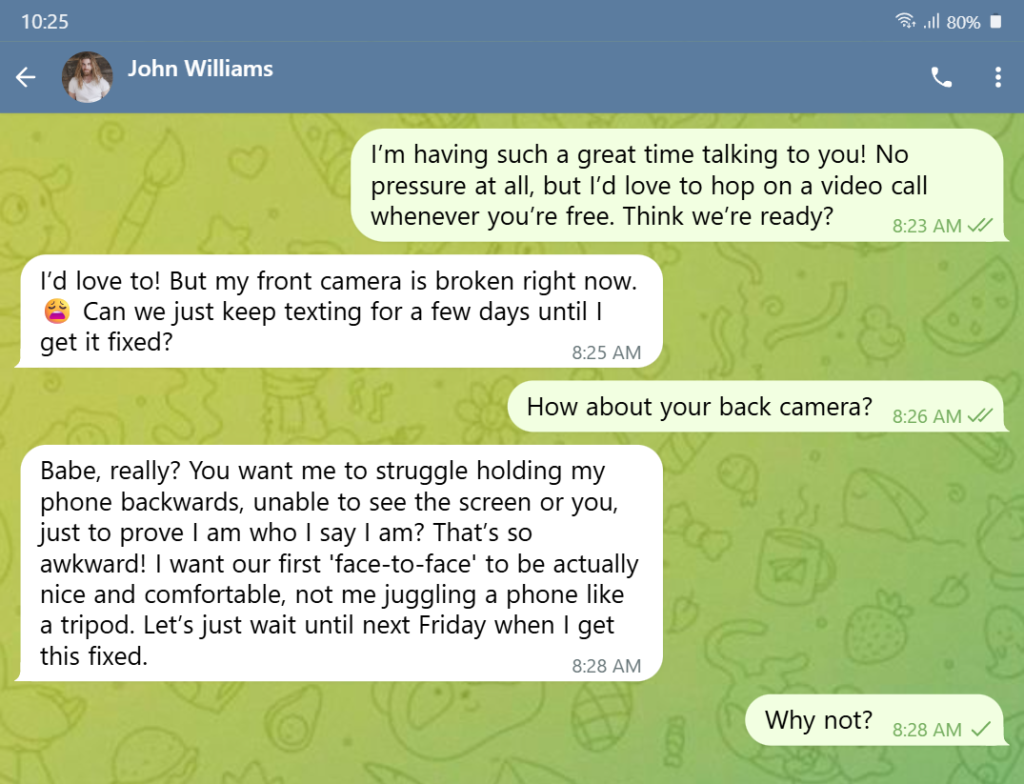
A catfish cannot show you its real face. So expect a revolving door of excuses — they’re deployed in a remote area, their phone is damaged, the Wi-Fi is terrible. In an era where anyone with a smartphone can video call from a cornfield, this excuse wears thin extremely fast.
4. They’re Permanently Unreachable In Person
Conveniently, an online deceiver is always inaccessible. They’re on an oil rig in the North Sea, stationed at an overseas military base, or running operations in some far-flung country. This creates a tragically romantic “us against the distance” dynamic while ensuring you two never actually meet.
5. The Story Develops Cracks.
Ask follow-up questions about their life across multiple conversations. A genuine person has consistent, detailed answers about their own existence. Someone managing fabricated identities on a spreadsheet will contradict themselves. These are classic catfish tells — and they compound over time if you’re paying attention.
6. The Money Request Arrives.
This is the bright red line. No matter how deep the emotional bond feels, no matter how urgent or heartbreaking the story sounds, a person you have never physically met should never be asking you for money. Full stop. No exceptions.
7. They Want to Keep It Secret.
Healthy relationships don’t require secrecy. If your new online love interest discourages you from telling friends or family about them, understand this clearly: that’s not romance. That’s damage control.
Exposing the Catfish: 11 Ways to Verify Who You’re Really Talking To
Suspicion is healthy. Action is better. Here’s your full toolkit for unmasking an impostor.
1. Reverse Image Search — Your Most Powerful Weapon
Take any photo they’ve sent you and run it through Google Images, TinEye, or Yandex Images. A catfish almost always uses stolen images — belonging to real models, fitness influencers, or military personnel. If the “gorgeous surgeon” turns out to be a Norwegian fitness blogger whose photos have been reported for fraud a dozen times, you’ll know in thirty seconds.
How To Do a Reverse Image Search?
As a critical step, conduct a reverse image search on the profile pictures to see if they appear elsewhere on the internet. Use search engines or image search tools like Google’s Reverse Image Search to verify the authenticity of the images.

So, you’ve come across this super handsome guy, but there’s this nagging doubt in your mind – is his profile real or just another catfish? Take a chill pill and don’t stress!
Snap a quick screenshot of his profile picture first.
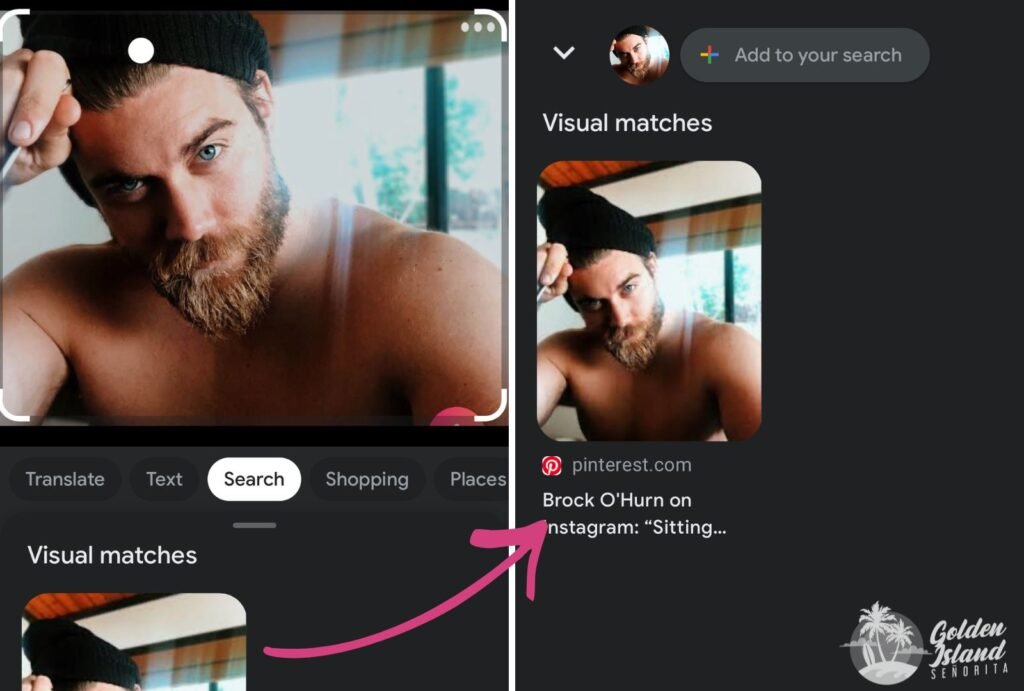
Run a reverse image search on it. Upload the photo you screenshot on the search engine (I used the Google Lens app), and it finds other similar pics or info related to it. Super handy to see if that pic is legit or if it’s just copy-pasted. If the photo is stolen, the search engines will pop up some “Visual Matches” for you. So, keep an eye out for those matches to know if someone’s trying to pull a fast one on you!
Still not convinced? Along with the pictures, the search results will dish out some info like the person’s name and where the pic came from. Then Google the result and see what other is info available online.
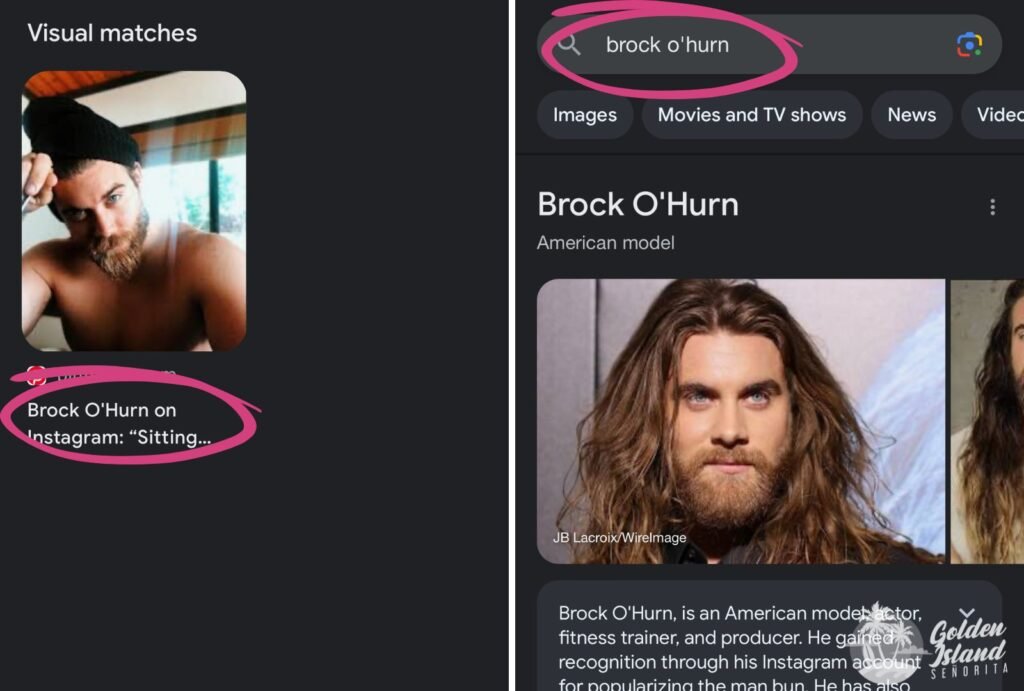
So, I did a quick check with Reverse Image Search, and guess what? The dude in the picture is none other than the model, Brock O’Hurn! Looks like I’ve got myself a classic catfish situation going on here. REPORT the profile.
List of Reverse Image Search Engines
- TinEye.
- Pixsy.
- Google Images.
- Bing Visual Search.
- Yahoo Image Search.
- Duplichecker.
2. Try a simple photo request.
If you’re unsure about someone, ask for a quick, specific photo—something casual like a thumbs-up or a random pose. A real person will usually have no issue snapping a quick, slightly silly picture. Someone using fake photos, on the other hand, will often avoid it or make excuses. It’s an easy, low-pressure way to see if things add up.
2. Search Their Name + “Scam” or “Fraud”
Drop their name into a search engine paired with words like “scam,” “romance fraud,” or “fake profile.” Victims of repeat catfish operations frequently post public warnings. You may find a detailed description of the exact persona you’ve been talking to.
3. Cross-Check Their Digital Footprint
Real people accumulate an organic online presence over years — old posts, tagged photos, mutual connections. Someone with a thin, pristine, recently created profile and zero mutual friends warrants serious scrutiny. A quick look across platforms tells you a lot.
4. Demand a Real-Time Video Call
Not a pre-recorded clip — a live call where you ask them to hold up a specific number of fingers, wave, or respond to something you say in the moment. A catfish cannot pull this off convincingly. Deepfakes still show tell-tale blurring around facial edges and unnatural mouth movement, so watch closely.
5. The Handwritten Note Test
Ask them to send a photo holding a handwritten note with your name and today’s date on it. A real person can do this in five minutes. Someone using images stolen from a model’s Instagram archive absolutely cannot — and their excuses will be telling.
6. Hyper-Local Knowledge Questions
If they claim to live in Seattle, ask about a specific neighbourhood, a local restaurant, or what the weather was like that afternoon. Vague, deflecting, or factually wrong answers about their own supposed city are significant red flags.
7. Check Company Website
If they mention where they work—especially if they claim to hold a high-ranking position or work in upper management—a great way to put your mind at ease is to take a quick look at the company’s official website. Verifying these professional details is a simple, smart step that helps you feel more confident as you get to know someone new.
8. People Search Engines
Sites like Spokeo, BeenVerified, or WhitePages can help verify whether a name, phone number, and claimed city align. Inconsistencies between what they’ve told you and what’s on public record are a meaningful warning sign worth investigating further.
9. Reverse Phone Lookup
Run their number through a lookup service. If it traces to a VOIP service, a Google Voice account, or a country completely different from where they claim to live, that’s a serious concern. Scammers routinely use disposable numbers to avoid any trail.
10. The Copy-Paste Profile Test
Highlight a distinctive line or phrase from their dating profile bio and search it in quotation marks. Fraudsters frequently reuse the same scripts across dozens of fake accounts. If their “About Me” turns up verbatim on fifteen other profiles, you have your answer.
11. Talk to Someone Outside the Situation
The most reliable catfish detector isn’t an app — it’s a trusted friend or family member who hasn’t been swept up in the emotional current of the relationship. Share the profile. Share the messages. Fresh, unattached eyes catch what a smitten heart consistently misses.
12. Test Consistency Over Time
Ask the same questions on different days, worded a little differently. Keep casual notes. Real people have naturally consistent memories because their life is actually happening. Someone managing fictional identities will contradict themselves — and when they do, that inconsistency is your clearest signal.
The Professional Catfish Playbook: Money Scams
Now let’s examine the specific financial manipulation tactics that a seasoned catfish deploys, because recognizing the script is your best defence against it.
The Stranded Traveller.
They were on their way to finally visit you when everything went wrong — wallet stolen, detained at customs, stuck at a foreign airport. Can you wire just enough to get them home? The story is engineered for maximum emotional leverage: you’re so close to meeting, and this one obstacle is in the way.
The Pig Butchering Investment Scam.
The catfish introduces you to a “can’t miss” investment opportunity — almost always cryptocurrency. They walk you through a platform they secretly control, where your “balance” appears to grow impressively. You invest more. When you try to withdraw, there are sudden “taxes,” “compliance fees,” or “verification deposits” required. The platform is entirely fake. Every dollar sent is gone.
The Emergency Medical Bill.
A child is sick. A parent has collapsed. They themselves are in hospital abroad. The emotional pressure is calibrated to be overwhelming, because the catfish counts on love and compassion overriding rational caution. It works with devastating frequency, targeting otherwise sharp, intelligent people.
The Package/Inheritance Hold.
They’re sending you a gift — diamonds, gold, a legal inheritance — but it’s stuck at customs and requires a “release fee” to clear. You pay the fee. There is no package. There is no inheritance. There is only the next fee request, and the one after that.
The Slow Escalation.
Perhaps the subtlest approach: it begins with something trivially small — a gift card, a tiny transfer “just until payday.” Once you comply, a psychological threshold is crossed that makes each subsequent request easier to justify. By the time the numbers become alarming, your emotional investment has long since obscured your view.
The throughline across every one of these scenarios is identical: urgency plus emotion plus isolation. A predatory catfish will never give you the time or space to think clearly, verify facts, or consult someone you trust. Every request comes wrapped in a ticking clock.
Protecting Yourself: 10 Rules to Live By
Here’s the truth worth saying clearly: you don’t have to be naïve or foolish to fall for a catfish. These operations are run by professionals with scripts, teams, and psychological expertise specifically designed to exploit normal, loving, trusting people. The shame so many victims feel is entirely misplaced — the same empathy and openness that makes someone a wonderful friend, parent, or partner is precisely what these operations target. That said, these ten rules will dramatically reduce your risk.
Rule 1: Never Send Money to Someone You Haven’t Met In Person.
This is the rule above all others. No emergency is so urgent, no love so deep, no story so heartbreaking that it justifies transferring money to someone you’ve never physically met. Real people in real crises have local support systems.
Rule 2: Make Video Calls a Baseline, Not a Milestone.
A legitimate person will happily jump on a live video call within the first few weeks of regular contact. This is non-negotiable. Weeks of excuses are not endearing — they’re a warning.
Rule 3: Tell Someone About the Relationship.
Share the person’s profile with a trusted friend or family member. Invite scrutiny. Genuine partners welcome being known by the people who matter to you. A catfish hates witnesses.
Rule 4: Never Share Financial Details.
Bank account numbers, routing information, credit card details, crypto wallet addresses — none of this belongs in a conversation with someone you’ve only met online, no matter how close things feel.
Rule 5: Run a Reverse Image Search Early.
Do it in the first week, not after months of emotional investment. Thirty seconds now can save you months of heartbreak and financial ruin later.
Rule 6: If the Pace Feels Unnatural, Slow It Down Yourself.
You’re allowed to pump the brakes. Any relationship that collapses the moment you ask for a little more time is not a relationship worth keeping.
Rule 7: Never Invest in Any Opportunity They Introduce.
Someone you met online leading you to a trading platform or financial venture is one of the most financially ruinous catfish scams of the current moment. Walk away immediately.
Rule 8: Use Platforms with Identity Verification.
Many reputable dating apps now offer photo verification and fraud-detection features. Use platforms that take user safety seriously — it filters out a lot of the noise before you even engage.
Rule 9: Report Suspicious Profiles Without Hesitation.
If something feels off, trust that feeling and report the account. You may not be the first target, but your report could help ensure someone else isn’t the next one.
Rule 10: Seek Help Without Shame If You’ve Been Victimized.
Being deceived this way is not a reflection of your intelligence or your worth as a person. It is a crime committed against you by a professional manipulator. The FBI’s Internet Crime Complaint Center (IC3) at ic3.gov and the FTC at reportfraud.ftc.gov exist for exactly this purpose. Use them — and please talk to someone you trust, because the psychological aftermath of these scams is real and it deserves real support.
Final Thoughts
Here’s what it all comes down to: every online deception scheme of this kind survives because of something genuinely beautiful in human nature — our persistent, powerful desire to connect. To love and be loved. To believe the world is populated with interesting, wonderful people who might find us equally interesting and wonderful in return.
That desire is not a weakness. It’s one of our finest qualities. It just happens to be exactly what a certain breed of predator is counting on — and that’s what makes the whole thing so despicable.
But you’re no longer swimming blind. You now understand the psychology, the stages, the scripts, and the red flags. You have the tools for verification and the rules for protection. The water hasn’t changed — but you have. And a more informed, more alert version of you is a far less appealing target than the one who started reading this article. Every catfish depends on its target staying in the dark. You’re not in the dark anymore.
Stay curious. Stay open to genuine connection. But hold your trust a little more carefully, verify a little more readily, and never let urgency — emotional or financial — rush you past your own good judgement. The things worth having are always worth a little patience and a little scrutiny.
The right person will never need to steal a face to win yours.

Polly Amora
Polly Amora is the señorita behind GoldenIslandSenorita.Net. A corporate warrior by day, and a perpetual explorer by heart. She is a lifelong learner who is very outgoing, speaks four languages, loud & outspoken, and loves to have adventures in the mountains, on the beach, and in the city. You can throw her anywhere, and she'll handle it like a pro. Ice cream and bourbon are two of her weaknesses.


You May Also Like

Why Smart People Fall for Romance Scams Online: Psychology Explained

The Scary Way AI Deepfakes Bypass Video Calls