

Traveling is exciting, but losing or having a damaged passport can quickly turn that excitement into stress. Your passport isn’t just a travel document—it’s proof of your citizenship, personal identity, and your ticket to explore the world. For Filipinos, understanding what to do when a passport is lost or damaged is essential. This guide walks you through everything from prevention to replacement, ensuring your travel plans stay on track.
Why a Passport is So Important
A passport is far more than a travel booklet. For Filipino travelers, its significance includes:
- Proof of Citizenship – Your passport confirms you are a Philippine citizen. Losing it or having a damaged passport can complicate identification, especially abroad.
- Mandatory for International Travel – Airlines and immigration authorities will not permit travel without a valid passport, and a damaged passport can sometimes be treated as invalid.
- Contains Personal Information – Name, date of birth, and photo are all in your passport. A lost or damaged passport could expose you to identity theft if it falls into the wrong hands.
Because of its importance, losing or having a damaged passport requires immediate action.
How Passports Get Lost or Damaged
Understanding common causes of a lost or damaged passport helps prevent future problems. Typical scenarios include:
- Theft or Misplacement – Busy airports, hotels, taxis, or public transport are common hotspots for lost passports, and sometimes passports are retrieved in damaged condition.
- Water Damage – Rain, spills, swimming, or even a leaky backpack can ruin pages, leaving you with a damaged passport.
- Wear and Tear – Frequent travel can bend the cover or tear pages, leading to a damaged passport over time.
- Accidents – Fire, luggage mishaps, or exposure to chemicals can result in a damaged passport.
Being mindful of these risks and taking precautions can save a lot of stress.
What to Do if Your Passport is Lost
Step 1: Stay Calm and Retrace Your Steps
Panicking is natural, but the first step is to stay calm. Check all possible places—bags, drawers, vehicles, and hotel safes. Many passports are “lost” simply because they are misplaced temporarily, and sometimes they are found in damaged passport condition.
Step 2: Report the Loss Immediately
Once confirmed lost, report it immediately:
- In the Philippines: Contact the nearest Department of Foreign Affairs (DFA) office. They will record your lost passport and prevent misuse.
- Abroad: Contact the nearest Philippine Embassy or Consulate. They can issue a replacement or emergency travel document.
Step 3: File a Police Report
While not always mandatory, a police report is highly recommended, especially if stolen. Benefits include:
- Evidence for passport replacement
- Proof for airline or travel insurance claims
- Protection against identity theft in case of a passport being misused.
Step 4: Apply for a Replacement Passport
Replacement Requires:
- Completed passport application form
- Valid IDs (e.g., PhilSys, UMID, PRC, driver’s license, etc)
- Affidavit of Loss (Notarized)
- Police report
- Payment of replacement fee
Replacement Options:
- Regular Replacement: Standard processing, suitable if travel is not urgent.
- Express Replacement: Faster processing, often for those traveling soon, especially if the original was a damaged passport.
What is an Affidavit of Loss (for a Lost Passport)?
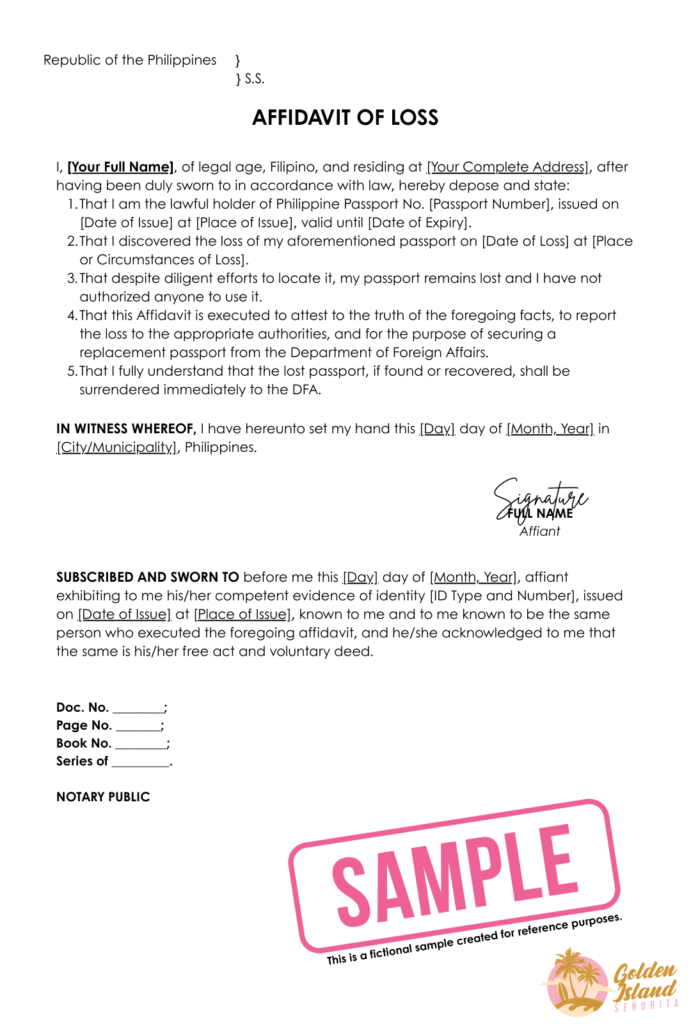
Losing a passport can be a stressful experience, especially for Filipino citizens who rely on it for international travel and identification. One of the first and most crucial steps after realizing your passport is lost is writing an Affidavit of Loss. This legal document serves as an official declaration that your passport has been misplaced or stolen, and it plays a key role in securing a replacement.
An Affidavit of Loss is more than just a formality. It protects you legally, preventing potential misuse of your lost passport, and is a mandatory requirement when applying for a new passport at the Philippine Department of Foreign Affairs (DFA). Without it, processing your replacement passport could be delayed or even denied.
Important Points to Remember
- Be Honest and Accurate – Clearly state the circumstances under which your passport was lost, including the date, time, and place. Misrepresentation could lead to legal consequences.
- Include Personal Details – Provide your full name, date of birth, passport number, and other identifying information to ensure the affidavit is valid and traceable.
- Notarization is Mandatory – An affidavit of loss must be notarized to be recognized by the DFA or other authorities. A notarized affidavit carries legal weight and confirms the authenticity of your claim.
- Report to Authorities if Necessary – If your passport was stolen, it’s highly recommended to file a police report. This adds another layer of protection against identity misuse.
- Attach Supporting Documents – Any identification documents, old passport copies, or proof of travel can help validate your affidavit.
- Keep Copies – Always keep a copy of your notarized affidavit for your records. It may be needed for other processes or emergencies.
Sample Affidavit of Loss
Pro Tips:
- Always double-check the passport number and personal info; errors can cause DFA delays.
- Bring two valid IDs when notarizing.
- Keep at least one notarized copy for your records before submitting it to the DFA.
Writing an Affidavit of Loss is a simple but essential step that safeguards your identity and expedites the replacement of your lost passport. Being prompt, honest, and thorough ensures a smoother process when dealing with the DFA and avoids potential complications down the road.
What to Do if Your Passport is Damaged
Step 1: Assess the Damage
Minor wear like scratches may still be acceptable. Replacement is required if:
- Pages are torn or missing
- Cover is damaged, preventing opening
- Ink is smudged or water damage makes details unreadable
A damaged passport can sometimes prevent you from boarding flights or entering foreign countries, making immediate action essential.
Step 2: Report to the DFA or Embassy
Even accidental damage must be reported. The DFA or Embassy will advise whether a damaged passport requires replacement.
Step 3: Submit Replacement Application
Provide:
- Damaged passport
- Valid IDs
- Completed application form
- Payment of fees
Step 4: Special Circumstances
- Children: Parental consent is required for minor’s passports.
- Urgent Travel: Embassies can issue emergency passports if your damaged passport prevents immediate travel.
Filipino Travelers Abroad: Special Tips
Traveling without a valid passport—or with a damaged passport—abroad can be stressful. Key tips include:
- Know Your Embassy Contact – Keep phone numbers and emails handy.
- Keep Digital and Physical Copies – Copies of passport and IDs help in reporting a lost or damaged passport.
- Emergency Travel Documents (ETC) – Issued by embassies if a passport is unusable, allowing safe travel back to the Philippines.
- Monitor Travel Plans – Airlines may need to verify your new passport if your original was damaged.
Preventing Passport Loss or Damage
Preventing problems is better than solving them. Tips include:
- Use a secure travel wallet or passport holder to prevent a passport from being damaged
- Keep a digital backup in secure cloud storage
- Protect from water and spills
- Avoid overstuffing your bag to prevent bending pages
- Check passport condition and validity before travel.
Fees and Processing Times
Philippines DFA:
- Regular: PHP 950.00, 12 working days
- Express: PHP 1,200.00, 6 working days
Philippine Embassies Abroad:
- Fees and processing vary by country
- Emergency passports can replace a lost or damaged passport within 1–3 days
Always check official DFA or embassy websites for updates.
Step-by-Step: Applying for Replacement in the Philippines
- Book an Appointment Online – DFA requires online scheduling (as advised).
- Prepare Documents – Passport application form, IDs, and a report if your passport is lost or damaged.
- Submit at DFA Office – Present documents and pay fees.
- Processing – Wait for processing (regular or express).
- Claim Your New Passport – Bring your receipt and valid ID.
Step-by-Step: Applying for Replacement Abroad
- Contact Embassy/Consulate – Inform them immediately
- Complete Application Forms – Often available online.
- Provide Supporting Documents – Old passport (if damaged), police report (if lost), proof of Philippine citizenship, valid ID.
- Emergency Passport (if needed) – Usually issued same-day or within 1–3 days if your damaged passport cannot be used.
- Travel Back to Philippines – Emergency passports valid for single or limited travel.
Frequently Asked Questions
Q1: Can I travel with a partially damaged passport?
- Minor scratches may be okay, but torn pages or illegible information render a passport invalid.
Q2: What if my passport is stolen abroad?
- File a police report, report to the embassy, and apply for an emergency passport.
Q3: How long is an emergency passport valid?
- Usually valid for single travel or up to one year if your original passport is unusable.
Q4: Can travel insurance reimburse passport replacement fees?
- Some policies cover lost or damaged passports. Check your insurance coverage.
Q5: Can someone else process my lost or damaged passport replacement for me?
- No. Passport applications and replacements are personal appearances only. You must go to the DFA in person for biometrics and verification.
Q6: Is there a penalty for losing my passport multiple times?
- Yes. The DFA imposes stricter verification and may apply penalties or longer processing times if you frequently report lost passports.
Common Myths
“You can still travel with a damaged passport as long as your photo is visible.”
Wrong. Airlines and immigration officers are strict. Even minor tears, loose pages, water damage, or ink smudges can render your passport invalid. If it looks tampered, expect a hard DENIED at the airport.
“Reporting a lost passport will blacklist you.”
Nope. Losing a passport doesn’t mean you’re branded as irresponsible for life. What does happen is your lost passport gets canceled in DFA’s system to prevent fraud. You won’t get penalized (unless you keep “losing” it every year).
“You can get a replacement the same day you apply.”
Not true. The DFA doesn’t do “while-you-wait” replacements. Even with expedited processing, you’ll usually wait 7–10 working days (sometimes longer). If you lost it right before a flight—ouch.
“An Affidavit of Loss automatically gets you a new passport.”
Nope. The affidavit is just the first step. DFA will still require extra documents (valid IDs, birth certificate, etc.) and conduct verification, especially if you lost your passport more than once.
“You need a police report for every lost passport.”
Not always. For a first-time loss, an affidavit of loss is usually enough. A police report may be required if the DFA suspects foul play, fraud, or repeated losses.
“If you find your ‘lost’ passport later, you can use it again.”
Big mistake. Once you’ve reported it lost, that passport is already canceled in DFA’s database. Using it again can land you in trouble at immigration, since it’ll show up as invalid.
“If my passport is damaged abroad, the embassy will replace it right away.”
Not exactly. Embassies issue Travel Documents (TDs) in emergencies, but a full passport replacement still follows processing timelines. A TD usually lets you travel back to the Philippines only, not country-hopping.
Pro Tips for Filipino Travelers
- Keep two copies of your passport: one physical, one digital in case of a damaged passport
- Save embassy numbers for reporting a passport issues quickly
- Use travel insurance covering lost or damaged passports
- Store your passport in a waterproof holder
- Avoid leaving your passport in checked luggage to prevent a damaged passport
Real-Life Scenarios
Scenario 1: Lost Passport Abroad
Maria, a Filipino traveler in Paris, misplaced her passport. She reported it immediately, and even though her passport was partially a damaged passport, the embassy issued an emergency passport the next day.
Scenario 2: Damaged Passport
Juan accidentally spilled coffee on his passport before a flight to Singapore. The embassy processed his damaged passport replacement within 3 days.
Scenario 3: Lost Passport Near Travel Date
Anne discovered her passport missing two days before a flight to Japan. Reporting it as a damaged passport allowed her to secure an emergency passport and travel on schedule.
Summary Checklist
Lost Passport:
- Stay calm and retrace steps
- Report to DFA or Embassy
- File a police report
- Apply for replacement or emergency passport
- Keep backup copies of IDs
Damaged Passport:
- Assess severity
- Report to DFA or Embassy
- Submit replacement application
- Secure emergency travel document if needed
- Practice preventive measures
Conclusion
Losing or having a damaged passport is stressful, but with the right knowledge, it doesn’t have to ruin your travel plans. Prompt reporting, following proper procedures, and having backup documentation can save time, money, and headaches. Remember: your passport isn’t just a booklet of pages; it’s your gateway to the world—and a damaged passport is a serious concern that deserves immediate attention. Protect it, and travel with peace of mind.
