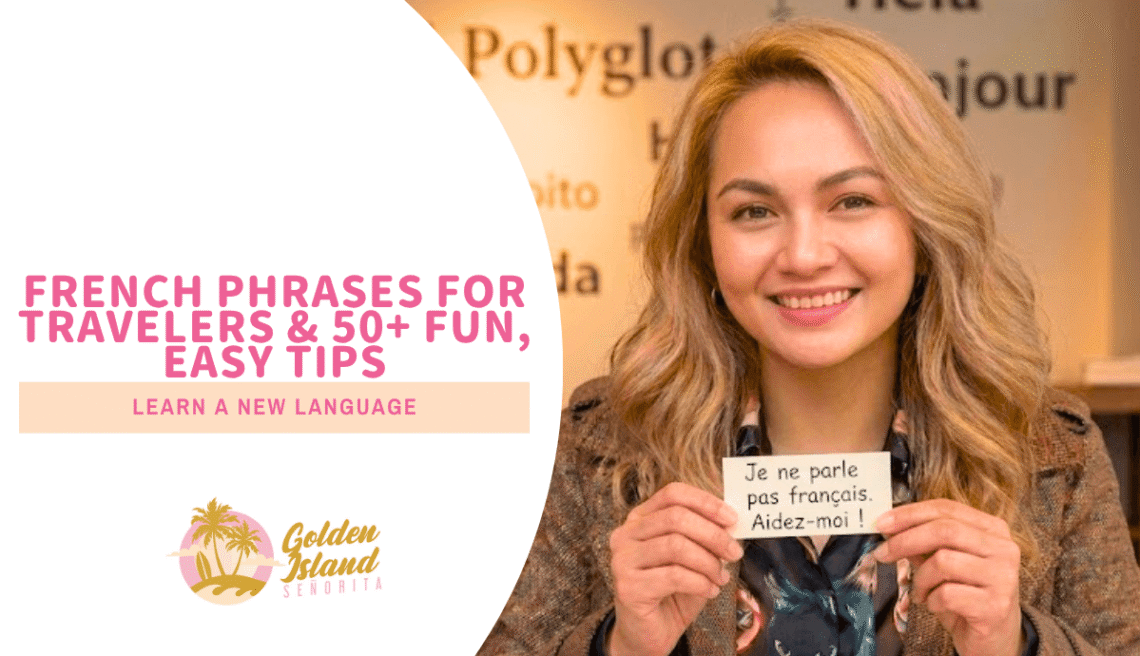
Bonjour, Y’all! French Phrases for Travelers & 50+ Fun, Easy Tips
So you’ve booked your ticket to France. You’ve got visions of croissants, the Eiffel Tower at sunset, and maybe a beret you’ll never actually wear. There’s just one tiny wrinkle in this romantic fantasy: you don’t speak a word of French, and the closest you’ve come to Parisian culture is ordering a “French vanilla” latte. Relax. Take a breath. Pour yourself a glass of something (wine, if you’re getting into the spirit). This guide exists to arm you with the essential French phrases you need to survive — and even thrive — on your trip, without requiring you to enroll in a four-year degree program first.
Learning French phrases before a trip is a bit like packing an umbrella. You probably won’t need all of them, but the one time you do, you’ll be very, very glad you have them. This isn’t about becoming fluent. It’s about collecting a travel-sized toolkit of expressions that will help you order food, find the bathroom, check into your hotel, and avoid accidentally insulting someone’s grandmother. Noble goals, all of them.
By the end of this beginner’s guide, you’ll have a solid stash of French phrases organized into handy categories, complete with English translations and pronunciation guides so you’re not left guessing whether “s’il vous plaît” is pronounced like a sneeze (it isn’t, but we understand the confusion). Let’s get into it!
Table of Contents
Bonjour, Mon Ami!
A Beginner’s Guide to the French Language
For curious travelers, brave souls, and those who refuse to point at menus
Why Bother Learning French Phrases At All?
Here’s the thing: the French don’t actually expect you to be fluent. Nobody is going to hand you a baguette and demand you recite Molière. But there’s a well-known (and largely true) rule of thumb when traveling in France: attempting a few French phrases, even badly, goes a long way. It signals effort. It signals respect. It says, “I recognize I am a guest in your beautiful country, and I am at least trying, even if my accent sounds like I’m gargling marbles.”
Locals — especially in smaller towns and away from the tourist-clogged arteries of Paris — tend to warm up considerably faster to travelers who open with a cheerful “Bonjour!” instead of launching straight into rapid-fire English. A handful of well-placed French phrases can be the difference between a shopkeeper sighing and switching to English out of pity, and a shopkeeper genuinely delighted to help you find the perfect scarf.
Plus, practically speaking, knowing a few basic phrases means you won’t be entirely dependent on spotty airport Wi-Fi and a translation app that insists you just told a waiter you’d like to marry his soup.
And before you wince and say “But the French language is so hard!” — let’s be clear: it is not as difficult as Mandarin, as grammatically ferocious as Finnish, or as phonetically baffling as Hungarian. The French language is closely related to English. We share thousands of words: possible, important, animal, silence, table — these are French words wearing English clothes. The biggest challenge when learning the French language is not vocabulary. It’s the sounds.
| 🇫🇷 France Western Europe | 🇧🇪 Belgium Western Europe | 🇨🇭 Switzerland Central Europe | 🇨🇦 Canada Quebec & regions |
| 🇸🇳 Senegal West Africa | 🇲🇦 Morocco North Africa | 🇨🇩 DR Congo Central Africa | 🇻🇳 Vietnam Southeast Asia (legacy) |
The Sound of the French Language: A Gentle Warning
The French language sounds beautiful. It flows. It lilts. It sounds like someone is permanently about to recite poetry. The reason for this is that the French language swallows half its letters whole. Silent letters in French are less a rule and more a philosophy of life — specifically, the philosophy that consonants at the end of words are merely decorative suggestions.
The famous nasal vowels are your first challenge in the French language. The sounds “an,” “on,” “in,” and “un” are produced deep in your nose, as if you’ve been asked to hum while chewing something magnificent. Then there’s the French “r” — a glorious guttural rumble produced at the back of the throat, as though you’re gargling a polite opinion. Don’t be afraid. Practice in the shower. The shower, unlike a Parisian waiter, will not judge you.
| ou Sounds like “oo” in “moon” e.g., bonjour (bohn-zhoor) | eu Round your lips, say “uh” — no English equivalent! e.g., deux (duh) = two | r A soft guttural rasp, back of the throat e.g., rue (ryoo) = street | -ent Usually completely silent at verb ends e.g., ils parlent = “eel parl” (they speak) |
| è / ê Open “eh” sound, like in “bed” e.g., fête (fet) = party | j Soft “zh” like the “s” in “measure” e.g., je (zhuh) = I |
The Golden Rule of French Language Pronunciation
A core feature of the French language: when in doubt, don’t pronounce the last consonant. Vous (you) = “voo”. Beaucoup (a lot) = “boh-koo”. However, when the next word starts with a vowel, they magically fuse together — this is called liaison, and it is one of the most beautiful quirks of the French language once you notice it.
A Two-Minute Pronunciation Crash Course
Before we dive into the tables, let’s talk pronunciation, because French spelling is a bit like a magician’s misdirection: what you see is very much not what you get. Half the letters in French words are apparently decorative. “Beaucoup” does not rhyme with “hiccup.” The “s” at the end of most words takes a vow of silence. And don’t even get us started on nasal vowels, which require you to sound faintly congested at all times.
The good news? You don’t need to master French phonetics to make yourself understood. In the tables below, we’ve included simple, phonetic, “sound it out like a slightly confused tourist” pronunciation for every phrase, so you can skip the years of study and go straight to the mildly embarrassing but endearing attempt. That’s really all these phrases require of you: attempt, don’t overthink, and smile a lot.
A few quick rules that’ll help with nearly every phrase on this list:
- The French “r” is made somewhere in the back of your throat, like you’re gently clearing it. Don’t roll it like Spanish.
- Most final consonants are silent, unless followed by an “e.”
- “Ou” sounds like “oo” (as in “food”), while “u” is a tighter, pursed-lips sound with no real English equivalent — just purse your lips like you’re about to whistle and say “ee.”
- When in doubt, mumble confidently. It works surprisingly often.
Alright, warm-up over. Let’s get to the good stuff: the actual French phrases, organized by where you’ll need them most.
Greetings and Politeness: The Foundation of All French Phrases
If you learn nothing else from this guide, learn this section. These French phrases are the social WD-40 of your entire trip — they make every interaction smoother, and the French genuinely notice (and appreciate) when visitors use them consistently. Skipping “bonjour” before asking a question is considered mildly rude in France, on par with barging into someone’s office without knocking.
| French Phrase | English Translation | Pronunciation |
|---|---|---|
| Bonjour | Hello / Good day | bohn-ZHOOR |
| Bonsoir | Good evening | bohn-SWAHR |
| Salut | Hi / Bye (informal) | sah-LOO |
| S’il vous plaît | Please | seel voo PLEH |
| Merci (beaucoup) | Thank you (very much) | mehr-SEE (boh-KOO) |
| De rien | You’re welcome | duh ree-EHN |
| Excusez-moi | Excuse me | ex-koo-zay MWAH |
| Pardon | Sorry / Pardon me | par-DOHN |
| Oui / Non | Yes / No | wee / nohn |
| Comment allez-vous ? | How are you? (formal) | koh-mahn tah-lay VOO |
| Ça va ? | How’s it going? (casual) | sah VAH |
| Enchanté(e) | Nice to meet you | ahn-shahn-TAY |
Pro tip: sprinkling “s’il vous plaît” and “merci” onto the end of literally any request instantly upgrades you from “clueless tourist” to “clueless tourist with manners,” which locals will reward with far more patience.
Airport and Transportation French Phrases
You’ve landed. You’re jet-lagged, mildly disoriented, and your suitcase may or may not have made the trip with you. This is prime real estate for a well-timed French phrase to save your entire day.
| French Phrase | English Translation | Pronunciation |
|---|---|---|
| Où est… ? | Where is…? | oo eh |
| L’aéroport | The airport | lah-ay-roh-POR |
| La gare | The train station | lah GAHR |
| Un billet, s’il vous plaît | A ticket, please | uhn bee-YEH seel voo PLEH |
| Aller simple / aller-retour | One-way / round-trip | ah-lay SAMP-luh / ah-lay ruh-TOOR |
| Le quai | The platform | luh KAY |
| À quelle heure part le train ? | What time does the train leave? | ah kel UHR par luh TRAHN |
| Je voudrais un taxi | I would like a taxi | zhuh voo-DRAY uhn tak-SEE |
| C’est combien ? | How much is it? | say kohm-bee-AHN |
| Mes bagages | My luggage | may bah-GAHZH |
Once you’ve got these travel-focused phrases down, navigating a French train station starts to feel less like a hostage negotiation and more like a mildly confusing scavenger hunt — which, honestly, is progress.
Hotel and Accommodation French Phrases
Whether you’re checking into a swanky Parisian boutique hotel or a countryside bed-and-breakfast run by a very opinionated cat, these French phrases will help you get settled without incident.
| French Phrase | English Translation | Pronunciation |
|---|---|---|
| J’ai une réservation | I have a reservation | zhay oon ray-zair-vah-see-OHN |
| Une chambre pour deux personnes | A room for two people | oon SHAHM-bruh poor duh pair-SUN |
| Avez-vous une chambre disponible ? | Do you have a room available? | ah-vay voo oon SHAHM-bruh dee-spoh-NEEB-luh |
| La clé | The key | lah KLAY |
| Le petit-déjeuner est inclus ? | Is breakfast included? | luh puh-tee day-zhuh-NAY eh tan-KLOO |
| Le Wi-Fi | The Wi-Fi | luh wee-fee |
| Pouvez-vous m’aider ? | Can you help me? | poo-vay voo may-DAY |
| À quelle heure est le check-out ? | What time is checkout? | ah kel UHR eh luh check-out |
Notice how many of these hotel-related phrases are just polite requests wearing different outfits. That’s the secret: master “je voudrais” (I would like) and “pouvez-vous” (can you), and you can plug in almost any noun to build a brand-new sentence on the fly.
Restaurant and Food French Phrases (The Important Ones)
Let’s be honest — this is the section you actually came for. Food is the heart and soul of a trip to France, and knowing the right French phrases here is the difference between a magical meal and pointing helplessly at a menu while the waiter judges you gently but fairly.
| French Phrase | English Translation | Pronunciation |
|---|---|---|
| Une table pour deux, s’il vous plaît | A table for two, please | oon TAH-bluh poor duh seel voo PLEH |
| Le menu, s’il vous plaît | The menu, please | luh muh-NOO seel voo PLEH |
| Je voudrais… | I would like… | zhuh voo-DRAY |
| L’addition, s’il vous plaît | The check, please | lah-dee-see-OHN seel voo PLEH |
| C’est délicieux | It’s delicious | say day-lee-see-UH |
| Je suis végétarien(ne) | I’m vegetarian | zhuh swee vay-zhay-tah-ree-AHN |
| Sans gluten | Gluten-free | sahn gloo-TEN |
| Un verre de vin rouge/blanc | A glass of red/white wine | uhn VAIR duh vahn ROOZH / BLAHN |
| L’eau, s’il vous plaît | Water, please | loh seel voo PLEH |
| Bon appétit | Enjoy your meal | bohn ah-pay-TEE |
A quick cultural note to go with these phrases: asking for tap water (“une carafe d’eau”) is completely normal and free, so don’t be shy. Also, “l’addition” will never arrive unless you ask for it — French dining culture doesn’t rush you out the door, so the check waits patiently until summoned, like a polite ghost.
Shopping French Phrases
Whether you’re hunting for the perfect macarons, a scarf that will make everyone back home insanely jealous, or just a phone charger because you forgot yours (again), these French phrases have you covered.
| French Phrase | English Translation | Pronunciation |
|---|---|---|
| Combien ça coûte ? | How much does this cost? | kohm-bee-AHN sah KOOT |
| C’est trop cher | It’s too expensive | say troh SHAIR |
| Je regarde seulement | I’m just looking | zhuh ruh-GARD suhl-MAHN |
| Puis-je essayer ceci ? | Can I try this on? | pwee zhuh eh-say-YAY suh-SEE |
| Acceptez-vous les cartes de crédit ? | Do you accept credit cards? | ak-sep-tay voo lay KART duh kray-DEE |
| Un sac, s’il vous plaît | A bag, please | uhn SAK seel voo PLEH |
| Je le/la prends | I’ll take it | zhuh luh/lah PRAHN |
These shopping-focused phrases are short, sweet, and endlessly reusable — swap out the item and you’re golden.
Directions and Getting Around: French Phrases for the Gloriously Lost
Getting lost in a charming French village is a rite of passage. Getting lost and having zero French phrases to ask for help is just a regular Tuesday nightmare. Let’s avoid the latter.
| French Phrase | English Translation | Pronunciation |
|---|---|---|
| Où sont les toilettes ? | Where’s the bathroom? | oo sohn lay twah-LET |
| Tournez à gauche/droite | Turn left/right | toor-NAY ah GOHSH / DRWAHT |
| Tout droit | Straight ahead | too DRWAH |
| C’est loin ? | Is it far? | say LWAHN |
| Je suis perdu(e) | I’m lost | zhuh swee pair-DOO |
| Pouvez-vous me montrer sur la carte ? | Can you show me on the map? | poo-vay voo muh mohn-TRAY soor lah KART |
| À côté de | Next to | ah koh-TAY duh |
| En face de | Across from | ahn FAHS duh |
Of all the French phrases in this guide, “où sont les toilettes” might genuinely be the single most valuable one you’ll ever memorize. Write it on your hand if you have to.
Emergency and Health French Phrases (Just in Case)
Nobody wants to think about this stuff on vacation, but a small set of emergency phrases is the travel equivalent of a spare tire — hopefully unused, but essential if things go sideways.
| French Phrase | English Translation | Pronunciation |
|---|---|---|
| Au secours ! | Help! | oh suh-KOOR |
| Appelez une ambulance | Call an ambulance | ah-play oon ahm-boo-LAHNS |
| J’ai besoin d’un médecin | I need a doctor | zhay buh-ZWAHN duhn mayd-SAHN |
| Où est l’hôpital ? | Where is the hospital? | oo eh loh-pee-TAL |
| J’ai perdu mon passeport | I lost my passport | zhay pair-DOO mohn pass-POR |
| Je suis allergique à… | I’m allergic to… | zhuh swee ah-lair-ZHEEK ah |
| Appelez la police | Call the police | ah-play lah poh-LEES |
These aren’t the most cheerful phrases in the guide, but tucking them away in your memory (or a notes app) is the responsible-adult equivalent of packing a first-aid kit.
Numbers: The Unsung Heroes of French Phrases
Numbers sneak into nearly every conversation you’ll have in France — prices, times, room numbers, phone numbers, how many croissants you’d like (the answer is always “more”). Here’s a starter set.
| French Phrase | English Translation | Pronunciation |
|---|---|---|
| Un, deux, trois | One, two, three | uhn, duh, twah |
| Quatre, cinq, six | Four, five, six | kat-ruh, sank, sees |
| Sept, huit, neuf | Seven, eight, nine | set, weet, nuhf |
| Dix | Ten | dees |
| Vingt | Twenty | vahn |
| Cent | One hundred | sahn |
French numbers get famously weird after sixty (ask a local to explain “quatre-vingt-dix” sometime and watch them shrug), but this basic set of French phrases will cover the vast majority of everyday transactions.
Small Talk and Making Friends: Conversational French Phrases
Want to go beyond transactional phrases and actually connect with people? This section is your friendly nudge into casual conversation territory.
| French Phrase | English Translation | Pronunciation |
|---|---|---|
| D’où venez-vous ? | Where are you from? | doo vuh-nay VOO |
| Je viens des États-Unis | I’m from the United States | zhuh vee-AHN day zay-tah-zoo-NEE |
| J’adore la France | I love France | zhah-DOR lah FRAHNS |
| Quel est votre nom ? | What’s your name? | kel eh VOH-truh nohn |
| Je m’appelle… | My name is… | zhuh mah-PEL |
| C’est très joli/beau | It’s very pretty/beautiful | say treh zho-LEE / BOH |
| Parlez-vous anglais ? | Do you speak English? | par-lay voo ahn-GLAY |
| Je ne comprends pas | I don’t understand | zhuh nuh kohm-PRAHN pah |
| Pouvez-vous répéter ? | Can you repeat that? | poo-vay voo ray-pay-TAY |
That last trio of French phrases — “I don’t understand,” “do you speak English,” and “can you repeat that” — form a beautiful little safety net. Deploy them liberally and without shame; even native French speakers use “pouvez-vous répéter” constantly, because apparently everyone mumbles sometimes.
Common Questions: Quick-Fire French Phrases
Sometimes you just need to ask something fast. These bite-sized phrases are built for exactly that.
| French Phrase | English Translation | Pronunciation |
|---|---|---|
| Qu’est-ce que c’est ? | What is this? | kes-kuh SAY |
| Pourquoi ? | Why? | poor-KWAH |
| Quand ? | When? | kahn |
| Comment ça marche ? | How does this work? | koh-mahn sah MARSH |
| Est-ce que je peux… ? | May I…? | es-kuh zhuh PUH |
Goodbyes: Wrapping Up Your French Phrases Toolkit
Every good conversation needs a graceful exit, and French has plenty of options depending on how formal (or fond) you’re feeling.
| French Phrase | English Translation | Pronunciation |
|---|---|---|
| Au revoir | Goodbye | oh ruh-VWAHR |
| À bientôt | See you soon | ah bee-en-TOH |
| Bonne journée | Have a good day | bun zhoor-NAY |
| Bonne soirée | Have a good evening | bun swah-RAY |
| Bon voyage | Safe travels | bohn voy-AHZH |
Putting Your French Phrases to Work: A Few Final Tips
You now have a genuinely solid arsenal of French phrases spanning greetings, transportation, hotels, food, shopping, directions, emergencies, numbers, small talk, and goodbyes. That’s not a small feat for a “beginner’s guide” — you’ve essentially built yourself a pocket-sized survival kit.
A few closing thoughts before you go pack your bags (and maybe a phrasebook, for backup):
Don’t aim for perfect. Aim for attempted. French people are generally far more forgiving of a mangled accent than the internet would have you believe. What actually annoys people is assuming everyone should just speak English to accommodate you. Leading with French phrases, even shaky ones, flips that dynamic entirely in your favor.
Practice out loud, even if it feels silly. Say these French phrases in the shower, in the car, to your bewildered pet. Muscle memory in your mouth (yes, that’s a real thing) matters more than memorizing spelling.
Carry a cheat sheet. Screenshot this guide, print it, scribble the tables on a napkin — whatever gets these French phrases in front of your eyeballs when you’re standing frozen in front of a boulangerie menu, panicking about the difference between a “pain au chocolat” and a “chocolatine” (a debate that, delightfully, will start actual arguments depending on which region of France you’re in).
Combine and remix. Once you’re comfortable with the building blocks in these tables, you can mix and match. “Je voudrais” (I would like) plus pretty much any noun you’ve learned equals a brand-new, perfectly usable sentence. That’s the beauty of learning French phrases in categories instead of just memorizing a random list — you start to see the underlying patterns, and suddenly you’re constructing your own sentences instead of just reciting ours.
Enjoy the mistakes. You will mix up “poisson” (fish) and “poison” (poison) at some point. You will call someone’s grandmother “chaud” instead of complimenting the weather. It happens to everyone, and it usually makes for a fantastic story later. The goal of learning these French phrases isn’t flawless delivery — it’s connection, curiosity, and not starving because you couldn’t order dinner.
So go forth, brave traveler. Armed with this beginner’s guide and a healthy stash of French phrases, you’re ready to wander cobblestone streets, order confidently at cafés, and charm your way through customs lines with nothing but a cheerful “bonjour” and sheer force of will. Bon voyage — you’ve absolutely got this.

Polly Amora
Polly Amora is the señorita behind GoldenIslandSenorita.Net. A corporate warrior by day, and a perpetual explorer by heart. She is a lifelong learner who is very outgoing, speaks four languages, loud & outspoken, and loves to have adventures in the mountains, on the beach, and in the city. You can throw her anywhere, and she'll handle it like a pro. Ice cream and bourbon are two of her weaknesses.



20 Comments
Goldfish and Gin
This is so great! I’ve always wanted to learn French and have a learned a few key phrases over the years but I’m seriously thinking about taking some classes.
LifeMagHealth
French is really an interesting language to learn. I’ve been very interested about it even before.
Nikhila
I am currently learning Spanish language and it’s really really exciting to learn a new language.
millylaps
French is quite a great language, though I studied it in highschool for 2years but never got to be an expert…lol
Elizabeth O
French language is a beautiful language that is challenging to learn.