

If you’ve ever applied for a tourist visa, student visa, or even a fiancé visa, you’ve probably heard of it. But what exactly is show money, and how much of it do you actually need sitting pretty in your bank account to get that precious visa approval?
Don’t worry — we’re going to break it down, de-mystify the myths, and walk you through what embassies are really looking for when they ask for financial proof. Whether you’re applying for a Schengen visa, a U.S. visa, or a visa to visit your long-distance jowa, we got you.
What is “Show Money”?
In the Philippines, “show money” refers to the amount of money a visa applicant must demonstrate in their bank account to prove they can financially support themselves during their stay abroad. It’s not an official immigration term, but it’s commonly used in conversations, especially among Filipinos preparing for tourist visas, student visas, or short-term visit visas.
Embassies want to see that:
- You can pay for your airfare, accommodations, and daily expenses.
- You won’t overstay because you’re financially stable in your home country.
- You have “strong ties” and intend to return home.
In most visa applications, this financial proof comes in the form of:
- A Bank Certificate (official statement of your current balance)
- A Bank Statement (usually from the last 3-6 months)
So yes, your show money needs to be real, and your documents need to be authentic.
How Much Show Money Do You Need?
Now, let’s get to the heart of the matter. How much show money is enough?
The answer depends on:
- Your destination country
- The type of visa
- Your travel itinerary (how long, what kind of trip)
- Your current financial situation
Here’s a breakdown of general show money estimates for popular destinations:
Schengen Tourist Visa (Europe)
Most embassies recommend a minimum of:
- €60–€150 per day of stay
- Multiply that by the number of days you’re staying
- Add your airfare and hotel reservation costs
Sample Budget for 14 Days:
| Expense Category | Estimated Cost (EUR) | Notes |
|---|---|---|
| Roundtrip Airfare | €1,070 – €1,200 | Manila to Paris roundtrip, flexible or full-service airline |
| Accommodation | €75/night × 14 nights = €1,050 | Mid-range hotel, well-rated Airbnb |
| Daily Allowance | €150/day × 14 days = €2,100 | Meals, transport, entrance tickets, local activities |
| Pocket Shopping/Extras | €300 | Souvenirs, personal items, light shopping |
| Travel Insurance | €35 – €50 | Required for Schengen Visa (minimum €30,000 coverage) |
| Emergency Buffer | €500 | Extra funds in case of emergencies or travel disruptions |
| TOTAL SHOW MONEY | €5,055 – €5,200 | (Approx. PHP 313,000 – PHP 322,000)* |
Exchange Rate Used: €1 = PHP 62. Always check updated FX rates before converting.
U.S. Tourist Visa (B1/B2)
The U.S. doesn’t set a fixed amount, but:
- Show enough to cover your stay (hotel, food, transpo, side trips)
- The longer your stay, the more show money you need
Sample Budget for 14 Days:
| Expense Category | Estimated Cost (USD) | Notes |
|---|---|---|
| Roundtrip Airfare | $1,800 – $2,000 | Based on regular to premium economy fares |
| Accommodation | $120/night × 14 nights = $1,680 | Mid-range hotel or comfortable Airbnb |
| Daily Allowance | $150/day × 14 days = $2,100 | Meals, local transport, attraction fees |
| Pocket Shopping/Extras | $400 | For souvenirs, minor purchases |
| Travel Insurance | $80 | Required or strongly recommended |
| Emergency Buffer | $300 | For unplanned expenses or contingencies |
| TOTAL SHOW MONEY | $6,360 – $6,560 USD | (Equivalent to ~PHP 375,000 – PHP 390,000)* |
*NOTE: PHP value is based on a PHP 59:1 USD exchange rate. Always pad a little more if you can — it gives more confidence to visa officers.
Japan Tourist Visa
Japan is strict with financial docs.
Sample Budget for 8 Days:
| Expense Category | Estimated Cost (JPY) | Notes |
|---|---|---|
| Roundtrip Airfare | ¥300,000 – ¥350,000 | Premium/bigger airlines, flexible dates, or peak season |
| Accommodation | ¥6,000/night × 8 = ¥48,000 | Budget hotels or Airbnb with good location |
| Daily Allowance | ¥10,000/day × 8 = ¥80,000 | For food, transport, entrance tickets, etc. |
| Pocket Shopping/Extras | ¥20,000 | For souvenirs or optional personal purchases |
| Travel Insurance | ¥2,000 – ¥3,000 | Often required for visa or emergencies |
| Emergency Buffer | ¥30,000 – ¥50,000 | Strongly recommended for any sudden costs |
| TOTAL SHOW MONEY | ¥480,000 – ¥551,000 | (Roughly PHP 180,000 – PHP 205,000)* |
*NOTE: PHP equivalent may vary based on the exchange rate, but this range is safe, solid, and visa officer-approved.
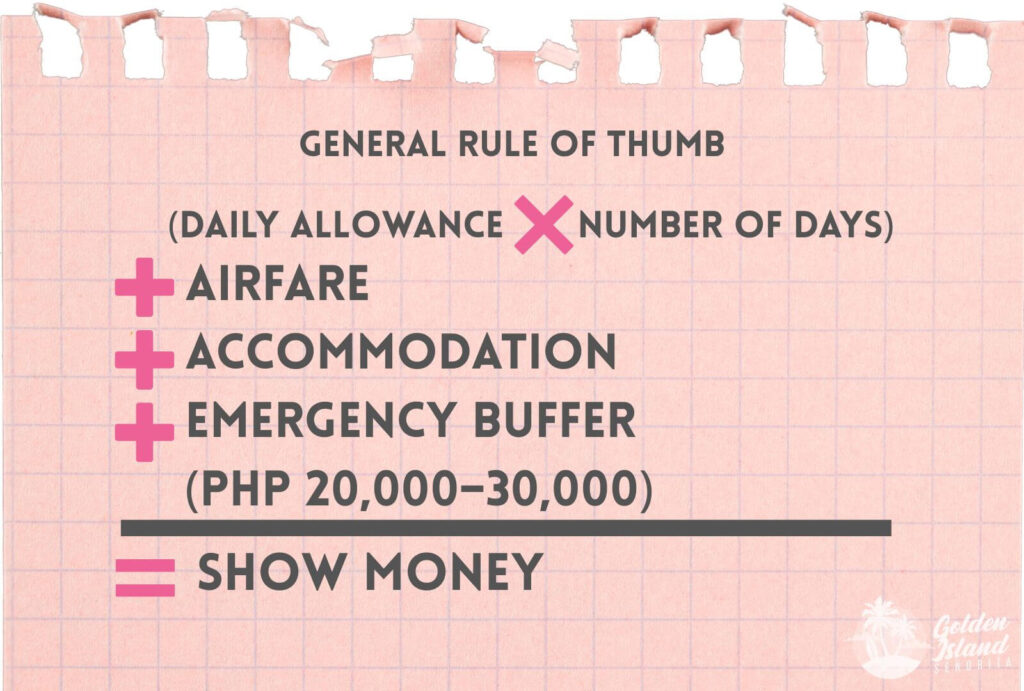
General Rule of Thumb
When in doubt, a good formula is:
Where Should This Show Money Come From?
Let’s be real — visa officers aren’t easily fooled, and when it comes to your show money, the source matters just as much as the amount.
Spoiler Alert: It Should Be YOUR Money.
Your show money should ideally come from your own, legitimate sources of income. Why? Because embassies are trained to spot suspicious financial activity. If you suddenly drop a huge amount into your bank account right before your visa application, it’s not going to impress them — it’ll raise red flags instead.
Here’s what to avoid:
 Last-Minute Lump-Sum Deposits
That sudden PHP 200,000 you deposited last week? Yup, it looks fishy. Visa officers will wonder: Where did this come from? Why just now? If they think it’s staged, they may doubt the rest of your documents too.
Borrowed Money
You might think, “I’ll just borrow from my friend or relative and return it after I get the visa.” But hold up — embassies often see through this. If your account history doesn’t match your financial documents or lifestyle, it’ll be obvious something’s off.
Fake Documents
Never, ever submit fabricated bank statements or certificates. Not only will this get your visa denied, but you could also face a travel ban or legal consequences. Embassies cross-check information more than you think.
So Where SHOULD Your Show Money Come From?
 Your Regular Salary
If you’re employed, your payslips and bank transactions should reflect your income over time.
Business Income
For entrepreneurs or freelancers, your account should show steady deposits from clients or sales, backed up by business permits or invoices.
Savings
If you’ve been saving up for this trip, that’s great! Just make sure your account shows a clear pattern — consistent savings build trust.
Remittance from Family Abroad
If your parents or a sibling are helping fund your trip, that’s okay too — but provide proof of remittance and your relationship with them.
Passive Income
Rental income, dividends, or side gigs are all valid sources of show money, as long as they’re well-documented.
Bottom line?
Your show money should make sense when viewed in the bigger picture of your life — your job, your lifestyle, your travel plans. Consistency and transparency are key. Think of your financial documents as your personal story — and make sure it’s one the visa officer can trust.
How Long Should the Show Money Be in Your Account?
Most embassies ask for your bank statements from the last 3 to 6 months.
So your show money shouldn’t magically appear just a week before applying. Instead:
- Maintain a healthy balance over time
- Avoid sudden, huge deposits
- Keep your bank activity steady and believable
Think of your account like a diary. Visa officers are reading it!
What If I’m Sponsored?
No problem! If someone else is paying for your trip (like your boyfriend, fiancée, parent, company, or friend abroad), the embassy will want to see:
- Sponsor’s Bank Statement and/or Certificate
- Affidavit of Support
- Their passport/visa/residency proof
- Proof of relationship
Even with a sponsor, you should still show some show money of your own to prove you’re financially responsible.
Common Misconceptions About Show Money
Let’s bust some myths, shall we?
Myth #1: I Need to Be Rich
Nope. You just need to show enough money to reasonably cover your trip. A modest budget with real proof is better than a bloated account with shady deposits.
Myth #2: I Can Just Borrow Money Temporarily
Embassies spot this quickly. If you deposit PHP 300,000 two days before printing your bank cert — red flag!
Myth #3: A Fat Bank Account Guarantees Visa Approval
Wrong again! While show money is important, visa officers also look at:
- Your travel history
- Strong ties to your home country
- Purpose of travel
- Your employment or business stability
- Previous visa rejections (if any)
So show money is just one piece of the puzzle.
How to Strengthen Your Show Money Proof
Here’s what you can do to make your financial docs work harder for you:
1. Maintain a Consistent Balance
A steady account with regular salary or business income is ideal.
2. Avoid Suspicious Deposits
Large, unexplained deposits are red flags. Spread them out.
3. Include Proof of Source
Salary slips, remittance receipts, or business income statements that match your bank transactions help verify your show money.
4. Add Supporting Docs
Your itinerary, employment certificate, income tax return, and even a letter of explanation can add context and strengthen your case.
What If I Don’t Have Enough Show Money?
Here are your options:
Option 1: Get a Sponsor
If a family member, employer, or partner is willing to sponsor you, gather the required documents we mentioned earlier.
Option 2: Delay Your Application
Wait 3–6 months to build up your show money steadily. Visa officers prefer genuine account activity.
Option 3: Shorten Your Stay
Planning a 30-day Euro trip but your budget says 10 days? Adjust your itinerary. Less stay = less show money needed.
Option 4: Add Other Assets
Land titles, investment accounts, car ownership, or business permits can all help paint a picture of financial stability.
Real Talk: Sample Scenarios
Applicant A: Budget Europe Trip
- 10 days in Paris and Amsterdam
- Total trip cost: PHP 130,000
- Bank account: PHP 150,000, stable for 6 months
Visa likely approved — realistic, consistent, supported itinerary
Applicant B: First-time Traveler to the US
- Wants to stay for 3 months
- Show money: PHP 300,000 deposited 2 weeks ago
- No job, no strong ties
Visa likely denied — suspicious deposit, no ties, unclear plans
TL;DR — Show Money Checklist
| Must-Haves | Avoid These |
|---|---|
| Steady balance for 3–6 months | Sudden large deposits |
| Bank Certificate & Statement | Fake or edited documents |
| Proof of income/savings | Overstated or unrealistic budgets |
| Sponsor documents (if any) | Applying without preparation |
| Itinerary that fits your funds | Weak travel purpose or no clear plan |
Final Thoughts
“Show money” isn’t just about showing off. It’s about showing that you’re financially prepared, responsible, and honest. It tells the embassy, “Hey, I can afford this trip and I’m definitely coming back.”
So, be strategic but sincere. Build your finances over time, gather proper documents, and be transparent. That’s the best combo to turn your travel dreams into visa stamps.
Now go secure that bank statement, calculate your show money, and get that visa approved!
