

SAGADA, MOUNTAIN PROVINCE: A Comprehensive Travel Guide (with 2-Day Itinerary)
Everything I wish someone had told me before my first bus ride up the Halsema Highway — the caves, the coffins, the coffee, the cost of it all, and the small-town rules that keep Sagada so quietly magical.
~1,500m
Elevation
~11,500
Population
Nov–Apr
Best Season
₱ PHP
Currency
Kankana-ey
Local Language
Table of Contents
The “Why Go” Factor
Sagada does not try very hard to impress you, and that is exactly why it does. There is no grand entrance, no welcome arch lit up in neon — just a bus easing down a ridge at dawn, pine trees leaning into the fog, and a town so quiet you can hear the roosters from three barangays over.
I have gone back to Sagada more times than I can count on one hand, and every single time, that first glimpse of the valley through the mist still gets me a little emotional. It sounds dramatic for a small mountain town in the Cordilleras. It is not. Sagada is simply one of those rare places that feels exactly like its reputation, and then some.
Here is the honest “why go” of it: Sagada is where the Philippines trades its beaches for pine forests and its jeepney jams for a 9 p.m. curfew. It is a limestone wonderland riddled with caves you can climb through by lamplight, a cliffside cemetery where coffins hang from rock faces as a living, still-practiced tradition, a sunrise so famous for its sea of clouds that people set alarms for 4 a.m. without complaint, and a food scene that runs on lemon pie, mountain-grown coffee, and slow-cooked smoked pork.
It is also, refreshingly, a town that has decided it would rather stay small and dignified than become the next overrun tourist strip. That tension — between wanting to share Sagada with you and wanting to protect what makes Sagada worth sharing — shapes almost everything about visiting here, and I think that is part of the charm.
This guide is the one I would hand a friend before their first trip to Sagada: the history and culture that make the town what it is, the logistics of actually getting up that mountain, a full rundown of what to see and eat, sample itineraries, a real budget breakdown, and the honest truths — scams to dodge, crowds to avoid, rules to respect — that most glossy travel posts skip. Let us get into it.
THE BASIC, UP CLOSE AND PERSONAL
Getting Acquainted with Sagada, Mountain Province
Before we get to caves and itineraries, it helps to know what Sagada actually is: a small, landlocked municipality tucked into the southern part of Mountain Province, within the Cordillera Administrative Region of northern Luzon. It is not a resort town built for tourism — it is a working farming community that tourism has grown around, and understanding that distinction changes how you experience Sagada.
Brief History
Long before Sagada appeared on anyone’s bucket list, it was home to Kankana-ey-speaking Igorot communities organized around the dap-ay, a communal council ground that still shapes decision-making in Sagada today. The Cordillera’s rugged terrain meant Sagada and its neighbors largely kept their autonomy through the Spanish colonial period, a point of quiet pride for many Igorot families.
Everything shifted in the early 1900s, when American Episcopal missionaries, most notably Reverend John Staunton, arrived and built the Church of St. Mary the Virgin — still standing, still active, and still one of Sagada’s most photographed landmarks. The missionaries introduced Western schooling and medicine, but Sagada’s indigenous customs never disappeared; instead, the town developed a genuinely rare blend of Anglican faith and older animist, ancestor-honoring traditions that coexist side by side. Sagada stayed a well-kept secret for decades, known mostly to backpackers and university students, until the 2014 indie film “That Thing Called Tadhana” sent domestic tourists flooding north, permanently changing how busy — and how regulated — Sagada would become.
Geography and Landscape
Sagada sits roughly 1,500 meters above sea level on karst limestone terrain, which is exactly why it is riddled with the cave systems it is famous for. Pine forests blanket the ridgelines, rice terraces step down the valleys, and the dramatic gorge of Echo Valley cuts below the town’s cliffside cemetery. Sagada is connected to the rest of the Cordillera by the Halsema Highway, also called the Mountain Trail — the highest highway system in the Philippines, a genuinely white-knuckle, genuinely gorgeous stretch of road.
Culture and Local Lifestyle
The people of Sagada are predominantly Kankana-ey and Applai Igorots, whose lifestyle still revolves around wet-rice terrace farming, backstrap-loom weaving, and communal labor traditions passed down through generations. The most striking cultural practice visitors encounter is the tradition of hanging coffins at Echo Valley and Lumiang Cave — an active, sacred burial custom, not a museum exhibit, where the dead are placed high on cliff faces or cave entrances to rest closer to their ancestors. Sagada asks, quite reasonably, that visitors treat these sites with the same hush and respect owed to any cemetery.
Demographics and Atmosphere
Sagada is home to roughly 11,500 residents spread across 19 barangays, according to the most recent census. It is a small enough community that the pace of life still runs on farming hours — up before dawn, home well before dark — and Sagada’s long-standing curfew ordinance (quiet hours generally from around 9 p.m.) keeps the town peaceful, safe, and refreshingly free of nightlife. The atmosphere in Sagada is warm but unhurried; nobody is in a rush to sell you anything, and that alone can feel like a small miracle after Manila.
Language and Communication
Kankana-ey is Sagada’s mother tongue, with a local Applai variation spoken in town. You will not need it to get by, though — Filipino (Tagalog) is widely understood, and English is spoken fluently by most people working in Sagada’s guesthouses, restaurants, and tour cooperatives. Still, a few Kankana-ey words (see the phrase list further down) tend to earn a genuine smile in Sagada.
Economy and Local Specialties
Agriculture anchors Sagada’s economy — terraced rice, root crops, and greenhouse vegetables grown on steep hillsides — alongside weaving, pottery, and mountain-grown arabica coffee as cottage industries. Tourism has become one of Sagada’s biggest income sources in the past two decades, supporting homestays, licensed guiding cooperatives (SEGA, SAGGAS, SETGO, KIGA, ASSETG, and BFTAMPGA for the northern barangays), and a small but beloved café scene.
Key Attractions Preview
A quick teaser before the full rundown: Sumaguing Cave and its underground cathedrals of limestone, the hanging coffins of Echo Valley, the sunrise sea of clouds at Kiltepan Viewpoint, the cooling plunge pool at Bomod-ok Falls, the surreal blue-tinted soil of Kaman-utek, and Sagada’s own quietly excellent weaving h
TIMING IS RIGHT
Best Time to Visit Sagada, Mountain Province
Sagada’s dry season, from roughly November to April, is the sweet spot: skies are clearer, the famous sea of clouds at Kiltepan is at its most reliable, and nighttime temperatures dip into the cool teens or lower (pack that fleece). The rainy season, May through October, brings warmer, wetter days, and some Sagada attractions may close temporarily during heavy rain for landslide safety, so flexibility matters if you travel then. December through April is also Sagada’s busiest stretch, especially around Christmas, New Year, and Holy Week, when Baguio’s overflow crowds spill north.
Seasonal Event Calendar
| Month | Event | Notes |
|---|---|---|
| Late Jan – Early Feb | Etag Festival (Sagada) | Sagada’s own town fiesta celebrating etag, its smoked-pork specialty, with parades, trade fairs, and cultural dances over about four days. |
| Late Feb – Early Mar | Ubbaya Festival (Besao) | Neighboring town, easy day trip from Sagada. |
| Early–Mid March | Ayyoweng & Begnas Festivals (Tadian, Bauko) | Harvest thanksgiving festivals across Mountain Province. |
| First week of April | Lang-ay Festival (Bontoc) | Mountain Province’s founding-anniversary festival, staged in Bontoc about an hour from Sagada — street dancing, free traditional food, and a province-wide street party. |
| Holy Week (Mar/Apr, movable) | National holiday period | One of Sagada’s busiest weeks of the year — book everything early. |
| Dec 25 – Jan 1 | Christmas & New Year | Peak season; Sagada accommodations fill up weeks in advance. |
Public Holiday Heads-Up
On Philippine public holidays — New Year’s Day, Holy Week, Araw ng Kagitingan (April 9), Labor Day (May 1), Independence Day (June 12), Ninoy Aquino Day (Aug 21), National Heroes Day (last Monday of August), All Saints’/Souls’ Day (Nov 1–2), Bonifacio Day (Nov 30), and Christmas through Rizal Day (Dec 25–30) — banks, some shops, and government offices (including parts of Sagada’s own tourism office) may run limited hours, and buses to Sagada sell out fast. Build in buffer days around these dates.
ENTRY REQUIREMENTS
Do You Need a Visa to Travel to the Philippines?
For most travelers heading to Sagada, the answer is a relieving no. As of 2026, citizens of more than 150 countries — including the US, UK, EU nations, Australia, Canada, and most of Southeast Asia — can enter the Philippines visa-free for up to 30 days, provided they hold a passport valid at least six months beyond their stay and a return or onward ticket. That 30-day window is extendable at any Bureau of Immigration office, with a system flexible enough to allow cumulative stays of up to 36 months for those who keep renewing.
Travelers from India and China now receive a dedicated 14-day visa-free entry window under a newer framework, separate from the standard 30-day allowance. If your nationality is not on the visa-free list, you will need to apply for a 9(a) temporary visitor’s visa at a Philippine embassy or consulate before departure — plan for a couple of weeks of processing time.
One more thing worth doing before you fly: complete the Philippines’ electronic arrival registration (eTravel) within the window specified before landing, through the official government platform only — be wary of unofficial sites charging fees for something that should be free. Since Sagada itself sits far from any immigration office, sort your visa status in Manila or Baguio before heading up the mountain, not after.
logistics and infrastructure
Book the Flight (and Everything After)
There is no airport in Sagada — the nearest useful entry point is Ninoy Aquino International Airport (NAIA) in Manila, or Clark International Airport north of the city if you are flying a budget carrier. From there, reaching Sagada takes real commitment, which honestly makes arriving feel earned.
Getting There
- Direct overnight bus: Coda Lines runs buses straight from its Cubao (Quezon City) terminal to Sagada, several times nightly between roughly 8 p.m. and 10:30 p.m. The trip takes 9 to 12 hours depending on traffic and road conditions, with fares generally ranging from about ₱760 for semi-deluxe seating up to ₱1,500 for the more comfortable super-deluxe class. This is the easiest way into Sagada if you would rather sleep through the drive than break the journey in Baguio.
- Via Baguio: Take any of the frequent Manila–Baguio buses (around 5–6 hours), then transfer at Baguio’s GL Trans or Lizardo Transit terminals for the onward leg to Sagada — a spectacular but winding 6-hour ride along the Halsema Highway, priced around ₱390–450. GL Trans runs more frequent departures than Lizardo, but both stop taking passengers by early afternoon, so arrive in Baguio well before noon if you are making the same-day connection to Sagada.
- Private car or hired van: About 7 hours from Manila via Baguio, useful for groups splitting the cost, and the most flexible option for stopping at viewpoints along the way.
Getting Around (Once You’re in Sagada)
Sagada’s town proper is compact enough to explore on foot, and honestly, walking it is half the charm. For anything farther out — Bomod-ok Falls, Kiltepan, Blue Soil Hill — tricycles, hired vans, or habal-habal motorbikes arranged through your homestay or the Tourist Information Center are the way to go. There is no Grab, Uber, or Bolt operating within Sagada itself (those apps work fine back in Manila or Baguio, but the signal and infrastructure up the mountain simply do not support ride-hailing yet), so budget a little more patience — and a little more trust in your guide’s tricycle driver cousin — for local transport.
Visas and Entry Requirements — Quick Recap
Covered in full above: most nationalities get 30 visa-free days in the Philippines, extendable at any Bureau of Immigration office; complete eTravel registration before landing; sort documentation in Manila, since Sagada has no immigration services of its own.
Budgeting — the Short Version
Sagada is not an expensive destination by international standards, but transport eats a bigger share of the budget than food or lodging because of the long overland journey. Expect the trip to Sagada itself (round-trip bus fare) to be your single biggest line item after accommodation for multi-day stays. A full, itemized budget breakdown — for solo travelers and for groups — is laid out later in this guide.
Get Travel Insurance — a Firm Reminder
Please don’t skip this one
I say this as someone who has been elbow-deep in limestone mud inside Sumaguing Cave: Sagada is remote-hiking, cave-crawling, cliff-adjacent territory, and the nearest full-service hospital is in Baguio, roughly six winding hours away (Bontoc’s smaller provincial hospital is closer, about an hour, for basic care). Private healthcare and emergency evacuation in the Philippines can be genuinely expensive without coverage, and a twisted ankle deep in a cave system is a very different problem than a twisted ankle on a city sidewalk.
Travel insurance with SafetyWing Nomad Insurance is worth arranging before you leave home — it is built for exactly this kind of remote, activity-heavy travel, covering emergency medical care and evacuation if a Sagada trek or cave tour goes sideways. It is inexpensive relative to the peace of mind, and in a town with one shared ATM and a six-hour drive to the nearest big hospital, that peace of mind is worth a lot.
curated itineraries and activities
Explore Sagada, Mountain Province
This is the heart of any Sagada trip — the caves, falls, and viewpoints that make people fall in love with this town. Every attraction below (except the church and cemetery) requires a licensed local guide by municipal ordinance, arranged through the Sagada Tourist Information Center, so start there on arrival.
Places to Visit in Sagada, Mountain Province — Top Experiences
🕯️Echo Valley & Hanging Coffins: Sagada’s most sacred landmark
A short, guide-led walk from the Church of St. Mary the Virgin down into Echo Valley reveals Sagada’s hanging coffins — centuries-old and still-practiced burial sites where coffins rest on cliff faces above the gorge. Silence is genuinely expected here; this is an active cemetery, not a photo backdrop.
🕳️ Sumaguing Cave & the Cave Connection: Sagada’s underground cathedral
Sumaguing is Sagada’s showpiece cave — vast limestone chambers, cascading rock formations, and the famous “Queen’s Curtain” flowstone. Ambitious travelers can attempt the Cave Connection, a 4–6 hour spelunking traverse linking Lumiang Cave (itself home to stacked coffins near its mouth) through to Sumaguing, involving rope descents, rock scrambles, and cold-water wading. Not for the claustrophobic, but unforgettable.
☁️Kiltepan Viewpoint: Sagada’s sea of clouds
Set an alarm for around 4:30 a.m. Kiltepan’s sunrise, when conditions align, delivers a genuine sea of clouds rolling through the valley below — one of Sagada’s most Instagrammed and most earned moments. Bring a jacket; it is cold up there before the sun clears the ridge.
💧Bomod-ok Falls: Sagada’s “Big Falls”
A moderate 45-minute to 1.5-hour trek from Barangay Banga-an leads to a broad, crashing waterfall with a genuinely swimmable pool at the bottom. Bring a change of clothes and expect the walk back up to be the real workout.
🟦 Kaman-utek (Blue Soil Hill) & Marlboro Hills: Sagada’s surreal, sunrise-only trail
An early pre-dawn trek (often starting around 4 a.m.) rewards you with rolling pine-topped hills, a chance at another sea-of-clouds view, and a genuinely strange patch of blue-tinted soil. Long, worth it, and best paired with a packed breakfast.
🖼️ Ganduyan Museum & Sagada Weaving: Sagada’s cultural memory, indoors
A small but rich museum of Kankana-ey and Applai artifacts, plus a working weaving house where you can watch backstrap looms in action and pick up genuinely handmade textiles — no guide required for either stop.
Hidden Gems
Once you have ticked off the headline stops, Sagada rewards travelers who wander a little further: the quieter Fidelisan Rice Terraces (a barangay of Sagada itself, and arguably as striking as Batad’s, minus the crowds), the smaller Bokong Falls closer to town, a visit to a family-run coffee farm to see arabica cherries drying in the sun, and the village of Latang, tucked further along the ridge with sweeping, largely tourist-free views.
Interactive Map — Sagada at a Glance
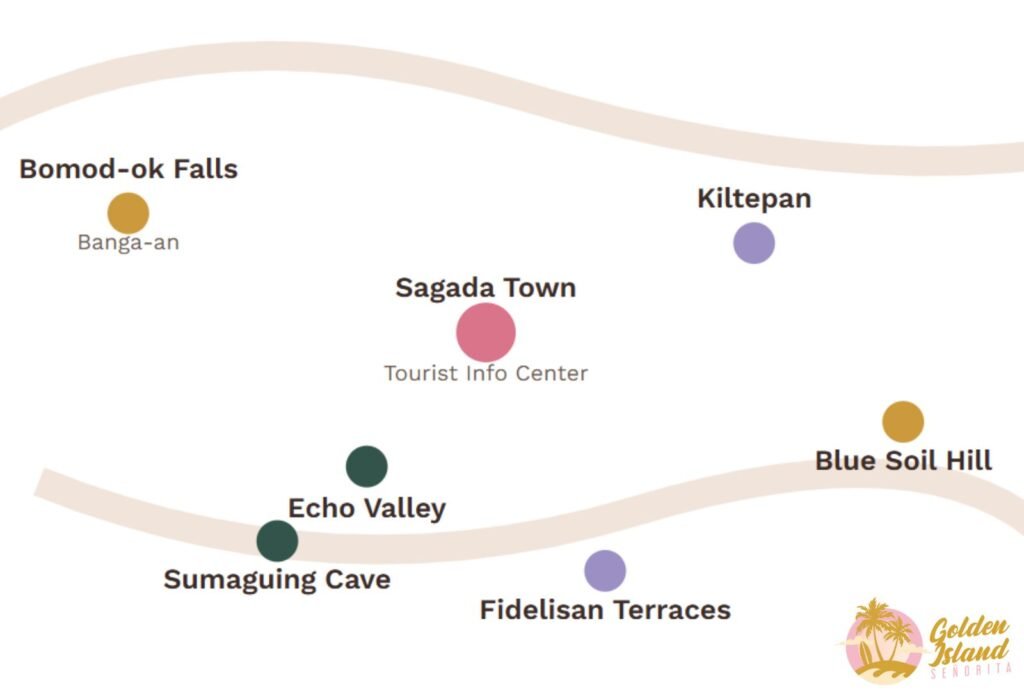
Sample Itineraries
Sagada rewards slow travel, but here is how to make the most of one, two, or three days, from someone who has regretted rushing it before.
The 1-Day Sagada Sprint
Food to Try in and near Sagada, Mountain Province
Local and Traditional Dishes
- Etag — Sagada’s signature salt-cured, smoked pork, aged for months and stewed into hearty mountain dishes. It is the namesake of Sagada’s own annual festival and worth trying at least once.
- Pinikpikan — a ceremonial Cordilleran chicken-and-etag soup, smoky and deeply savory, traditionally prepared through a specific ritual method; many present-day Sagada eateries now use more conventional, animal-welfare-conscious preparation while keeping the same smoky, comforting flavor.
- Sagada arabica coffee — grown on the surrounding mountainsides, often roasted locally, and occasionally offered as the rarer, pricier civet (“alamid”) coffee.
- Lemon pie — Sagada’s most famous dessert, a tangy, meringue-topped slice best known from the Yoghurt House, practically a rite of passage.
- Heirloom mountain rice — unpolished red and pink rice varieties grown on Sagada’s own terraces, nuttier and heartier than lowland white rice.
- Tapuy — traditional Cordilleran rice wine, best enjoyed responsibly and within Sagada’s quiet-hours ordinance.
Meal Structure — How Sagada Actually Eats
Sagada runs on a farming clock, and its 9 p.m. curfew shapes the whole day’s eating rhythm. Breakfast happens early, often before 7 a.m., especially if you are chasing a sunrise trek. Lunch is Sagada’s biggest meal, and many restaurants ask for advance reservations for groups, so call ahead. Dinner wraps up early — most kitchens close well before curfew — so do not plan on a leisurely 9 p.m. dinner in Sagada; aim for 6 or 7 instead. Homestay meals are often served family-style, a communal plate of rice, vegetables, and a protein like etag, which turns out to be one of the loveliest, most unscripted ways to experience local hospitality.
Regional Specialties Worth Seeking Out
Beyond the classics, look for Sagada orange marmalade, greenhouse-grown organic vegetables and salads (a legacy of the town’s cooler climate), fresh yogurt with local honey, and camote (sweet potato) as a humble, satisfying trailside snack. Sagada’s café culture — think Bana’s, Salt & Pepper Diner, Log Cabin, and Gaia Café — blends these Cordilleran ingredients into a genuinely good, farm-to-table, vegetarian-friendly menu that punches well above its small-town size.
Insider Tips and Recommendations
Notes from repeat visits
- Register at the Sagada Tourist Information Center the moment you arrive — it is the only place to legally arrange guides, and it sets the tone for every other stop on your itinerary.
- Weekday visits to Sagada mean shorter guide queues, quieter caves, and a genuinely different (better) experience of Kiltepan sunrise.
- Bring more cash than you think you need — Sagada’s ATM situation is genuinely limited.
- Book your Sagada accommodation in advance, especially for weekends; the local government enforces a no-reservation-means-next-day-only rule during peak periods.
- Pack a reusable water bottle; disposable plastic bottles are discouraged or outright restricted at several Sagada attractions.
Day Trips from Sagada, Mountain Province
Sagada makes an excellent base for exploring more of the Cordillera.
- Bontoc, about an hour away, has a small but excellent museum on Igorot culture and its own dramatic rice terraces.
- Banaue and Batad, home of the UNESCO-listed Ifugao rice terraces, are a longer but doable day trip (roughly 3–4 hours each way) for travelers with extra time.
- Besao, Sagada’s quieter neighbor, offers similar viewpoints with a fraction of the visitors, especially worthwhile during its own Ubbaya Festival.
- For serious trekkers, the trailheads for Mt. Pulag and the Kabayan Fire Mummies are reachable with an early start and a hired van, though both deserve a full day of their own rather than a rushed add-on.practical essentials
Practical Information and Tips for Your Sagada Trip
Internet & SIM Cards
Signal in Sagada is patchy and genuinely part of the town’s charm — Globe tends to edge out Smart in the town proper, but both drop out completely at caves, falls, and viewpoints. Most Sagada inns and cafés offer WiFi, though speeds are modest and shared. Buy a Philippine SIM or activate an eSIM before you head up the mountain, ideally while still in Manila or Baguio, since Sagada’s own SIM-loading options are limited.
Power & Electricity
The Philippines runs on 220–240V with flat, American-style two-prong outlets (Type A/B/C). Brief brownouts are not unheard of, especially during storms, so a power bank is genuinely useful for Sagada’s longer treks and cave tours, none of which have outlets along the way.
Transportation Micro-Tips
- Booking windows: The Coda Lines direct bus to Sagada should be booked 3–7 days ahead for weekends and holidays via their website, Klook, or Facebook page; weekday walk-up tickets are usually available but riskier in peak season. GL Trans and Lizardo Transit’s Baguio–Sagada buses are first-come, first-served at the terminal with no advance booking — arrive early.
- Transit apps: Grab works fine in Manila and Baguio, but there is no ride-hailing app coverage within Sagada itself — arrange tricycles, vans, or habal-habal rides through your homestay or the tourism office instead.
- Self-guided walking tour: Start at the Sagada Public Market near the Municipal Hall, walk to St. Mary the Virgin Church and the cliffside Sagada Cemetery, continue to the Echo Valley viewpoint edge for a respectful look at the Hanging Coffins from above, loop past Calvary Hill, and finish at Ganduyan Museum or a café on the main road. Roughly 2–2.5 hours, no guide required for this specific public loop — though it is always worth confirming current rules at the tourism office, since Sagada’s regulations do evolve.
Safety and Health
The nearest full-service hospital is in Baguio, about six hours away; Bontoc’s smaller provincial hospital, roughly an hour from Sagada, handles basic care. Cave routes involve wading, crawling, and rock-climbing in low light — disclose any relevant medical conditions to your guide beforehand. Mountain roads in and around Sagada are steep and winding, so pack motion sickness remedies if you are prone to it, and stick to bottled or filtered water.
Packing List
- Light rain jacket and warm layers (Sagada nights can dip into the low teens Celsius, December–February)
- Sturdy, grippy trekking shoes — Sagada’s cave floors are wet and slick
- A reusable water bottle
- Headlamp or flashlight as backup
- Dry bag or ziplock bags for your phone during caving
- Cash in small bills
- Power bank
- Modest clothing for the church and cemetery
- A valid ID for tourism registration
The “Know Before You Go” Reality Check
Common scams and hustles
- Unaccredited guides and homestays: Sagada’s local government has publicly suspended tour organizers for using stolen photos of legitimate properties online. Book directly through Sagada Inns and Hotels Association (SIHA)–accredited listings or confirm legitimacy at the tourism office before paying anything.
- The “photo op” fee ambush: Locals or children in traditional attire may pose for photos and then request payment afterward. Agree on whether you want the photo — and whether a tip is expected — before you take it.
- Unofficial fixers near bus terminals: Arrange guides and tours only through Sagada’s official Tourist Information Center, not through strangers offering “package deals” near the drop-off point.
- Cash shortages: Sagada has very limited ATM access, and machines run dry or queue up fast during peak periods. Bring more cash than you think you will need.
On over-tourism
Sagada’s weekends and holiday periods — especially December through April, Holy Week, and festival weeks — bring real congestion: full parking areas, long cave queues, and a shoulder-to-shoulder Kiltepan sunrise that loses some of its magic. If you can, visit midweek. If the headline spots feel overrun, consider quieter alternatives that carry the same spirit with far fewer crowds: the Fidelisan Rice Terraces within Sagada itself, neighboring Besao’s viewpoints, or a deeper detour to Barlig or Sadanga for travelers craving real off-grid trekking.
Useful Sagada Phrases for Travelers
English and Filipino will carry you through nearly any conversation in Sagada, but a few Kankana-ey words go a long way with locals.
| English | Kankana-ey |
|---|---|
| Hello / Good day | Sagada-ay algaw / “Ka-nemnem” |
| Thank you | Agyamanak |
| How are you? | Kumusta ka? |
| Delicious | Naimas |
| Beautiful | Napintas |
| Cold | Nalamiis |
| Goodbye | Mapan ak un |
Pronunciation and spelling vary by village elder and household — locals genuinely appreciate the effort far more than the accuracy.
Where to Stay near Sagada, Mountain Province
All legitimate Sagada accommodations should be registered with the Sagada Inns and Hotels Association (SIHA) and follow standard, non-negotiable pricing — a rule the local government enforces to protect both visitors and honest homestay owners.
| Type | Vibe | Nightly range (PHP) |
|---|---|---|
| Backpacker hostels | Dorm beds, shared bath, social common areas | ₱350–600 |
| Budget homestays | Private room, family-run, home-cooked meals available | ₱800–1,500 |
| Mid-range inns | Private bath, hot showers, mountain views | ₱1,800–3,000 |
| Higher-end lodges | Larger rooms, restaurants on-site, better heating | ₱3,500–6,000+ |
Homestays are, in my experience, the most memorable way to stay in Sagada — the chance to share a meal with a local family tends to teach you more about the town than any guided tour.
More Activities near Sagada, Mountain Province
- Extended spelunking beyond Sumaguing, including Balangagan Cave, for travelers who want more caving and fewer crowds.
- Mountain biking along Sagada’s ridge roads and rice-terrace paths.
- Stargazing — Sagada’s minimal light pollution and 9 p.m. curfew make for genuinely excellent night skies.
- Coffee farm tours, walking the arabica groves that supply Sagada’s cafés.
- Weaving and pottery workshops, hands-on sessions with local artisans.
- Quiet retreats — several Sagada guesthouses lean into yoga, journaling, or simple slow mornings with a view.
culture and etiquette
Culture and Etiquette in Sagada
Local Customs
Sagada’s Hanging Coffins and Echo Valley are active burial grounds, not tourist installations — never touch a coffin, never enter Lumiang or Sumaguing without a licensed guide, and keep your voice down as you walk through. Ask permission before photographing elders or anyone in traditional dress, and dress modestly when visiting St. Mary the Virgin Church and the Sagada Cemetery.
Sustainability Tips
- Carry a reusable bottle; several Sagada sites discourage or restrict single-use plastics.
- Book licensed Sagada guides and SIHA-accredited stays so tourism income actually supports the community.
- Buy weaving, pottery, or coffee directly from Sagada artisans rather than resellers elsewhere.
- Pack out what you pack in, and use designated waste points only.
Estimated Budget for a Sagada Trip
Figures below are per-day estimates in Philippine Pesos (roughly ₱61 = US$1 as of 2026, though rates fluctuate), covering accommodation, food, local guide/environmental fees, and in-town transport — not the round-trip journey to Sagada itself, which is covered separately in the Getting There section.
Individual Traveler — per day
₱1,200 – ₱3,500
- Backpacker/budget: ₱1,200–1,600 (hostel bed, local meals, shared guide fee)
- Mid-range: ₱2,000–2,800 (private room, café meals, private guide share)
- Comfort: ₱3,000–3,500+ (upgraded lodge, restaurant meals, private transport)
₱100 environmental/registration fee and optional ₱50 accident insurance apply once per visit, on top of the above.
Group of 4 — per person, per day
₱900 – ₱2,600
- Guide fees for caves, falls, and treks are charged per group (often up to 6–10 pax), so splitting them across four people meaningfully lowers everyone’s daily cost.
- Shared vans for out-of-town stops (Bomod-ok, Kiltepan) also divide down nicely for groups.
- Homestay rooms booked for 3–4 people often run cheaper per head than solo hostel beds.
| Item | Solo traveler | Group of 4 (per person) |
|---|---|---|
| Accommodation (2 nights) | ₱1,600–3,600 | ₱1,200–2,600 |
| Meals (3 days) | ₱1,500–2,700 | ₱1,500–2,700 |
| Guides & environmental fees | ₱1,500–2,500 | ₱600–1,200 |
| Local transport (tricycles/vans) | ₱500–1,000 | ₱300–600 |
| Estimated total | ₱5,100–9,800 | ₱3,600–7,100 |
closing thoughts
Final Thoughts
I have tried, in this guide, to give you both the practical bones of a Sagada trip and the feeling of the place itself — because Sagada is not really about ticking off Sumaguing Cave or Kiltepan sunrise on a list. It is about the quiet: the curfew that forces you to slow down, the guides who talk about the hanging coffins with real reverence rather than a rehearsed script, the lemon pie eaten a little too fast after a cold morning trek.
Sagada asks a bit more of its visitors than most destinations do — a longer bus ride, a mandatory guide, an early curfew, real respect for sacred ground — and in return, it gives back something increasingly rare: a place that still feels like itself. Go gently, go with cash in your pocket and a reusable bottle in your bag, and Sagada will very likely ruin you a little for every place that comes after it.
safe travels, and see you on the mountain.
This guide reflects conditions as of 2026. Sagada’s fees, schedules, and tourism rules do evolve — always confirm current details at the Sagada Tourist Information Center on arrival.

Polly Amora
Polly Amora is the señorita behind GoldenIslandSenorita.Net. A corporate warrior by day, and a perpetual explorer by heart. She is a lifelong learner who is very outgoing, speaks four languages, loud & outspoken, and loves to have adventures in the mountains, on the beach, and in the city. You can throw her anywhere, and she'll handle it like a pro. Ice cream and bourbon are two of her weaknesses.


28 Comments
Chique
What a wonderful group of friends you have. I love everything about this amazing journey!
Explorethe6
This looks like an amazing trip. I didn’t know the history behind the hanging coffins. I’d love to explore those caves too.
Esme Sy
I hope more people can see this post and be able to experience going to this place. I’ve only visited this once and it’s sad that I wasn’t able to fully maximize my stay due to bad weather but I would very much like to return ASAP!
pujarinimitra
You guys seem to have had a lot of fun as a group. I an quite intrigued by the hanging coffins. Do you know why they would bury only the married and with grand children?
Ana Vukosavljevic
I would love to go on a trip like this one!! It looks like you guys had so much fun, you could see the energy thourgh the pictures!!