
My Life-Changing Cancer Scare: What I Learned About Faith, Fear, and Finding Strength
October is Breast Cancer Awareness Month — and this October, my world got flipped upside down.
Like every year, I went in for my routine scans and doctor visits — but this year felt different. It was the most surreal experience I’ve ever had. I want to share what it’s really like to go through a cancer scare — the racing thoughts, the creeping fear, the long waits, and the small lessons that quietly sneak in along the way. I’m not writing this as a medical professional, but as a woman who suddenly found herself sitting in her car after a routine scan, struggling to catch her breath and wondering what might come next.
This is my story — and maybe, just maybe, it can help someone out there facing their own cancer scare feel a little less alone.
The Ultrasound That Changed Everything
I’ve always been diligent about my health. Twice a year, I see my doctors and have my routine ultrasounds — part of my personal checklist to stay on top of things. It’s become almost mechanical at this point: go in, lie down, gel on the skin, quick scan, and a calm “everything looks stable” from the radiologist. Nothing dramatic. Nothing that hinted at what was coming.
But this time, things were different.
The radiologist took longer than usual. I could tell she was focused — too focused — her eyes darting between the screen and the images, occasionally pressing the probe a little longer on one area. The silence was loud. As a former nurse, I’ve seen that kind of quiet concentration before. It’s the kind that says, “I don’t want to alarm you, but I see something.”
When she finally spoke, her tone was gentle but cautious. “You should bring these ultrasound pictures to your doctor,” she said. No reassuring “everything’s stable” this time. Just that one sentence — and in that moment, my heart sank.
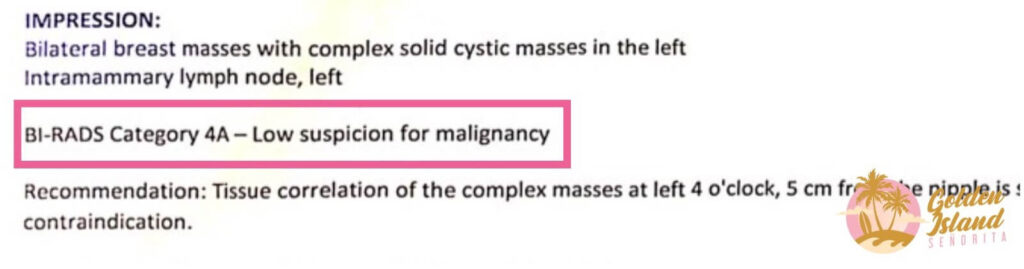
The next day, when I saw my results, everything made sense. BI-RADS Category 4A: Low Suspicion for Malignancy. Low suspicion — but suspicion nonetheless. That single line was enough to send my mind into overdrive. I knew exactly what it meant: they’d found something that didn’t look entirely benign, and a biopsy was needed to be sure.
And that’s when I entered the world of what many call a cancer scare — the in-between space where you’re not diagnosed, but not cleared either. It’s a strange and terrifying limbo that tests your patience, your logic, and your faith all at once.
I knew my risks — my age, my family history, the fact that I’ve never given birth. I rarely drink now (I partied well enough in my 20s, trust me) and I stopped smoking over a decade ago. I’ve tried to live as healthy as possible. But when you’re suddenly staring at the word “malignancy,” none of that seems to matter. You realize how fragile control really is.
In this article, I want to share what it’s like to go through a cancer scare — the thoughts, the fear, the waiting, and the lessons. Not as a medical professional, but as a woman who found herself sitting in her car after a routine scan, suddenly unable to breathe properly.
This is my story — and maybe, it’ll help someone out there facing their own cancer scare to feel a little less alone.
Understanding My Diagnosis — What BI-RADS Category 4A Really Means
When my doctor handed me the report, I didn’t even need to scan for the medical jargon — my eyes went straight to the bold text near the bottom:
BI-RADS Category 4A — Low Suspicion for Malignancy.
That single line might look cold and clinical to anyone else, but for me, it shouted louder than anything else on the page. I knew what it meant. Low suspicion doesn’t mean no suspicion. And when a doctor recommends a biopsy, it means they saw something worth checking twice — or three times.
For those who aren’t familiar, BI-RADS stands for Breast Imaging Reporting and Data System — a standardized way radiologists categorize breast imaging findings. It’s meant to help doctors communicate clearly and ensure patients get the right follow-up.
There are several BI-RADS categories, and each one tells a story:
- Category 0: Incomplete — they need more images.
- Category 1: Negative — everything looks normal.
- Category 2: Benign — no sign of cancer.
- Category 3: Probably benign — less than 2% chance of malignancy; usually just needs follow-up.
- Category 4: Suspicious abnormality — biopsy recommended.
- Category 5: Highly suggestive of malignancy.
- Category 6: Known biopsy-proven malignancy.
So, where did I land? Right in the middle of that gray zone — Category 4A, the lowest level of suspicion under the “suspicious” category. Statistically speaking, that means about a 2–10% chance of cancer.
Now, let’s be honest: when you’re the person reading that number, logic doesn’t help much. Whether it’s 2% or 10%, all you see is the word malignancy. You can know every fact in the book, but when it’s your own name on the report, your heart doesn’t care about probabilities.
I remember staring at the paper and thinking, “Okay, so there’s a 90% chance this isn’t cancer… but what if I’m the 10%?” That’s how the cancer scare takes root — it doesn’t need certainty. Just the whisper of what if? is enough to set off a full-blown emotional storm.
Still, the nurse in me refused to let panic win. I knew the process: a biopsy would confirm what that shadow on the ultrasound really was. It’s the only way to know for sure. The rational part of my brain reminded me that BI-RADS 4A often ends up being benign — things like fibroadenomas or cysts that just happen to look suspicious.
But then there’s the human part of me — the one who still lay awake at 3 a.m. replaying that ultrasound scene, the one who Googled every worst-case scenario despite knowing better. (If you’ve ever gone through a cancer scare, you know that “Do not Google it” advice goes straight out the window.)
What made it harder was that I’d seen this from both sides. As a nurse, I’d been in rooms where patients were told they needed a biopsy. I remember how their faces would fall, how I’d reassure them that “it’s just to be safe.” Now, sitting on the other side of that conversation, I finally understood that no amount of medical rationalization can erase the uncertainty.
A cancer scare is more than just a health issue — it’s an emotional ambush. It makes you hyper-aware of your own mortality, your body, your choices. Suddenly, you start questioning everything: Did I eat too much processed food? Should I have gone for my check-up earlier? Is this something I could have prevented?
That’s the cruel irony of being health-conscious — the more you know, the more your mind can spiral.
But here’s what I kept reminding myself: A BI-RADS 4A result is not a cancer diagnosis. It’s a cautious step. It’s your medical team saying, “We just want to be absolutely sure.” And if you’re facing the same thing, please hold onto that.
Yes, it’s terrifying. Yes, your brain will jump to the worst-case scenario. But remember — early detection is your greatest weapon, and this kind of thoroughness is actually a blessing in disguise.
By the end of that appointment, I had a biopsy schedule in hand and a knot in my stomach the size of a grapefruit. The logical side of me understood it was routine, but the emotional side couldn’t help but whisper, What if this is the start of something big?
That’s the strange limbo of a cancer scare — your life doesn’t stop, but your thoughts do. You still go to work, you still answer emails, you still laugh with friends, but somewhere deep inside, there’s this quiet, persistent hum of fear.
And so began the longest few weeks of my life — the waiting period between the biopsy and the results. I told myself I was fine. I told myself to stay calm. But the truth is, no amount of self-talk could silence the what-ifs.
The Waiting Game — Managing the Fear and “What Ifs”
During my appointment, I told my doctor that I wanted to schedule the biopsy as soon as possible. I didn’t even hesitate — I just needed answers. Waiting around, imagining every worst-case scenario, wasn’t an option for me. Thankfully, she checked her schedule and said she had an open slot the very next day. Without a second thought, I took it.
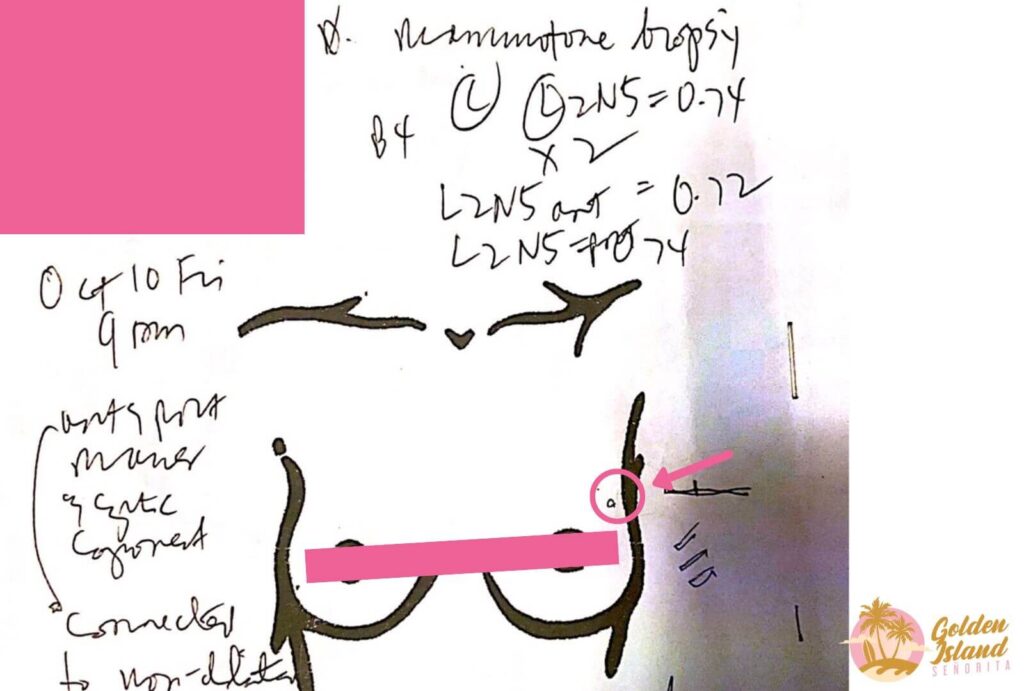
I’m not the type who likes to sit and stew in anxiety; I’d rather face things head-on. So that’s exactly what I did. The procedure was called a Mammotome biopsy, a minimally invasive test that uses a hollow probe to collect tissue samples. I’d read about it before in my nursing days, but it feels entirely different when you’re the one lying on the table instead of assisting beside it.
In that moment, I reminded myself that knowledge is power — and this was me taking control of my own story.
If I had to describe the days between the biopsy and the results, I’d say it felt like living in slow motion — like time decided to play a cruel trick on me. Every minute stretched endlessly, every notification from my phone made my heart jump, and every quiet moment gave my mind another chance to spiral.
That’s the thing about a cancer scare — it’s not just the physical tests or procedures that drain you, it’s the waiting. The silence between steps. The endless, uneasy pause where your brain becomes both your best friend and your worst enemy.
I tried to keep things normal. I went to work. I answered emails. I chatted with friends like nothing was wrong. But beneath the surface, I was constantly bargaining with myself. “It’s probably benign,” I’d say one moment — and the next, “But what if it’s not?”
The what-ifs are merciless. They creep in at the quietest hours — when you’re brushing your teeth, lying in bed, scrolling through social media pretending you’re fine. Suddenly, every little ache or twinge in your body feels suspicious. Every mention of “breast cancer awareness” on TV feels like a sign from the universe.
And as someone with a medical background, it was both a blessing and a curse. I knew too much to be comforted by vague reassurances. I understood the processes, the risks, the survival rates. But knowledge doesn’t always calm fear — sometimes, it sharpens it.
I remember the day of the biopsy vividly. The sterile smell of the room. The way the nurse smiled just a little too kindly. I lay there, staring at the ceiling, doing breathing exercises to steady myself. “It’s routine,” I kept repeating in my head. “It’s just confirmation.”
But when they numbed the area and I heard the faint click of the needle, my composure cracked for a moment. Because in that instant, I wasn’t the nurse anymore. I was the patient. The one lying on the table, praying silently that this would all end up being nothing more than a cancer scare.
The days that followed felt like a strange mix of normal and nightmare. I’d go about my routine, but there was always this low hum of anxiety beneath everything. It was like background noise I couldn’t turn off. I’d catch myself checking my phone constantly, half-dreading, half-hoping for a call from my doctor.
When people talk about bravery, they often imagine grand gestures — facing danger head-on, staying calm under pressure. But the truth is, bravery during a cancer scare is quieter. It’s getting out of bed when you’d rather hide. It’s eating breakfast even when your stomach’s in knots. It’s choosing to show up to work, to smile at others, to pretend you’re okay when your brain feels like it’s imploding.
I had moments when I broke down — quietly, privately. I’d cry in the shower or in my car, then wipe my face and remind myself, “You’ve got this.” Because that’s what you do when you’re scared but don’t want to let the fear win.
Still, I won’t lie — I spiraled a few times. I went down the rabbit hole of online forums, reading stories of women who started with the same diagnosis. Some had benign results, others didn’t. And even though I knew comparing my situation to strangers on the internet was the worst thing I could do, I couldn’t stop. A cancer scare has this sneaky way of making logic optional.
So I tried to channel that energy into control — the one thing I could cling to. I journaled. I prayed. I limited my social media (because nothing good comes from doomscrolling at 2 a.m.). I even did something I hadn’t done in a while — I called close friends and actually talked. Not the superficial “I’m fine” kind of talk, but the raw, honest, “I’m terrified and I need to say it out loud” talk.
And that helped. Not the talking itself, but the reminder that I wasn’t alone. Because that’s another cruel thing about a cancer scare — it makes you feel isolated, even when you’re surrounded by people. But once I started opening up, I realized how many others had been through the same thing. Different details, same fear. Same waiting. Same prayers.
What I learned in that stretch of uncertainty is that life doesn’t pause for your fear. Bills still need to be paid. Work still piles up. The world keeps spinning. So, you learn to move with it, even if every step feels heavy.
But you also learn the art of surrender — of accepting that some things are beyond your control. That sometimes, all you can do is show up, take the tests, and trust that whatever the result, you’ll handle it.
And if you’re in that same waiting period right now — waiting for results, waiting for clarity, waiting for peace — please know this: you’re not weak for being scared. You’re human. A cancer scare doesn’t just test your health; it tests your spirit. But it also reveals something beautiful — that even in fear, there’s resilience. Even in uncertainty, there’s strength.
When I finally returned to the hospital to get my biopsy results, my hands were shaking as I reached for the familiar Manila envelope. That moment — the one you brace for, the one you’ve rehearsed in your mind a hundred different ways — somehow manages to be both the longest and shortest second of your life.

I opened it slowly, my heart pounding so loudly I could hear it in my ears. And then I saw it: “Microcalcifications Present in Non-Neoplastic Ducts.”
For a second, I just stared, letting the words sink in. Then the relief hit me — powerful, overwhelming, almost dizzying. I finally exhaled, realizing it was the first real breath I’d taken in weeks. It was, indeed, just a cancer scare — a terrifying, humbling reminder of how fragile and precious good health really is.
But that relief didn’t erase what I’d just been through. It left a mark — a shift in perspective that would change how I saw my body, my priorities, and even my life.
Risk Factors and Reality Checks — Knowing My Body and My History
After the biopsy came back benign, my first reaction was pure relief — that kind of full-body exhale that makes your knees weak and your eyes well up. But once the adrenaline faded and the dust settled, I started reflecting.
I asked myself the same question everyone asks after a cancer scare: “Why did this happen?”
Not in the self-blaming way, but more like a quiet curiosity. Because when you’ve seen your own name next to the words suspicious for malignancy, you start viewing your body differently — not as something you control, but as something you negotiate with.
As a former nurse, I knew my risk factors — both the ones written in my DNA and the ones shaped by my lifestyle. I’m at that age where screenings become less of a precaution and more of a necessity. I also know that some risks, like genetics or reproductive history, are things you simply can’t undo with kale and positivity.
Let’s start with the obvious: I’ve never given birth.
Now, that fact alone isn’t a ticking time bomb, but it does matter statistically. Studies show that women who’ve never been pregnant or given birth have a slightly higher risk of developing breast cancer. Something about hormonal exposure and how breast tissue matures differently after pregnancy. Science, in short, can be brutally specific.
Then there’s family history. While no one in my immediate family has been diagnosed with breast cancer, I’ve seen enough chronic illnesses to keep me humble. Genetics can be sneaky — sometimes skipping generations, sometimes appearing out of nowhere.
I’ve also had my fair share of lifestyle adventures. I’ll admit it — I partied well in my twenties. There were nights of too much laughter and a bit too much alcohol and I like it strong. I don’t regret it, but I’ve definitely slowed down in recent years. I rarely drink now, and I kicked the habit years ago — which, thankfully, knocks out one major risk factor.
Still, during my cancer scare, I found myself doing mental math — adding up all my “maybes” and “could-have-beens.”
- Maybe it’s the stress I’ve been carrying.
- Maybe it’s the lack of sleep.
- Maybe it’s that one time I ate my feelings in fried form for two straight weeks.
You see, a cancer scare messes with your logic. You start connecting dots that may not even be in the same constellation. But in a strange way, that reflection can also become a gift — a push to be more mindful of your health, not out of fear, but out of respect for your body.
The truth is, some risk factors are modifiable, and some aren’t. You can’t change your age, your family history, or the fact that you’ve never had kids. But you can make daily choices that tip the balance in your favor — small, boring, consistent habits that protect your future self.
Here’s what I’ve committed to since my cancer scare:
- Regular Screenings – No more pushing appointments “to next month.” I keep my ultrasounds and mammograms like sacred calendar events. If something changes, I’d rather know early.
- Lifestyle Tweaks – I focus on balanced eating, not perfection. I still enjoy a glass of wine once in a while, but moderation is my new mantra.
- Movement Over Motivation – I stopped chasing motivation and started embracing consistency. Even a 20-minute walk counts. Movement keeps the body resilient and the mind clear.
- Mental Health Check-ins – Because anxiety doesn’t just live in your mind; it seeps into your body. Stress management is now as much a health priority as vitamins.
- Self-Awareness Without Obsession – I do regular self-breast exams, but I refuse to live in paranoia. There’s a fine line between being proactive and being consumed by fear.
The biggest realization from my cancer scare was that prevention isn’t about living perfectly — it’s about living consciously. It’s knowing your risks without letting them define you.
And let’s be real — no one is immune to health scares, no matter how disciplined they are. I’ve met women who eat organic everything, meditate daily, and still get that dreaded call. That’s the humbling truth: sometimes, it’s just the roll of the genetic dice.
But instead of letting that paralyze me, I’ve learned to see it as empowerment. Because knowledge — about your body, your habits, your risks — gives you agency. It allows you to take charge of what can be managed and make peace with what can’t.
My cancer scare didn’t just test my resilience — it reminded me of my responsibility to myself. To listen to my body when it whispers before it has to scream. To respect my limits. To treat wellness as a privilege, not a chore.
I can’t change my family history or rewrite my biology, but I can choose how I live with it. And that choice — that quiet, steady commitment — is how I take back control after something that once made me feel powerless.
The Aftermath
When I finally got my results and read the words “Microcalcifications Present in Non-Neoplastic Ducts.,” I cried. Not the dramatic, movie-style kind of crying — more like the quiet release of a breath I didn’t realize I had been holding for days. It wasn’t just relief. It was gratitude. Gratitude for early detection, for access to healthcare, and for the reminder that life doesn’t wait for us to be ready. It just happens.
That cancer scare changed me in ways I didn’t expect. Before it, I was diligent but detached — my checkups were just routine. After it, I started to truly listen to my body. I became more present, more attuned to what I eat, how I rest, and how stress quietly creeps in and settles where it shouldn’t. That scare wasn’t just a medical event; it was a wake-up call from my own body saying, “Hey, I’m doing my best. Help me out here.”
I also started to appreciate the small things again. The way my morning coffee smells. The laughter of people I love. The silence of an evening spent reading without doomscrolling. It sounds cliché, but when you’re confronted with the word “malignancy,” everything familiar becomes sacred.
That cancer scare reminded me that health isn’t a finish line — it’s an ongoing conversation between body, mind, and spirit. It’s not just about avoiding illness, but about nurturing yourself with intention. I learned to set better boundaries. To say no without guilt. To rest without apology. Because as women, we often give so much of ourselves to others that we forget we’re the ones keeping our own hearts beating.
When I shared my experience with friends, I noticed how many of them admitted to delaying their checkups. Some out of fear, others because life simply got too busy. And I get it — I really do. But if my cancer scare taught me anything, it’s that courage isn’t the absence of fear. It’s choosing to act despite it. Getting that ultrasound, going to that follow-up, asking questions, demanding answers — those are acts of courage.
I’ve stopped taking my health for granted. I’ve stopped brushing off fatigue as “just tired.” I’ve stopped ignoring my instincts. My cancer scare was a blessing in disguise — a terrifying, humbling, life-affirming blessing.
Days after the confirmation from the doctor that it wasn’t cancer, I live with more grace. Not the polished kind that looks perfect from afar, but the kind that comes from surviving something that shakes you to your core and realizing you’re still standing. Stronger. Wiser. Softer in all the right places.
So, if you’ve ever had your own cancer scare or you’re putting off that checkup because you’re afraid of what they might find, please — go. Make that appointment. Knowledge will never hurt you as much as silence can. And no matter the outcome, know that you are braver than you think, and your story — just like mine — isn’t defined by fear. It’s defined by grace.
Final Reflections: From Fear to Faith
Looking at where I am right now, I realize that my cancer scare isn’t just a chapter in my medical file — it’s a turning point in how I see myself and my life. Fear has a strange way of making you appreciate everything you once overlooked — from the soft hum of my air purifier at night to the way my heart still beats strong, no matter what. This cancer scare reminds me how fragile life can be, and how important it is to cherish each moment.
I used to think strength meant being unshakeable — the kind of woman who never flinches, no matter how bad the storm gets. But this cancer scare teaches me that true strength is found in vulnerability — in letting myself feel scared, cry ugly tears, and still show up the next day to face whatever comes.
It teaches me grace, too — not the dainty, picture-perfect kind, but the messy, real-world grace that lets me forgive my body when it falters, and myself when I panic. Grace, I’m learning, is holding space for both fear and hope in the same breath. Even a small moment of peace after a cancer scare feels like a victory.
So here’s to every woman who’s ever waited for results, who’s ever googled symptoms at 2 A.M. (don’t do that, trust me), and who’s ever felt her heart stop for a moment while sitting in a sterile clinic room. You are not alone. Whether your cancer scare ends in relief, in answers, or in something harder to carry, your courage matters.
My story isn’t over — and neither is yours. This cancer scare doesn’t define me; it refines me. It makes me more present, more intentional, and more loving toward the only body I’ll ever have.
If you take one thing away from my story, let it be this: life is fragile, yes, but it’s also resilient — and so are you. So go get that check-up, eat something nourishing, hug someone you love, and live your life loudly and unapologetically.
Because every heartbeat, every breath, every new sunrise after a cancer scare is a quiet miracle worth celebrating.
Faith, Love, and Laughter: My Pillars Through the Storm.
First and foremost, I want to thank Father God — for the strength that carried me when I thought I couldn’t take another step, and for watching over me through every anxious night and quiet prayer during my cancer scare. When fear started whispering the worst possibilities, His grace silenced them. To the Blessed Virgin Mary, whose presence I truly felt beside me throughout this cancer scare, thank you for your gentle comfort and for reminding me that I was never alone. And to my favorite saint, Padre Pio — thank you for whispering, “Pray, hope, and don’t worry.” I clung to those words like a lifeline during my cancer scare, and somehow, they always steadied me.
To my family — my ever-persistent aunt who made sure I never missed a day at church (especially when my cancer scare kept me anxious and restless), my parents who stayed strong even when I could see the worry in their eyes, my sister Carol who never failed to check in, and my aunts and uncles who showered me with love and encouragement — thank you. You are my home, my reason to breathe easier through every uncertain day of this cancer scare. To my prayer warriors who continue to lift me up, your faith became my armor — proof that prayers truly have power when fear tries to take over.
To my dearest friends, Laurrene and Julius — even from miles away, your messages, care, and a healthy dose of Laurrene’s signature nagging (which I secretly adore) made the distance feel shorter. You never let me face my cancer scare in silence, and that means more than words can say.
And to my boyfriend, Grayson — thank you for never leaving my side, even when your schedule was a whirlwind. You held my hand through it all, made me laugh when I wanted to cry, and somehow made everything feel a little lighter. Though when you asked if you could watch the biopsy, that’s where I lovingly drew the line — devotion has limits, mon amour. Still, you made my cancer scare a little less frightening simply by being there.
This cancer scare showed me that faith, love, and laughter — no matter how small or silly — are the real medicines. And I’ll never stop being grateful for the people who reminded me of that every single day.

Polly Amora
Polly Amora is the señorita behind GoldenIslandSenorita.Net. A corporate warrior by day, and a perpetual explorer by heart. She is a lifelong learner who is very outgoing, speaks four languages, loud & outspoken, and loves to have adventures in the mountains, on the beach, and in the city. You can throw her anywhere, and she'll handle it like a pro. Ice cream and bourbon are two of her weaknesses.


You May Also Like

10 Travel Photos with Hilarious/Epic Fail Back Stories (A Throwback Post)
Healing Through Heartbreak: A Letter to My Future Self on Surviving and Thriving with the Power of Travel
