
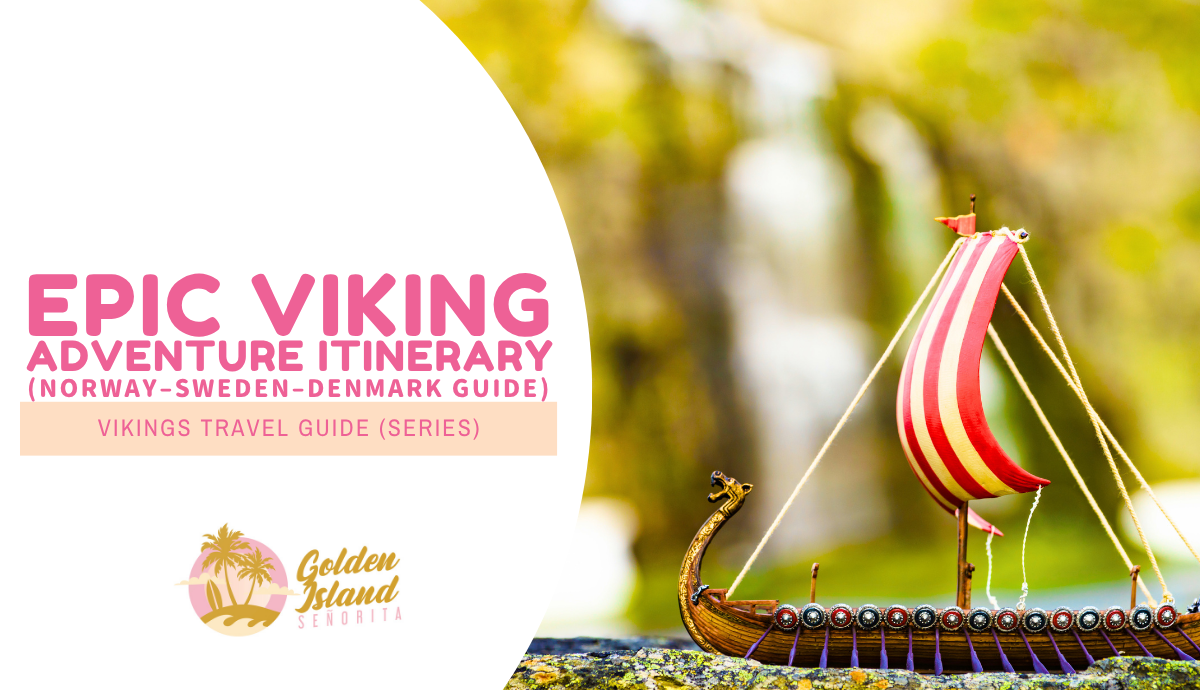
Scandinavia on My Bucket List: A Filipina’s Epic Viking Adventure Itinerary (Norway–Sweden–Denmark Guide)
Scandinavia has a strange pull on the imagination. Even from the Philippines—where humidity is practically a personality trait and the closest thing to a fjord is a flooded street in Marikina during typhoon season—it’s impossibly easy to romanticize longships cutting through misty waters, medieval castles standing quietly against icy winds, and fire-lit Norse feasting halls echoing with ancient stories.
This is the kind of destination that earns its spot on a bucket list. And for me, planning this Epic Viking Adventure is already half the journey. So let’s call it that, the Epic Viking Adventure.
This guide is not about pretending I’ve already been there. It’s about planning it properly, realistically, and with enough detail that when the time actually comes, you’re not wandering around Oslo thinking, “So… now what?” Whether you’re a history lover, a fantasy fan who discovered Norse mythology through books and pop culture, or simply someone who wants to do something completely different from a beach resort vacation—this epic Viking adventure is worth every centavo of planning.
Let’s build a realistic Scandinavia itinerary covering Norway, Sweden, and Denmark, complete with Viking history sites, fjords, castles, logistics, and a practical budget breakdown for Filipino travelers.
Table of Contents
Click the relevant heading to jump to that section.
⚔️ Why Scandinavia? The “Why Go” Factor
Before we get into the planning details of this epic Viking adventure, let’s talk about why Scandinavia deserves a spot on your list in the first place.
Scandinavia isn’t just about Vikings in horned helmets—and that’s actually the first thing you’ll learn when you get there. Spoiler: archaeologists have confirmed that Viking warriors almost certainly did not wear horned helmets in battle. Those are a 19th-century Romantic-era invention. The real Vikings were something far more fascinating: navigators, traders, settlers, explorers, and yes, fierce raiders—but also poets, farmers, and craftspeople who built one of the most far-reaching maritime cultures the ancient world had ever seen.
- Dramatic fjords carved by glaciers over thousands of years, with walls of rock rising hundreds of meters from glassy water
- Museums preserving actual Viking ships—not replicas, but the real, thousand-year-old vessels pulled from burial mounds
- Medieval castles and fortresses that feel straight out of a historical drama
- Clean, efficient, remarkably walkable cities with deep historical roots beneath their modern surfaces
- A mix of nature, design, and storytelling that you genuinely won’t find anywhere else on Earth
This Epic Viking Adventure offers:
This is where myth meets geography—and somehow, improbably, survives.
🛂 Before You Go: Realities for Filipino Travelers
Every proper epic Viking adventure begins with paperwork. Let’s be honest about that.
✈️ Visa: Schengen Requirement
Filipino passport holders need a Schengen visa to visit Norway, Sweden, and Denmark. All three countries are Schengen Area members, which means one visa covers all three—as long as you apply through the embassy of your main destination or your first point of entry.
Basic requirements typically include:
- Valid Philippine passport (at least 6 months validity beyond your travel dates)
- Proof of income or employment (certificate of employment, ITR, or business registration)
- Bank statements (usually last 3–6 months)
- Detailed travel itinerary
- Hotel bookings or accommodation confirmation
- Travel insurance (minimum EUR 30,000 coverage—non-negotiable for Schengen)
- Visa fee: approximately PHP 5,000–PHP 6,500 depending on the embassy and season
Processing times vary, but allow at least 3–4 weeks before your intended departure. Apply early. This is your Epic Viking Adventure — don’t let a rushed visa application sink it before you even board the plane.
📌 For the most up-to-date Schengen visa requirements, check the Schengen Visa Info portal for Philippine passport holders.
💰 Currency
- Norway: Norwegian Krone (NOK) — 1 NOK ≈ PHP 5.50–PHP 6.00
- Sweden: Swedish Krona (SEK) — 1 SEK ≈ PHP 4.80–PHP 5.20
- Denmark: Danish Krone (DKK) — 1 DKK ≈ PHP 7.50–PHP 8.00
Card payments dominate across all three countries. Many places in Norway and Sweden are nearly cashless. Having a debit card with low foreign transaction fees (like a Wise card or similar) is strongly recommended for your Dream Viking Adventure. Cash is rarely necessary, but it doesn’t hurt to have a small emergency amount.
📌 Check live exchange rates at Wise Currency Converter or XE.com.
🌦️ Best Time to Visit
- May to September: Best weather, fjords fully accessible, very long daylight hours (in June, Oslo gets nearly 18 hours of daylight—wild for us Filipinos used to 12-hour days)
- December to February: Winter magic, Christmas markets, and the aurora borealis further north—but expensive and very, very cold
For first-timers: Late spring to early autumn is the most practical window for this epic Viking adventure. You’ll be comfortable, you’ll see more, and you’ll pay slightly less for accommodation than peak winter.
📌 Official seasonal travel info: Visit Norway — Plan Your Trip | Visit Sweden | Visit Denmark
🗺️ The Itinerary: 10–12 Days Across Norway, Sweden, and Denmark
This route is designed to be realistic for first-time visitors who want to experience as much Viking history as possible without collapsing from exhaustion. It minimizes unnecessary backtracking and connects major hubs via efficient rail and ferry links.
🇳🇴 NORWAY — Days 1 to 6
The Heart of the EPIC Viking Adventure
Day 1–2: Oslo
Oslo is your gateway to the Epic Viking Adventure and a genuinely excellent starting point. The Norwegian capital is compact, walkable, and full of history hiding behind its clean, modern Scandinavian design.
Must-visit in Oslo:
- Viking Ship Museum (Vikingskipshuset) — This is one of the most important stops on your epic Viking adventure. The museum houses three actual Viking ships recovered from burial mounds in the Oslo Fjord area. The Oseberg ship (built around 820 AD) is arguably the most ornately decorated Viking artifact in existence, complete with intricate woodcarvings that still look astonishing after more than 1,200 years. Note: The museum is currently undergoing renovation as part of an expansion into the new Viking Age Museum (Vikingtidsmuseet), so check the current status before your visit—exhibits may be in transition.
- Norwegian Museum of Cultural History (Norsk Folkemuseum) — An open-air museum with relocated historic buildings including a 12th-century stave church. Context for the broader Scandinavian story.
- Akershus Fortress — A medieval castle on the Oslo Fjord waterfront, built around 1300. Not Viking-era, but a solid medieval anchor point for Day 2.
- Aker Brygge — The old wharf district, now a pleasant harborside area for an evening walk.
📌 Getting around Oslo: The Oslo Pass is worth it for multiple museum entries and unlimited public transport.
Day 3: Sverd i Fjell (Swords in Rock) — Stavanger
No epic Viking adventure is complete without a pilgrimage to Sverd i Fjell (Swords in Rock), one of Norway’s most iconic Viking Age monuments. Located in Hafrsfjord just outside Stavanger, this monumental sculpture by artist Fritz Røed was unveiled in 1983 to commemorate the Battle of Hafrsfjord (872 AD)—the pivotal naval battle in which Harald Fairhair unified Norway under one crown.
Three enormous bronze sword hilts rise from bedrock overlooking the fjord, representing the three regions that fought in the battle. The largest sword stands about 10 meters tall. The setting—open sky, salt air, the fjord stretching out behind the blades—makes this one of the most atmospheric stops on your epic Viking adventure.
Getting to Stavanger from Oslo: approximately 1 hour by domestic flight (Norwegian Air or SAS) or 7–8 hours by train. Flying is more practical if time is limited.
From Stavanger, take Bus 4 toward Madlamark and get off near Hafrsfjord. Entry is free. The site is open year-round.
📌 Official info: Visit Norway — Swords in Rock | Edge of Norway regional guide
Day 4: Gudvangen Viking Valley — Gudvangen
From Stavanger, make your way northeast toward the inner fjords. Gudvangen is a small village at the innermost point of the Nærøyfjord—a UNESCO World Heritage Site and one of the narrowest fjords in the world. It is also home to Gudvangen Viking Valley (Njardarheimr), one of the most immersive living history experiences in all of Scandinavia.
This reconstructed Viking village is staffed by costumed inhabitants who demonstrate authentic Viking-age crafts, food preparation, combat training, and daily life. You can handle replica weapons, taste traditional Viking-era foods, and ask questions of people who take their historical recreation extraordinarily seriously. For anyone on a epic Viking adventure, this is a full-sensory experience that no museum can quite replicate.
The Nærøyfjord cruise from Flåm to Gudvangen takes approximately 2 hours and is one of the most jaw-dropping boat rides in Europe. Add it to your epic Viking Adventure without hesitation.
Practical info:
- Gudvangen Viking Valley is typically open from May through early autumn
- Entry fee approximately NOK 150–250 (check their official website for current pricing)
- Combine with the Flåm Railway (Flåmsbana) for a scenic detour
Day 5: Sagastad Viking Centre — Nordfjordeid
Further north along the western coast, Sagastad in Nordfjordeid is one of Scandinavia’s newer and most ambitious Viking heritage projects. The centre is home to a full-scale reconstruction of the Myklebust ship—a Viking Age chieftain ship discovered locally and believed to be one of the largest Viking ships ever built. The original ship was used as a cremation burial vessel around 900 AD, and what you see at Sagastad is the extraordinary effort to bring it back to life through experimental archaeology.
The centre combines a world-class museum with an active shipbuilding workshop where you can watch craftspeople using traditional methods. For anyone genuinely invested in their epic Viking adventure, Sagastad delivers a kind of serious, scholarly depth that complements the more theatrical experiences elsewhere on the route.
Getting to Nordfjordeid: best by car or regional bus from Sogndal or Stryn. It’s off the beaten tourist path—which honestly makes it feel more authentic.
📌 Official website: sagastad.no/en | Regional info: Visit Nordfjord
Day 6: Lofotr Viking Museum — Lofoten Islands
If the epic Viking adventure had a crown jewel in Norway, many would argue it’s the Lofotr Viking Museum in Borg, on the Lofoten Islands in northern Norway. This is where a full-scale reconstruction of the largest Viking longhouse ever discovered stands on the very hilltop where the original was excavated in 1983.
The longhouse stretches an extraordinary 83 meters—longer than an Olympic swimming pool. Inside, you’ll find reconstructed Viking-age interiors, a feast hall where evening banquets are held during summer, and a replica longship that actually sails on the nearby lake. The Lofoten Islands themselves—dramatic peaks rising from the Arctic Sea, red fishing huts clinging to rocky shores, cod drying in the sea air—are breathtakingly beautiful in a way that photographs genuinely cannot prepare you for.
Getting to Lofoten: fly from Oslo or Bergen to Leknes or Svolvær airport (approximately 1.5–2 hours), then drive or take a bus to the museum in Borg.
Entry fees: Approximately NOK 200–280 for adults. Evening Viking banquets cost significantly more and should be booked in advance. This experience alone can make your epic Viking adventure feel like it was worth every peso.
📌 Official website: lofotr.no/en | Museum Nord profile: museumnord.no — Lofotr
🇸🇪 SWEDEN — Days 7 to 8
Cities, History, and the Viking Thread
Day 7–8: Stockholm
Fly or take the overnight train from Oslo to Stockholm. Sweden’s capital is spread across 14 islands at the point where Lake Mälaren meets the Baltic Sea—a geography that immediately explains why Scandinavian peoples became such extraordinary sailors. Your epic Viking adventure continues here in a more urban key.
Must-visit in Stockholm:
- Historiska Museet (Swedish History Museum) — Home to an exceptional Viking Age collection including the Guldhuset (Gold Room), which houses one of the world’s largest collections of Viking Age gold artifacts. Torcs, pendants, and jewelry that were buried by people who fully intended to come back for them, and never did. Essential for any epic Viking adventure.
- Gamla Stan (Old Town) — The medieval island at Stockholm’s center, with cobblestone alleys and buildings dating to the 13th century. Not Viking-era, but atmospheric medieval history worth half a day.
- Vasa Museum — Not Viking, but unmissable: a perfectly preserved 17th-century warship that sank on its maiden voyage in 1628 and was raised intact in 1961. One of the world’s most extraordinary maritime museums.
- Skansen — The world’s oldest open-air museum, founded in 1891, with historic buildings relocated from across Sweden. Good cultural context for the broader Nordic story.
Stockholm is also a beautiful city for walking, cafe-sitting, and processing the historical density of your epic Viking adventure before the final leg.
🇩🇰 DENMARK — Days 9 to 12
Where the Viking Dream Comes Full Circle
Take the high-speed train from Stockholm to Copenhagen (approximately 5 hours via the Øresund Bridge)—a journey that is itself wonderfully Scandinavian, crossing the strait between Sweden and Denmark on one of the world’s great engineering bridges.
Denmark is where this epic Viking adventure finds some of its deepest roots. Historically, Denmark was one of the main homelands of the Viking Age. The famous raids on England, France, and Ireland were launched from Danish shores. The country has preserved this heritage with remarkable seriousness.
Day 9–10: Copenhagen + Day Trips
Copenhagen itself:
- Nationalmuseet (National Museum of Denmark) — Superb prehistoric and Viking Age collections. The Pre-history section alone contains thousands of artifacts including the famous Sun Chariot (Solvognen), a bronze Age masterpiece, and extensive Viking Age material culture. An important anchor for your epic Viking adventure.
- Rosenborg Castle — A Renaissance castle in the city center with the Danish crown jewels. Not Viking, but historically significant and visually spectacular.
- Nyhavn — The iconic colored waterfront. Touristy, yes, but genuinely beautiful for an evening walk.
- Tivoli Gardens — If you need a break from museums on your epic Viking adventure, this historic amusement park (founded 1843) is a pleasant detour.
Day 10 Day Trip: Viking Ship Museum — Roskilde
Roskilde, approximately 30 minutes west of Copenhagen by train, is one of the most important stops on any epic Viking adventure to Denmark. The Viking Ship Museum (Vikingeskibsmuseet) is home to five original Viking ships raised from Roskilde Fjord in 1962, where they were deliberately sunk around 1070 AD as a defensive barrier to protect the harbor.
These are not replicas. These are the original ships—beautifully displayed in a purpose-built harborside museum that allows natural light to illuminate the fragile wooden frames. The collection includes a large ocean-going merchant ship (a knarr), a warship, and smaller vessels, representing the full range of Viking maritime activity.
The museum also operates an active shipyard where craftspeople build replica Viking ships using traditional tools and techniques—and in summer, you can actually sail on one of those replicas on the fjord. Few experiences on an epic Viking adventure are quite this viscerally connected to history.
Practical info:
- Entry fee: approximately DKK 175 for adults
- From Copenhagen Central Station (København H), take the train toward Roskilde (30 minutes, approximately DKK 80 each way)
- Open year-round; check for sailing experiences which are seasonal
Day 11 Day Trip: Viking Fortress of Trelleborg + Lindholm Høje
This is a day for serious Viking history enthusiasts—and serious epic Viking adventure travelers.
Trelleborg Viking Fortress (near Slagelse, approximately 1.5 hours from Copenhagen by train) is one of six surviving Viking ring fortresses built during the reign of Harald Bluetooth in the late 10th century (around 980 AD). The geometrically precise circular fortification, with its four gateways aligned to the cardinal directions, was clearly built by a highly organized military power—not the chaotic raiders of popular imagination. The museum on site provides excellent context on Danish Viking-age state formation.
Lindholm Høje (near Aalborg in northern Jutland—a longer trip, about 4 hours by train) is one of Scandinavia’s largest Viking Age and Iron Age burial grounds, with over 700 graves marked by stones arranged in ship-shapes. The elevated hillside cemetery overlooking the fjord below is genuinely moving. The adjacent museum explains the burial practices and daily life of the communities who lived here. If your epic Viking adventure allows the time to reach northern Denmark, Lindholm Høje is unforgettable.
Practical note: Combining Trelleborg and Lindholm Høje in one day requires early starts and careful train planning. Consider spending an extra night in Aalborg if the itinerary allows.
Day 12: Ribe Viking Centre
End your epic Viking adventure in Denmark’s oldest surviving town. Ribe, on the southwestern Jutland coast, was a major Viking Age trading center from around 700 AD—predating the famous raids by over a century—and is considered Denmark’s oldest city.
The Ribe Viking Centre is a living history museum on the outskirts of town, reconstructing life in an early Viking Age marketplace. Costumed interpreters demonstrate crafts, cooking, and trade in a setting that authentically represents the commercial rather than military side of Viking culture. Ribe itself—with its well-preserved medieval streets, the imposing Ribe Cathedral (built beginning in 1150), and the original old town layout—deserves several hours of exploration beyond the Viking Centre.
Getting to Ribe: approximately 3 hours from Copenhagen by train (with a change at Bramming). It’s a longer journey but a deeply satisfying final chapter to your epic Viking adventure before returning to Copenhagen for your flight home.
💰 Estimated Budget for Filipino Travelers (10–12 Days)
Let’s be completely realistic. Scandinavia consistently ranks among the most expensive travel destinations in the world. This is not a budget destination. But it is absolutely doable with disciplined planning.
| Category | Budget Range (PHP) |
|---|---|
| ✈️ Flights (Manila–Scandinavia, round trip) | PHP 60,000 – PHP 100,000 |
| 🏨 Accommodation (10 nights, budget to mid-range) | PHP 30,000 – PHP 120,000 |
| 🚆 Inter-city transport (trains, ferries, domestic flights) | PHP 20,000 – PHP 40,000 |
| 🍽️ Food (PHP 1,500–PHP 3,000/day) | PHP 15,000 – PHP 36,000 |
| 🎟️ Attractions (museums, Viking centres, fjord cruises) | PHP 10,000 – PHP 20,000 |
| 🛡️ Travel insurance + Schengen visa | PHP 6,000 – PHP 10,000 |
| 🎒 Miscellaneous (souvenirs, emergencies, laundry) | PHP 5,000 – PHP 15,000 |
| 💰 TOTAL ESTIMATED COST | PHP 146,000 – PHP 341,000+ |
Accommodation Breakdown
- Budget hostels: PHP 2,500–PHP 4,500 per night (shared dorm in Oslo, Stockholm, or Copenhagen)
- Mid-range hotels: PHP 6,000–PHP 12,000 per night
- Budget tip: Use generator.hostelworld.com to find well-rated hostels in each city. Many Scandinavian hostels are genuinely excellent—clean, well-managed, and located centrally.
Food Reality Check
Eating out in Scandinavia is expensive by any standard. A simple café lunch in Oslo or Stockholm can cost NOK/SEK 150–200 (roughly PHP 800–PHP 1,200). Dinner at a mid-range restaurant easily runs NOK 300–500 per person.
Budget strategies for your EPIC Viking Adventure:
- Buy breakfast supplies at a supermarket (Kiwi and Rema 1000 in Norway, Lidl and Coop in Sweden and Denmark are affordable options)
- Look for lunch deals—many restaurants offer a fixed-price lunch menu (dagens rett in Norwegian) that is significantly cheaper than dinner prices
- Eat your main hot meal at lunch and keep dinner light and supermarket-sourced
- Scandinavian tap water is excellent and completely safe to drink everywhere
Transport Tips
- Eurail passes can be cost-effective if you’re doing multiple train journeys—compare against individual ticket prices before buying
- SJ (Sweden) and DSB (Denmark) both offer advance purchase discounts that can significantly reduce rail costs
- Book the Flåm Railway (Flåmsbana) in advance—it sells out quickly in summer
- Domestic flights within Norway (e.g., Oslo to Leknes for Lofoten) can be found cheaply through Norwegian Air if booked early
Yes, it’s a steep investment. Vikings also didn’t live cheap.
🎒 Packing Reality Check: Coming from the Philippines
This EPIC Viking adventure requires a packing approach that is the polar opposite of a beach trip.
You will absolutely need:
- Thermal base layers (merino wool is ideal—warm, lightweight, doesn’t retain odor)
- A quality waterproof outer jacket (fjords are wet and windy even in summer)
- Comfortable, waterproof walking shoes or boots
- Light gloves and a beanie (even in July, fjord boat rides are cold)
- A power bank (long travel days in remote areas)
- European plug adapter (Type C/F)
- A good quality backpack for day trips
- Sunscreen—because June daylight in Norway is relentless and UV exposure at northern latitudes is surprisingly intense
And emotionally:
- Full preparedness for “it’s colder than I expected” moments every single day
- Acceptance that things are expensive and building that into your budget rather than being surprised
- Patience with the quieter pace of Scandinavian public life (it’s not unfriendly—it’s just culturally different)
⚔️ The Viking Highlights: What You Learn
After tracing the route of this epic Viking adventure across all three countries, the picture that emerges is more nuanced and more impressive than any popular culture depiction has prepared you for.
What you realize:
- The Vikings were not a unified nation or empire—they were Norse-speaking peoples from different regions who raided, traded, and settled across an enormous range from North America to Central Asia
- Their shipbuilding was genuinely revolutionary—shallow-draft hulls that could navigate both open ocean and shallow rivers gave them access that no other seafaring culture of the time possessed
- The epic Viking adventure across Scandinavia reveals the same coastlines and fjords that made Vikings into the sailors they became. The geography explains the history.
- Viking society was stratified—jarls (nobles), karls (free farmers), and thralls (enslaved people)—and more literate than popular myth suggests, producing the saga literature that preserves much of what we know
- The Viking Age (roughly 793–1066 AD) ended not with conquest but with gradual cultural integration into Christian European civilization
Most importantly: the sites on this epic Viking adventure—from Gudvangen to Roskilde, Lofotr to Ribe—are staffed by people who genuinely care about accuracy. The experience you get is not a theme park version of history. It is a serious, often moving encounter with a real civilization.
🧭 Quick Reference: Viking Sites by Country
🇳🇴 Norway
| Site | Location | Highlight |
|---|---|---|
| Lofotr Viking Museum | Borg, Lofoten Islands | World’s largest reconstructed Viking longhouse |
| Gudvangen Viking Valley (Njardarheimr) | Gudvangen, Vestland | Immersive living history village |
| Sagastad Viking Centre | Nordfjordeid, Vestland | Myklebust ship reconstruction |
| Sverd i Fjell (Swords in Rock) | Hafrsfjord, Stavanger | Monument to the Battle of Hafrsfjord, 872 AD |
🇸🇪 Sweden
| Site | Location | Highlight |
|---|---|---|
| Historiska Museet | Stockholm | Major Viking Age artifact collection, Gold Room |
🇩🇰 Denmark
| Site | Location | Highlight |
|---|---|---|
| Viking Ship Museum | Roskilde | Five original Viking ships + active replica shipyard |
| Viking Fortress of Trelleborg | Near Slagelse | Harald Bluetooth-era ring fortress, c. 980 AD |
| Lindholm Høje | Near Aalborg | 700+ graves in ship-stone formations |
| Ribe Viking Centre | Ribe | Living history in Denmark’s oldest city |
💬 Final Thoughts: Planning the Dream
As someone who has been a huge fan of Norse mythology and fascinated with all things Viking, planning and mapping this itinerary has been a genuine source of inspiration. This Epic Viking Adventure may still be months—or even years—away from becoming a reality, but that doesn’t make it any less meaningful.
Visa requirements, flight costs, and the undeniable financial weight of Scandinavia mean that every Epic Viking Adventure requires serious planning for Filipino travelers. But here’s the truth: the planning itself is part of the journey.
Every time you research the Nærøyfjord, every time you watch a documentary about the Oseberg ship excavation, every time you save a little more toward your flight fund—you’re already living the early chapters of your Epic Viking Adventure.
Scandinavia isn’t going anywhere. The fjords remain as dramatic as ever. The longships are still preserved in museums—quiet, powerful, and waiting to tell their stories. Sverd i Fjell still stands firmly at Hafrsfjord, its stone swords rising from the bedrock, overlooking waters once sailed by Viking fleets.
This Epic Viking Adventure is worth building toward. Research it seriously. Budget for it honestly. Plan it with the level of detail the Norse sagas themselves would respect.
And when you finally stand at the edge of the Nærøyfjord—cold wind brushing past you, mountains rising impossibly high, the silence almost overwhelming—you’ll understand exactly why this Epic Viking Adventure was always worth putting on your bucket list.
Skål. The longships are ready when you are.
📌 Planning Checklist
- Apply for Schengen visa at least 4–6 weeks before departure
- Book flights early (3–6 months ahead for better rates)
- Get a Wise or multi-currency card for cashless payments
- Book Flåm Railway tickets in advance (sells out fast)
- Check seasonal opening dates for Gudvangen Viking Valley and Sagastad
- Reserve Lofotr Viking Museum evening banquet early (limited seats)
- Book Viking Ship Museum Roskilde sailing experience (seasonal)
- Invest in thermal layers before leaving Manila
- Download offline maps for Norway’s more remote areas
- Save your emergency contacts + embassy numbers before departure
📚 Sources & References
All factual claims in this article are drawn from official museums, government tourism agencies, UNESCO records, and verified travel resources. Always verify visiting hours, admission fees, and practical details directly with official sources before travel, as these are subject to change.
Official Museum & Attraction Websites
| Source | URL |
|---|---|
| Lofotr Viking Museum | lofotr.no/en |
| Viking Age Museum, Oslo (Vikingtidsmuseet) | khm.uio.no — Viking Age Museum |
| Gudvangen Viking Valley (Njardarheimr) | en.vikingvalley.no |
| Sagastad Viking Centre | sagastad.no/en |
| Sverd i Fjell — Visit Norway | visitnorway.com — Swords in Rock |
| Sverd i Fjell — Edge of Norway | edgeofnorway.com |
| Historiska Museet (Swedish History Museum) | historiska.se/en |
| Viking Ship Museum Roskilde | vikingeskibsmuseet.dk/en |
| Trelleborg Museum — National Museum of Denmark | en.natmus.dk — Trelleborg |
| Lindholm Høje Museum — Nordjyske Museer | nordjyskemuseer.dk |
| Ribe Viking Centre | ribevikingecenter.dk/en |
| Norsk Folkemuseum | norskfolkemuseum.no/en |
| Akershus Fortress | forsvarsbygg.no — Akershus |
| Vasa Museum | vasamuseet.se/en |
| Skansen | skansen.se/en |
| Nationalmuseet, Copenhagen | en.natmus.dk — National Museum |
| Rosenborg Castle | kongernessamling.dk/en/rosenborg |
| Tivoli Gardens | tivoli.dk/en |
Official Tourism Authorities
| Source | URL |
|---|---|
| Visit Norway (Innovasjon Norge) | visitnorway.com |
| Visit Sweden | visitsweden.com |
| Visit Denmark | visitdenmark.com |
| Visit Oslo | visitoslo.com/en |
| Visit Stockholm | visitstockholm.com |
| Fjord Norway | fjordnorway.com/en |
| Visit Nordfjord | nordfjord.no/en |
UNESCO World Heritage Listings
| Site | UNESCO Link |
|---|---|
| Nærøyfjord (West Norwegian Fjords) | whc.unesco.org/en/list/1195 |
| Viking-Age Ring Fortresses (Trelleborg et al., inscribed 2023) | whc.unesco.org/en/list/1660 |
Transport & Booking
| Source | URL |
|---|---|
| Flåm Railway (Flåmsbana) | flamsbana.no/en |
| SJ Swedish Rail | sj.se/en |
| DSB Danish Rail | dsb.dk/en |
| Norwegian Air | norwegian.com/en |
| Eurail Pass | eurail.com |
| Øresund Bridge | oresundsbron.com/en |
| Hostelworld | hostelworld.com |
| Booking.com | booking.com |
| Skyscanner PH | skyscanner.com.ph |
| KLM Philippines | klm.com/en/ph |
Visa & Currency Resources
| Source | URL |
|---|---|
| Norwegian Embassy Manila | norway.no/en/philippines |
| Swedish Embassy Manila | swedenabroad.se — Manila |
| Danish Embassy Manila | philippines.um.dk |
| VFS Global Philippines | vfsglobal.com |
| Schengen Visa Info — Philippines | schengenvisainfo.com |
| Wise Currency Converter | wise.com/ph/currency-converter |
| XE Currency Reference | xe.com |
Wikipedia Entries (for General Historical Reference)
- Lofotr Viking Museum
- Viking Ship Museum (Roskilde)
- Trelleborg (Slagelse)
- Sverd i fjell
- Sagastad
- Swedish History Museum
Article written for future travel planning purposes. All entry fees, transport costs, and attraction details are subject to change. Always verify with official sources before booking. Exchange rate estimates are approximate and based on 2024–2025 averages. This guide is not sponsored by any attraction, tourism board, or airline.
Published: October 03, 2019
Last Updated: August 10, 2025

Polly Amora
Polly Amora is the señorita behind GoldenIslandSenorita.Net. A corporate warrior by day, and a perpetual explorer by heart. She is a lifelong learner who is very outgoing, speaks four languages, loud & outspoken, and loves to have adventures in the mountains, on the beach, and in the city. You can throw her anywhere, and she'll handle it like a pro. Ice cream and bourbon are two of her weaknesses.

