
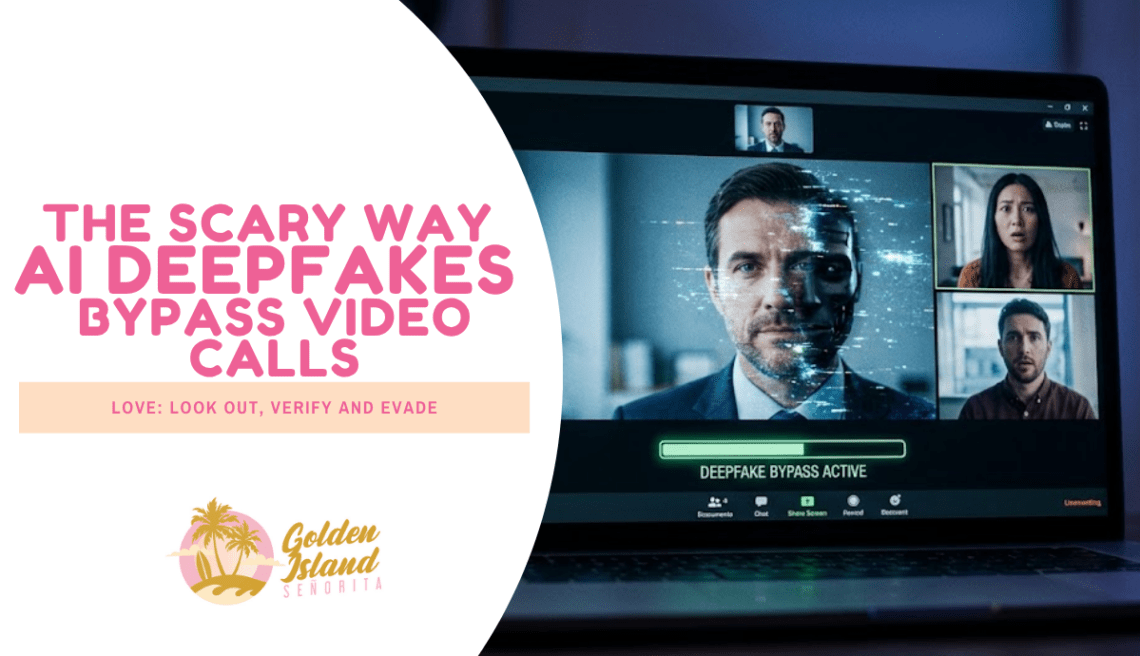
The Scary Way AI Deepfakes Bypass Video Calls
Remember when someone told you, “If you’re not sure who you’re talking to online, just ask them to video call”? For years, this was considered the gold-standard test of digital identity. Seeing someone’s face — live, moving, talking in real time — felt like proof you couldn’t argue with. Scammers couldn’t fake a live video call. Or so we thought.
Welcome to 2026, where deepfakes have quietly dismantled that assumption. Today’s fraudsters aren’t just hiding behind fake email addresses and stolen profile photos. They’re showing up on your screen in real time — wearing borrowed faces, speaking in stolen voices, and convincingly mimicking the people you trust most. The video call test, once a reliable safety net, now has serious holes in it.
This article breaks down exactly how deepfakes and voice-cloning technology work, how scammers are weaponizing them against ordinary people, and — most importantly — what you can do right now to protect yourself and the people you love.

Table of Contents
Click the relevant heading to jump to that section.
| DISCLOSURE & DISCLAIMER |
|---|
| Purpose & Research Transparency This article was written solely for the purpose of raising public awareness regarding online safety and AI-driven deception. The insights shared here are based entirely on publicly available studies, reports, and data found across the internet. I believe in full transparency, which is why you can find every single piece of literature used to build this article detailed in the “Sources and References” section at the bottom of this post. No Professional Affiliation Please note that I am an independent creator. I am not employed by, partnered with, or affiliated with any cybersecurity company, software developer, or digital security firm. The views expressed here are entirely my own and do not represent the official stance of any technical or corporate entity. No Technical Expertise Claimed I do not claim to be an expert in artificial intelligence, machine learning, or cybersecurity. To be completely candid, I have never created a deepfake myself—the backend technology is incredibly complex, and I am far from being a tech-savvy developer. I am approaching this topic not as a programmer, but as a dedicated researcher analyzing the psychological and social impacts of these digital tools. Limitation of Liability Because digital technology and scam tactics evolve at a rapid pace, the content provided in this post is for general informational and educational purposes only. It does not constitute professional cybersecurity, technical, or legal advice. Any action you take based on the information presented in this article is strictly at your own risk, and I cannot be held liable for any digital security issues or losses that may arise. |
What Are Deepfakes, Exactly?
Before we get into the threat, let’s make sure we’re on the same page about what we’re dealing with.
The word “deepfake” is a mashup of “deep learning” and “fake.” Deepfakes are AI-generated media — video, audio, or images — in which a person’s likeness, voice, or both have been synthetically created or manipulated using machine learning models. The technology relies on neural networks, particularly a type called Generative Adversarial Networks (GANs), which learn to analyze thousands of real images and audio samples of a person and then generate eerily convincing imitations.
Here’s what makes today’s situation truly alarming: early deepfakes required massive datasets of footage, expensive hardware, and serious technical know-how. Not anymore. Today, sophisticated deepfake tools are freely available online, and some can produce convincing results from just a few seconds of audio or a small handful of photos. The barrier to entry has dropped to nearly zero — and that’s precisely why this technology has become a playground for criminals.
From Novelty to Kitchen Table Crime
When deepfakes first entered mainstream awareness, they were associated with celebrity face-swaps and viral novelty videos. Troubling in concept, yes — but it felt distant, like a problem for Hollywood studios and tech insiders, not for everyday people.
That distance has collapsed entirely.
Deepfakes are now showing up in scams targeting grandparents, small business owners, romance seekers, and job applicants. The technology that once required a film production budget is now running on someone’s laptop, pointed directly at your family. Let’s look at the most common ways criminals are deploying this technology today.
The Grandparent Scam Gets a High-Tech Upgrade
You may have heard of the grandparent scam — a fraudster calls an elderly person pretending to be their grandchild in distress, claiming to be in jail, the hospital, or a car accident, and begging for money urgently. It’s been around for decades because it works. It exploits the most powerful forces there are: love, fear, and urgency.
Now add voice cloning to the equation.
Using just a short audio clip — snatched from a social media video, a voicemail, or a YouTube post — scammers can generate a synthetic voice that sounds virtually identical to your grandson, your daughter, or your closest friend. They call you. You hear the voice you love. Your heart lurches. And before your rational brain catches up, you’re wiring money to an account that belongs to a criminal.
Deepfakes take this even further. In several reported cases, video deepfakes have been used in WhatsApp and FaceTime calls to visually impersonate family members. The scammer runs a deepfake overlay on their webcam feed, mimicking the facial expressions of the real person in real time. It’s not always flawless — but it’s convincing enough to fool someone who’s panicked, sleep-deprived, and emotionally overwhelmed.
Corporate Fraud: When Your Boss Isn’t Your Boss
In 2024, a case out of Hong Kong rattled the corporate world. A finance employee at a multinational firm was tricked into transferring $25 million USD after what appeared to be a completely legitimate video conference with his company’s CFO and several senior colleagues. Every single person on that call — except the employee himself — was a deepfake.
The deepfakes were sophisticated enough to hold a real-time conversation, respond naturally to questions, and present every visual cue of credibility. The employee had no reason to suspect anything. He saw familiar faces, heard familiar voices, and received an authoritative instruction. He complied.
This type of attack — sometimes called Business Email Compromise 2.0 — is rapidly becoming one of the most financially devastating forms of fraud in existence. And it isn’t only targeting multinationals. Small law firms, accountancy practices, family businesses, and nonprofits are all in the crosshairs. Anywhere there’s a financial chain of trust, AI-powered fraud can be inserted.
Romance Scams: Falling for a Face That Doesn’t Exist
Online romance scams have long relied on stolen photographs and fabricated personas. But deepfakes have supercharged this particular con in a way that’s deeply unsettling.
Traditionally, romance scammers avoided video calls — the stolen photos they used wouldn’t match a live face, and the excuse (“my camera is broken,” “the internet here is too slow”) became a well-known red flag that savvier online daters learned to spot immediately.
Deepfakes have erased that red flag entirely.
Today, scammers can conduct live video calls using deepfake overlays synchronized to their real-time movements. The target sees an attractive, articulate person who responds naturally, laughs at their jokes, seems completely at ease, and looks entirely real. Relationships built over months — emotionally intimate, sometimes physically suggestive — can be based entirely on a face that was never human.
By the time victims realize they’ve been scammed (usually when the money requests begin), they’ve formed a genuine emotional bond with someone who never existed. The psychological damage, layered on top of the financial loss, can be life-altering.
How Real-Time Deepfakes Work — And Why It’s So Alarming
Here’s where things get genuinely unnerving. Early deepfakes were post-production creations — you recorded video, processed it through software, and produced a manipulated file afterward. That took time, and it certainly couldn’t happen live.
Real-time deepfakes change everything.
Software tools now exist that apply a synthetic face overlay to a live webcam feed with minimal latency. These tools — some openly available on developer platforms, others traded on underground markets — operate by:
- Capturing the live webcam feed in real time.
- Mapping a target face (generated from existing photos or video of the person being impersonated) onto the live stream frame by frame.
- Rendering the output as a virtual webcam that apps like Zoom, Microsoft Teams, FaceTime, and Google Meet simply see as a regular camera input — indistinguishable from the real thing.
The voice can also be synthesized in real time using voice-cloning software, completing the illusion. The scammer sits at their desk, and the person on the receiving end of the call sees an entirely different human being.
When deepfakes operate at this level — live, interactive, emotionally responsive — the traditional “just ask them to video call” safety check doesn’t just fail. It becomes a false sense of security that makes victims more vulnerable, not less.
Voice Cloning: The Quieter Half of the Crime
While deepfakes dominate the headlines, voice cloning deserves its own spotlight — because in many scams, it’s the more immediately accessible tool.
Voice-cloning AI can now replicate a person’s voice with startling accuracy using as little as three to ten seconds of audio. That audio could come from:
- A voicemail left on someone’s phone
- A short TikTok or YouTube clip
- A podcast or recorded webinar
- A public speech or company presentation
- Even a brief Instagram Story
Once cloned, the synthetic voice can say anything the scammer types or dictates. The tone, cadence, regional accent, and emotional texture are all preserved. The result is a vocal twin that can make calls, leave voicemails, and send audio messages that are virtually indistinguishable from the real person.
When voice cloning is paired with deepfakes on a video call, the combined illusion is extraordinarily difficult to break in the heat of the moment. But even on its own, a cloned voice is powerful enough to deceive — particularly when it arrives in a context loaded with urgency and emotion.
The Psychology of Why We Fall For It
Understanding why this technology is so effective requires stepping back from the tech and looking at human psychology.
Our brains are hardwired to trust faces and voices. Hundreds of thousands of years of evolution have tuned us to read facial expressions, interpret vocal tone, and make snap trust decisions based on audiovisual cues. Seeing a familiar face and hearing a familiar voice triggers an almost automatic sense of safety. It bypasses our rational skepticism and goes straight for the emotional core.
Scammers understand this perfectly. They engineer their deepfake attacks to create maximum emotional pressure — urgency, fear, love, shame, and excitement all suppress critical thinking. When you see your son’s face on a screen, the part of your brain that evaluates risk gets switched off by the part that loves your child unconditionally.
Add to this the fact that most people have no idea how far deepfake technology has advanced, and you have a near-perfect storm of psychological vulnerability. The best protection begins with simply knowing this is real and happening today.
How to Spot a Deepfake: The Warning Signs
The encouraging news is that deepfakes, while impressive, aren’t perfect. They still leave telltale signs if you know what to look for — and knowing these signs can give you a crucial moment of hesitation.
Visual Red Flags in Video Calls
- Unnatural blinking — too infrequent, too robotic, or missing altogether
- Edge blurring around the hairline, ears, or jaw, especially during head movement
- Lighting inconsistencies — the face appears lit from a different direction than the rest of the scene
- Stiff or choppy movements, especially around the mouth during speech
- Flickering or distortion during rapid head turns or expressions
- Skin that looks unusually smooth — almost plastic or rendered
- Accessories behaving strangely — glasses, earrings, or hair that seem to glitch or lose coherence
Audio Red Flags in Cloned Voices
- Emotionally flat delivery in moments that should carry strong feeling
- Unnatural pauses between words, especially mid-sentence
- Subtle digital artifacts — a faint clicking, static, or abrupt audio cuts
- Overly perfect pronunciation that feels slightly mechanical
- Background noise that cuts in and out unnaturally
Keep in mind that as deepfake technology improves, some of these cues will vanish. The goal isn’t to become an infallible detection machine — it’s to develop enough awareness to pause and verify before acting.
The Secret Code Word: A Simple, Powerful Defense
One of the most effective defenses against deepfakes and voice-clone scams is wonderfully low-tech: a family code word.
The concept is simple. You and your closest family members agree on a secret word or phrase in advance — something unusual, something that would never come up organically in conversation. If someone calls you claiming to be your child, your spouse, or your parent and tells you they’re in trouble, you ask for the code word. A scammer running a deepfake or a voice clone won’t know it.
Financial advisors, cybersecurity experts, and even the FBI have begun actively recommending this approach. It adds a meaningful layer of friction with zero technology required.
The same logic applies in professional settings. Many organizations are now implementing mandatory callback protocols: if you receive an unexpected instruction to transfer funds or share sensitive information — even from what appears to be a verified senior executive on a live video call — you hang up and call them back on a verified number from your internal directory. Not a number they provide. A number you already have.
AI Fighting Back: Technology vs. Technology
The same AI revolution that gave scammers deepfakes is also being mobilized to fight them — and this is one of the most promising developments in the space.
Deepfake detection technology has become a serious field of research and commercial investment. Companies, academic institutions, and government agencies are building tools that analyze video and audio for the microscopic inconsistencies that AI generation leaves behind — artifacts invisible to the human eye but detectable by trained algorithms.
Active approaches include:
- Biological signal detection: Real human faces show subtle color changes caused by blood flow, micro-expressions, and natural eye moisture. Deepfakes often lack these physiological signatures entirely.
- Content provenance standards: Initiatives like C2PA (the Coalition for Content Provenance and Authenticity) embed cryptographic signatures into media files, verifying their origin and any edits made along the way.
- Behavioral biometrics: AI systems that track how a known person moves, speaks, and blinks over time can flag anomalies consistent with synthetic generation.
- Liveness detection: Identity systems that ask users to perform random, unprompted actions — smile, blink, turn your head — to confirm they’re a real human, though advanced real-time deepfakes are beginning to challenge some implementations.
Social media platforms, video conferencing software companies, and financial institutions are investing heavily in these technologies. The challenge is that it remains a fast-moving arms race. Detection improves; so does generation. But awareness and tools are catching up.
What Governments Are Doing — and What They’re Still Missing
Governments worldwide are beginning to grapple with the deepfake threat, though legislation is still running behind the technology.
In the United States, several states have passed laws targeting malicious deepfakes — particularly around election interference and non-consensual intimate imagery. Federal legislation including the DEFIANCE Act has advanced through Congress, specifically addressing AI-generated abuse.
The European Union’s AI Act, which came into force in 2024, mandates labeling of AI-generated content and imposes strict rules on high-risk AI applications. Deepfake-based fraud clearly falls within this high-risk category, and the regulatory framework is beginning to reflect that.
In the UK, the Online Safety Act has been updated to address synthetic media, and financial regulators are increasingly requiring banks to build protocols for detecting and responding to AI-assisted fraud.
The persistent challenge is enforcement. Deepfake scammers frequently operate across international borders, cloaked by VPNs, cryptocurrency transactions, and anonymous infrastructure. Even with robust legislation, identifying, extraditing, and prosecuting these criminals remains enormously difficult. Legal frameworks are necessary but not sufficient — which is why personal awareness remains your most practical line of defense.
Protecting Yourself: Eight Practical Steps You Can Take Today
Let’s bring this home with concrete, actionable steps. No technical expertise required.
1. Create a Family Code Word Right Now
Pick something unusual — a random animal, a place from your childhood, a made-up word. Tell only your immediate family, in person or through a secure, trusted channel. Use it as your verification tool if anyone ever calls in distress.
2. Pause Before You Act
Urgency is a scammer’s greatest weapon. Deepfake attacks almost always come packaged with time pressure — “I need money NOW,” “There’s no time to explain,” “Don’t tell anyone.” Train yourself to recognize this pressure as a red flag and pause. Even 60 seconds of reflection can save you.
3. Verify Through a Different Channel
If anything about a call feels off — however slightly — hang up and call the person back on a number you already have. Not a number they gave you. Not a number that appeared on caller ID. A number you know.
4. Use Multi-Factor Authentication (MFA) Everywhere
MFA won’t stop a deepfake, but it protects the accounts and credentials that deepfakes are frequently trying to access or exploit. Enable it on every account that matters.
5. Limit Your Public Audio and Video Presence
The more of your voice and face that’s publicly accessible online, the easier it is for bad actors to clone them. Audit your social media. Make accounts private where you can. Be intentional about what video and audio content you post publicly — especially anything with clear, uninterrupted speech.
6. Have the Conversation with Vulnerable People in Your Life
Elderly relatives are disproportionately targeted by these scams. Have a plain-language conversation with them about what this technology is and how it works. Set up the code word system with them. Make sure they know to call you directly — before sending money to anyone, even someone who looks and sounds exactly like you.
7. Watch for the “Too Smooth” Effect
Ironically, a video call that seems almost unnervingly perfect can be a signal worth heeding. Real video calls have natural imperfections — lag, pixelation, awkward silences, background interruptions. Deepfake renders sometimes appear strangely pristine. Let that trigger a moment of healthy skepticism.
8. Stay Informed and Share What You Know
The rise of deepfakes isn’t slowing down. Staying current on how these tools evolve is part of your protection. Share what you learn with your network — the more people who understand this threat, the smaller the pool of potential victims.
The Bigger Picture: Trust in the Age of Synthetic Media
Beyond the individual scam, deepfakes represent something more profound: a fundamental challenge to how we establish trust in a digital world.
When any video can be fabricated, any voice cloned, and any image manipulated, our instinctive reliance on audiovisual evidence breaks down. This has implications that reach far beyond fraud — into journalism, legal evidence, political discourse, and the very fabric of interpersonal trust.
We are entering an era where “seeing is believing” can no longer be our default operating mode. In its place, we need layered verification, healthy skepticism, new social norms around authenticating identity — and, frankly, a willingness to ask awkward questions before acting on what we think we’ve witnessed.
That’s a significant cultural and psychological shift. But it’s one we need to make, and the earlier we make it, the better.
Conclusion: Don’t Trust the Call — Verify It
The video call test isn’t completely dead. But it can no longer be your only line of defense. Deepfakes have seen to that. What once felt like an unbreakable wall of verification has become, in the hands of sophisticated criminals, just another surface to manipulate.
The most empowering truth in all of this is straightforward: awareness is your most effective weapon. Scammers using deepfakes rely almost entirely on the element of surprise — on their targets not knowing this technology exists, or not knowing how convincingly it can be deployed. The moment you genuinely understand what deepfakes are and how they work, you’re already ahead of the vast majority of potential victims.
So stay curious. Stay skeptical. Create that code word today. And the next time someone makes an urgent request over a video call — even from a face and voice you’d recognize anywhere — remember that in 2025, the face on your screen is only the beginning of the story.
Deepfakes are real, they’re here, and they’re getting more convincing every single month. But so is the collective knowledge of the people determined to outsmart them — and with what you now know, that group includes you.
Sources & References
All sources verified as of May 2026. Links are to original publications.
1. The Hong Kong / Arup $25 Million Deepfake Fraud
The corporate fraud case referenced in the article is one of the most thoroughly documented deepfake crimes on record. Multiple major outlets independently verified and reported on it.
| Source | Publication | Date | Link |
|---|---|---|---|
| “Finance worker pays out $25 million after video call with deepfake ‘chief financial officer'” | CNN | Feb 4, 2024 | https://www.cnn.com/2024/02/04/asia/deepfake-cfo-scam-hong-kong-intl-hnk |
| “A $25 Million Hong Kong Deepfake Scam on Zoom Shows New AI Risks” | Bloomberg | Feb 5, 2024 | https://www.bloomberg.com/opinion/articles/2024-02-05/a-25-million-hong-kong-deepfake-scam-on-zoom-shows-new-ai-risks |
| “A deepfake ‘CFO’ tricked the British design firm behind the Sydney Opera House in $25 million fraud” | Fortune | May 17, 2024 | https://fortune.com/europe/2024/05/17/arup-deepfake-fraud-scam-victim-hong-kong-25-million-cfo/ |
| “Arup Deepfake: How An AI-Generated Video Stole $25 Million” | PurpleSec | Jan 25, 2026 | https://purplesec.us/breach-report/arup-deepfake/ |
| “Arup Deepfake Scam: How $25M Was Stolen via Video Call” | Adaptive Security | May 16, 2024 | https://www.adaptivesecurity.com/blog/arup-deepfake-scam-attack |
| “Deepfake CFO Video Calls Result in $25MM in Damages” | Trend Micro | Feb 7, 2024 | https://www.trendmicro.com/en_us/research/24/b/deepfake-video-calls.html |
2. Voice Cloning & AI-Powered Fraud — FBI & Government Warnings
| Source | Publication | Date | Link |
|---|---|---|---|
| “Criminals Use Generative Artificial Intelligence to Facilitate Financial Fraud” (Official PSA) | FBI Internet Crime Complaint Center (IC3) | Dec 3, 2024 | https://www.ic3.gov/PSA/2024/PSA241203 |
| “FBI warns senior US officials are being impersonated using texts, AI-based voice cloning” | Cybersecurity Dive | May 16, 2025 | https://www.cybersecuritydive.com/news/fbi-us-officials-impersonated-text-ai-voice/748334/ |
| “FBI warns of AI voice messages impersonating top U.S. officials” | CNBC | May 15, 2025 | https://www.cnbc.com/2025/05/15/fbi-ai-us-officials-deepfake.html |
| “FBI says ‘ongoing’ deepfake impersonation of U.S. gov officials dates back to 2023” | CyberScoop | Dec 19, 2025 | https://cyberscoop.com/fbi-says-ongoing-deepfake-impersonation-of-us-officials-dates-back-to-2023/ |
| “AI voice scams are on the rise. Here’s how to protect yourself.” | CBS News | Dec 17, 2024 | https://www.cbsnews.com/news/elder-scams-family-safe-word/ |
| “The FBI Says Scammers Can Clone Any Voice in 10 Seconds” | GBlock | 2025 | https://www.gblock.app/articles/fbi-ai-voice-cloning-scam |
| “FBI Warning AI Voice Phishing: How To Spot And Stop The Threat” | BlackFog | Dec 10, 2025 | https://www.blackfog.com/fbi-warning-ai-voice-phishing-how-to-stop-threat/ |
| “Announcing the FTC’s Voice Cloning Challenge” | FTC Consumer Advice | Nov 2023 | https://consumer.ftc.gov/consumer-alerts/2023/11/announcing-ftcs-voice-cloning-challenge |
3. Financial Losses & Deepfake Fraud Statistics
| Source | Publication | Date | Link |
|---|---|---|---|
| “Deepfake fraud caused financial losses nearing $900 million” | Surfshark Research | Jul 8, 2025 | https://surfshark.com/research/chart/deepfake-fraud-losses |
| “Facebook led in deepfake-related fraud in 2025” (Surfshark study, full 2025 data) | Surfshark | 2025 | https://surfshark.com/research/chart/deepfake-social-media-fraud |
| “How deepfake scams are reaching record levels by targeting social media users” | Euronews | Feb 24, 2026 | https://www.euronews.com/my-europe/2026/02/23/how-deepfake-scams-are-reaching-record-levels-by-targeting-social-media-users |
| “150+ Deepfake Statistics (March 2026)” | Bright Defense | Mar 2026 | https://www.brightdefense.com/resources/deepfake-statistics/ |
| “This Week in Scams: $16.6 Billion Lost, Deepfakes Rise” | McAfee Blog | Jul 30, 2025 | https://www.mcafee.com/blogs/security-news/this-week-in-scams-16-6-billion-lost-deepfakes-rise-and-google-email-scams-emerge/ |
| “AI, Deepfakes, and the Future of Financial Deception” | SEC / KnowBe4 | Mar 6, 2025 | https://www.sec.gov/files/carpenter-sec-statements-march2025.pdf |
| “Top 5 Ways Scammers Have Used AI and Deepfakes in 2025” | Norton | Oct 28, 2025 | https://us.norton.com/blog/online-scams/top-5-ai-and-deepfakes-2025 |
| “Financial Losses from Deepfake-Related Fraud have Reached Almost $900 Million” | Disaster Recovery Journal | Jul 8, 2025 | https://drj.com/industry_news/financial-losses-from-deepfake-related-fraud-have-reached-almost-900-million/ |
4. Romance Scams & Elder Fraud
| Source | Publication | Date | Link |
|---|---|---|---|
| “Romance scams cost US consumers $1.14 billion a year” | BOXX Insurance / FTC data | Feb 4, 2025 | https://boxxinsurance.com/us/en/resources/romance-scams-are-costing-consumers-billions/ |
| “How deepfake scams are fueling a new wave of fraud” | Avast Blog | 2025 | https://blog.avast.com/blog/deepfake-scams |
| “Protecting Seniors from AI Voice Cloning Scams: What Every Family Needs to Know” | Kathie Brown Roberts P.C. | Nov 30, 2025 | https://kathierobertslaw.com/protecting-seniors-from-ai-voice-cloning-scams-what-every-family-needs-to-know/ |
5. Deepfake Detection Technology & C2PA Content Provenance
| Source | Publication | Date | Link |
|---|---|---|---|
| “Fighting Deepfakes With Content Credentials and C2PA” | CMSWire | Feb 18, 2026 | https://www.cmswire.com/digital-experience/fighting-deepfakes-with-content-credentials-and-c2pa/ |
| “Deepfake disruption: A cybersecurity-scale challenge and its far-reaching consequences” | Deloitte Insights | Dec 24, 2025 | https://www.deloitte.com/us/en/insights/industry/technology/technology-media-and-telecom-predictions/2025/gen-ai-trust-standards.html |
| “C2PA Content Provenance: How Digital Watermarks Fight Deepfakes” | DeepIDV | Apr 3, 2026 | https://www.deepidv.com/media/articles/c2pa-content-provenance-digital-watermarks-fight-deepfakes |
| “What Is C2PA? The Tech That’s Ending the Deepfake Era (2025)” | HiSolace | Nov 19, 2025 | https://hisolace.com/what-is-c2pa-the-tech-thats-ending-the-deepfake-era-2025/ |
| “Privacy, Identity and Trust in C2PA” (Full Technical Review) | World Privacy Forum | 2024 | https://worldprivacyforum.org/posts/privacy-identity-and-trust-in-c2pa/ |
| “Deepfake Detection Now Required Under European Union AI Act Rules” | Blackbird.AI | Aug 25, 2025 | https://blackbird.ai/blog/deepfake-detection-required-eu-ai-act-blackbird-ai-compass/ |
6. Government Regulation & Legislation
European Union — EU AI Act
| Source | Publication | Date | Link |
|---|---|---|---|
| “Article 50: Transparency Obligations for Providers and Deployers of Certain AI Systems” (Official text) | EU Artificial Intelligence Act | Jun 13, 2024 | https://artificialintelligenceact.eu/article/50/ |
| “EU AI Act unpacked #8: New rules on deepfakes” | Freshfields (Technology Quotient) | Jun 25, 2024 | https://technologyquotient.freshfields.com/post/102jb19/eu-ai-act-unpacked-8-new-rules-on-deepfakes |
| “What the EU’s New AI Code of Practice Means for Labeling Deepfakes” | TechPolicy.Press | Jan 7, 2026 | https://www.techpolicy.press/what-the-eus-new-ai-code-of-practice-means-for-labeling-deepfakes/ |
| “Code of Practice on marking and labelling of AI-generated content” | European Commission | 2025 | https://digital-strategy.ec.europa.eu/en/policies/code-practice-ai-generated-content |
| “EU’s AI Act Advances with Deepfake Transparency Rules” | Clarity AI | 2024 | https://www.getclarity.ai/ai-deepfake-blog/eus-ai-act-advances-with-deepfake-transparency-rules |
United States — DEFIANCE Act
| Source | Publication | Date | Link |
|---|---|---|---|
| “S.3696 — DEFIANCE Act of 2024” (Official bill text) | Congress.gov / Library of Congress | 2024 | https://www.congress.gov/bill/118th-congress/senate-bill/3696 |
| “Defiance Act passes in the Senate, potentially allowing deepfake victims to sue” | NBC News | Aug 20, 2024 | https://www.nbcnews.com/tech/tech-news/defiance-act-passes-senate-allow-deepfake-victims-sue-rcna163464 |
| “Deepfakes Are at the Center of A New Federal Bill” | TIME | Jan 31, 2024 | https://time.com/6590711/deepfake-protection-federal-bill/ |
| “Durbin Applauds Senate Passage Of His Bipartisan Bill” | U.S. Senate Judiciary Committee | Jul 24, 2024 | https://www.judiciary.senate.gov/press/dem/releases/durbin-applauds-senate-passage-of-his-bipartisan-bill-to-tackle-nonconsensual-sexually-explicit-deepfakes |
| “Rep. Ocasio-Cortez Leads Bipartisan Introduction of DEFIANCE Act” | Rep. Alexandria Ocasio-Cortez (Official) | Mar 7, 2024 | https://ocasio-cortez.house.gov/media/press-releases/rep-ocasio-cortez-leads-bipartisan-bicameral-introduction-defiance-act-combat |
7. Background: How Deepfake Technology Works
| Source | Publication | Date | Link |
|---|---|---|---|
| “Arup Deepfake Scam Forensic Analysis” | University of Hawaii West Oahu — Cyber | Nov 7, 2025 | https://westoahu.hawaii.edu/cyber/forensics-weekly-executive-summmaries/arup-deekfake-scam-forensic-analysis/ |
| “$25M Deepfake CEO Scam Shakes Hong Kong Firm” (Technical breakdown) | GetClarity.ai | 2024 | https://www.getclarity.ai/ai-deepfake-blog/25m-deepfake-ceo-scam-shakes-hong-kong-firm |
| “How deepfake scams are fueling a new wave of fraud” (Technology mechanics) | Avast Blog | 2025 | https://blog.avast.com/blog/deepfake-scams |
Quick-Reference by Article Section
| Article Section | Key Source(s) |
|---|---|
| What Are Deepfakes? | Freshfields (EU AI Act), Arup Forensic Analysis (Hawaii) |
| Grandparent / Family Scams | FBI IC3 PSA, CBS News, Kathie Brown Roberts Law, BlackFog |
| Corporate Fraud ($25M case) | CNN, Bloomberg, Fortune, PurpleSec, Trend Micro |
| Romance Scams | BOXX Insurance / FTC, Norton, Avast |
| How Real-Time Deepfakes Work | Adaptive Security, Trend Micro, GetClarity |
| Voice Cloning | FBI/CNBC, CyberScoop, GBlock, Cybersecurity Dive |
| How to Spot a Deepfake | BOXX Insurance, Avast, Norton |
| Secret Code Word Strategy | CBS News, FBI IC3, GBlock |
| AI Detection / C2PA | CMSWire, Deloitte, DeepIDV, World Privacy Forum |
| Government Regulation (EU) | EU AI Act Art. 50, Freshfields, TechPolicy.Press, EC |
| Government Regulation (US) | Congress.gov, NBC News, Senate Judiciary, TIME |
| Financial Loss Statistics | Surfshark, McAfee, Bright Defense, Euronews, SEC/KnowBe4 |
Found this article useful? Share it with someone who needs to read it. One conversation about code words and video call skepticism could save a family member from losing their savings — or their sense of security. Start that conversation today.

Polly Amora
Polly Amora is the señorita behind GoldenIslandSenorita.Net. A corporate warrior by day, and a perpetual explorer by heart. She is a lifelong learner who is very outgoing, speaks four languages, loud & outspoken, and loves to have adventures in the mountains, on the beach, and in the city. You can throw her anywhere, and she'll handle it like a pro. Ice cream and bourbon are two of her weaknesses.


You May Also Like

Love Bombing as a Romance Trap: How Scammers Build False Intimacy

Blackmail and Sextortion: How to Protect Yourself from Love Scammers