
Manila vs. Metro Manila: The Great Philippine Identity Crisis (Explained for Humans Who Just Landed at the Airport)
So you’ve booked a hotel “in Manila.” You’ve read three blogs, watched six vlogs, and bookmarked a restaurant that promises the best sisig of your life. You land, jump into a Grab, and say, “Take me to Manila, please.” The driver pauses, gives you a look of deep philosophical pity, and asks the question that has launched a thousand awkward conversations: “Manila… or Manila?”
Welcome to the Philippines, where one name does the job of two, three, and occasionally seventeen.
If you’re confused about the difference between Manila and Metro Manila, congratulations: you are in excellent company. Tourists are confused. Expats are confused. Even some Filipinos from the provinces will squint at you and say, “Well, it’s all Manila, di ba?” (Which, as we’ll see, is both completely wrong and weirdly understandable.)
So grab a cup of coffee (or a cold Red Horse, no judgment), because this is your friendly, slightly sarcastic, fully caffeinated guide to the difference between Manila and Metro Manila. By the end, you’ll know what’s what, who’s who, which city your airport is actually in, and why your Google Maps pin keeps sending you on small adventures you did not sign up for.
The Short Answer (For People Who Skip to the Good Part)
Here it is, the whole thing in three sentences:
Manila is one city. A single, historic, very busy, very photogenic city with its own mayor, its own city hall, and its own set of problems and glories.
Metro Manila is a giant urban region made up of 17 separate local government units, which are 16 cities and one municipality. Manila is just one of them. Think of it as the main character who somehow got its name on the whole movie poster.
The confusion exists because the world, including airlines, hotels, travel sites, and your well-meaning cousin in Chicago, uses “Manila” to mean all of it.
Still with me? Good. Now let’s unpack it, because the story is much more entertaining than three sentences can handle.

(Yeah, I know I am not from Manila (city). I’m a proud Pasigueña with legendary go-bags and Pamaskong Handog, but I’d rather use my own face than risk giving anyone a heart attack by posting theirs. Pasig is in Metro Manila.
Meet Manila: The Original, the Legend, the Capital
Let’s start with the city that started it all.
Manila, the city, at the heart of Metro Manila, sits on the eastern shore of Manila Bay, at the mouth of the Pasig River. It’s small. Really small. The city covers only about 43 square kilometers, which is smaller than many suburbs in other countries. But what it lacks in size, it makes up for in history, drama, and an almost heroic density of people. It’s home to around 1.8 million residents, which makes it one of the most densely populated cities on the planet. Personal space here is less a right and more a rumor.
The name “Manila” comes from the Tagalog phrase “May-nilad,” meaning “where there is nilad.” Nilad was a flowering plant that grew along the riverbanks, so the name basically translates to “the place with the flowers.” Yes, the core of Metro Manila, one of the most chaotic, honking, glorious urban areas in Southeast Asia, is named after a plant. Nature’s little joke.
Before the Spanish arrived, the area was a thriving Muslim-ruled settlement along the river, a busy trading post with connections all over Asia. Then, in 1571, Spanish conquistador Miguel López de Legazpi showed up, declared the place the capital of the Spanish East Indies, and built a fortified city that still stands today: Intramuros, the “walled city.” It’s all cobblestones, old churches, horse-drawn carriages called kalesa, and the kind of centuries-old stone walls that make you feel like you’ve walked into a history textbook that has air conditioning in the gift shop.
For over 300 years, Manila was the Asian end of the famous Manila Galleon trade, where ships carried silver from the Americas to Manila and silks, spices, and porcelain back across the Pacific. In other words, Manila was doing global e-commerce while most of the world was still figuring out the wheel’s second edition.
Today, the City of Manila is the official capital of the Philippines. This is the fact that surprises people: the capital is not “Metro Manila.” It’s the city of Manila itself. (For a brief period between 1948 and 1976, Quezon City was the capital, but Manila took the crown back, as old cities do.) The presidential residence, Malacañang Palace, sits right there on the banks of the Pasig River, in Manila proper.
What you’ll find inside the actual City of Manila:
- Intramuros, the Spanish-era walled city
- Rizal Park (also called Luneta), the famous national park honoring national hero José Rizal
- Binondo, the world’s oldest Chinatown, founded in 1594, where the dumplings are legendary and the street food will rearrange your priorities
- Quiapo, home of the Black Nazarene and a bazaar of everything under the sun
- Divisoria, the bargain-hunter’s paradise where you can buy a wedding gown, 40 phone cases, and a live chicken in the same afternoon (not recommended, but technically possible)
- Ermita and Malate, the old tourist belt of bars, cafés, and Manila Bay sunsets
That, dear friend, is Manila, the original heart of Metro Manila. One city. One mayor. One very full agenda.
Enter Metro Manila: The Big Squad
Now, let’s zoom out. Way out.
Metro Manila is a region, and it’s officially known as the National Capital Region, or NCR for short. If you hear a Filipino say “NCR,” they’re talking about the same big metropolis. It’s one of the 17 regions of the Philippines, and it’s the one where most of the country’s economic activity, government offices, universities, hospitals, and traffic jams are concentrated.
How big is it? Roughly 13 million people live in Metro Manila, according to the most recent census, and during weekdays that number swells as workers and students pour in from neighboring provinces. It covers about 636 square kilometers. That’s not much land for that many humans, which explains the commute stories you’ll hear at every dinner table. Filipinos have a gift for turning a two-hour trip across town into an epic saga of survival. Ask about their last commute and prepare to be moved.
Metro Manila is also the political, cultural, educational, and economic engine of the country. Most major corporations, banks, embassies, and media networks have their headquarters in Metro Manila. When someone says “the Philippines’ economy,” a surprisingly large part of that sentence is happening inside this relatively small slice of land.
And here is the key idea: Metro Manila is not governed by one mayor. It’s a collection of cities and one municipality, each with its own mayor and local government, stitched together into one continuous urban sprawl. You can walk from one city to another without noticing, except for a small sign, a slightly different pavement color, or a sudden change in garbage collection schedules.
How Metro Manila Came to Be (A Short, Slightly Dramatic History)
You might wonder: why does the region exist at all? Why not just let each city do its own thing?
Well, they did, for a long time. As Manila grew through the 20th century, it started spilling over its borders. Nearby towns like Makati, Pasay, Caloocan, and San Juan, once separate and sleepy, were absorbed into one continuous urban area. After World War II, when much of Manila was heavily devastated, people rebuilt and expanded outward. Suburbs bloomed. Highways were carved. Suddenly the “city” didn’t have an edge anymore.
By the 1970s, the problem was obvious: traffic, water, waste, flooding, and public transportation don’t care about city boundaries. A river doesn’t stop flooding at the border of Pasig, and a garbage truck doesn’t know where Mandaluyong ends. Someone needed to coordinate.
So in 1975, then-President Ferdinand Marcos issued a decree creating Metro Manila as a formal region, combining four cities and thirteen municipalities into one administrative unit. First Lady Imelda Marcos was appointed its governor. Over the years, the municipalities grew up and became cities, one by one, like proud graduates, until today only one municipality remains.
In 1995, the coordination duties were handed to a special agency: the Metropolitan Manila Development Authority, or MMDA. Here’s the funny part. The MMDA does not govern Metro Manila the way a mayor governs a city. It doesn’t pass local laws. It coordinates the big, shared stuff: traffic management, flood control, waste disposal, and urban planning. It’s the group project manager of the region, the one who sends the reminders no one wants to read but everyone needs.
If you see people in blue uniforms standing in the middle of a chaotic intersection, blowing whistles with the confidence of an orchestra conductor, those are MMDA traffic enforcers. Respect them. They are the unsung heroes holding back the tide.
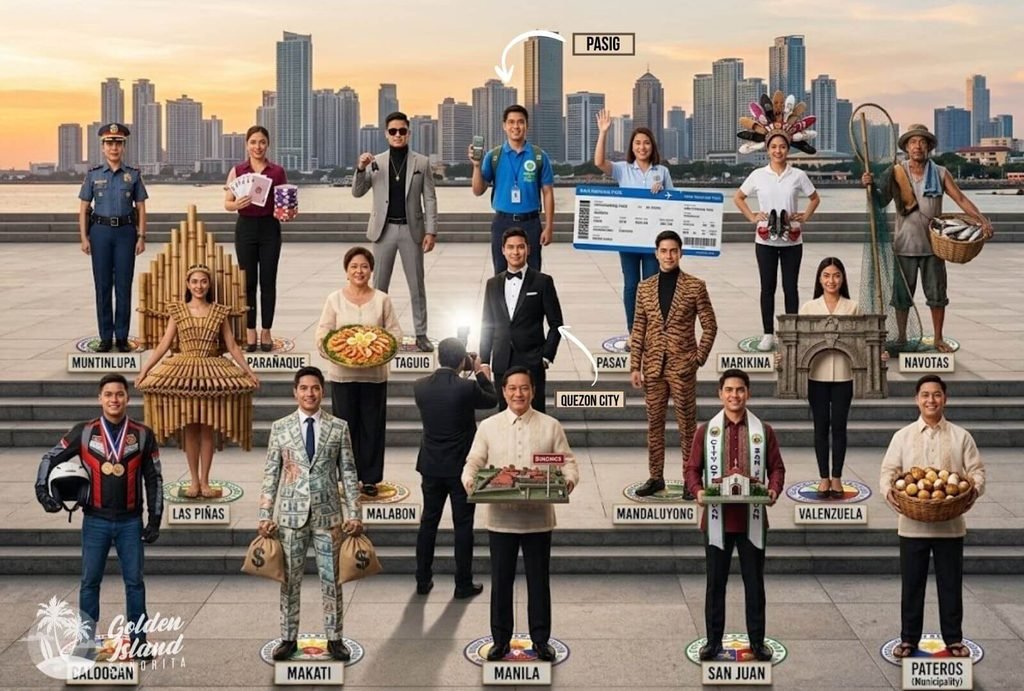
The 17 Local Governments of Metro Manila (Meet the Cast)
Now for the part where we meet everyone. Metro Manila consists of 16 cities and 1 municipality. Let’s go through them like roll call on the first day of school, with a short, affectionate description of each.
- Manila: The capital, the historic center, the OG. Intramuros, Binondo, Rizal Park, and Malacañang Palace live here.
- Quezon City: The biggest city by population (nearly 3 million people) and by land area. It was named after President Manuel Quezon and was once the capital. Home to the University of the Philippines Diliman, many TV networks, and an endless buffet of restaurants.
- Makati: The financial heart. Skyscrapers, high-end malls, the Ayala business district, and more coffee shops per square meter than should be legally allowed.
- Taguig: Home to Bonifacio Global City (BGC), a shiny, modern district of glass towers, street art, and rooftop bars. If Makati is the classic business suit, BGC is the stylish sneaker version.
- Pasig: A mix of business and home. It’s the location of the Ortigas Center (shared with neighboring cities), the Kapitolyo food scene, and a river that has been through a lot and is slowly being rehabilitated.
- Mandaluyong: A compact city with big malls and a growing skyline. It shares the Ortigas business district with its neighbors.
- San Juan: One of the smallest cities, but with a big personality. It’s famous for its annual Wattah Wattah Festival, where everyone gets thoroughly drenched in the name of tradition.
- Pasay: Home to the airport (more on that in a moment), the SM Mall of Asia complex, and the Cultural Center of the Philippines.
- Parañaque: Shares the airport territory with Pasay and also hosts casinos, seafood markets, and the famous Baclaran church.
- Las Piñas: Known for its unique Bamboo Organ, the only one of its kind in the world, in a centuries-old church.
- Muntinlupa: The southern gateway. Think Alabang, a leafy, upscale area full of gated villages and shopping malls.
- Marikina: The “Shoe Capital of the Philippines,” known for being relatively tidy, bike-friendly, and rather proud of it.
- Caloocan: A large, two-part city split into northern and southern sections that aren’t physically connected. Yes, the city is in two pieces. Yes, that is as confusing as it sounds.
- Malabon: Famous for its food, especially pancit Malabon, a noodle dish that has launched many lifelong loyalties.
- Navotas: The fishing hub of the region. If you’ve eaten Philippine seafood, there’s a decent chance it passed through here first.
- Valenzuela: Industrial and quietly growing, with a reputation for making things, from steel to patis (fish sauce).
- Pateros: The only municipality, and proudly so. It’s famous for balut, the fertilized duck egg that has humbled many brave travelers on reality TV. Pateros is small, charming, and fiercely independent.
There you have it. Seventeen local governments, 17 mayors (with Pateros having a municipal mayor), 17 sets of local ordinances, and one very complicated group chat.
The Four Districts (Because Seventeen Wasn’t Complicated Enough)
To make things easier for planners and, presumably, to give geography teachers something to test, Metro Manila is also divided into four districts:
- Capital District (First District): the City of Manila by itself
- Eastern Manila (Second District): Mandaluyong, Marikina, Pasig, Quezon City, and San Juan
- CAMANAVA (Third District): Caloocan, Malabon, Navotas, and Valenzuela, which together form a name that sounds like a cheerful energy drink
- Southern Manila (Fourth District): Las Piñas, Makati, Muntinlupa, Parañaque, Pasay, Pateros, and Taguig
You don’t need to memorize these, but if a Filipino starts talking about “going to the south” or “living in the east,” now you’ll know they mean parts of the same giant metropolis, and not the opposite end of the country.
So Why Does Everyone Say “Manila” for Everything?
This is where the story gets fun, because the confusion is not your fault. Several perfectly reasonable forces have conspired to confuse you.
Reason #1: The airport. Our beloved Ninoy Aquino International Airport is famously called the “Manila airport,” and its airport code is MNL. Here’s the plot twist: it isn’t in the City of Manila. It sits across the borders of Pasay and Parañaque. You can fly to “Manila” and never actually land in Manila. It’s like ordering a pizza from “Chicago Pizza” and finding out the kitchen is two states away.
Reason #2: Airlines and travel websites. For decades, “Manila” has been the label on tickets, boarding passes, and booking sites. It’s shorthand for “the whole Metro Manila area where you’re headed.” Almost nobody on a flight is thinking about municipal boundaries at 3:00 a.m. with a neck pillow.
Reason #3: History and branding. Manila was the center for hundreds of years, so the name stuck to the surrounding urban sprawl of Metro Manila the way “Kleenex” stuck to tissues. Even Filipinos say “I’m going to Manila” when they’re traveling from a province to Makati or Quezon City. In everyday speech, “Manila” often means “the big city,” and nobody blinks.
Reason #4: Hotels and businesses. A hotel in Makati, deep inside Metro Manila, might call itself “Manila Something-Something” because international visitors recognize “Manila” faster than they recognize “Makati.” It’s marketing. It’s pragmatic. It’s slightly misleading, but nobody means harm.
Reason #5: The “Greater Manila” bonus round. Just to add extra spice, there’s also something informally called Greater Manila Area, which stretches beyond the official region into the nearby provinces of Bulacan, Cavite, Laguna, and Rizal. Together, this mega-region is home to over 20 million people. People who commute from there often say they work in “Manila,” even though they’ve crossed multiple borders to get there. This is the metropolitan sprawl equivalent of a nesting doll: Manila inside Metro Manila inside Greater Manila.
So when someone tells you they’re “from Manila,” the honest answer is: it depends. They could mean the city, the region, or “somewhere near a lot of traffic.”
The Great Cheat Sheet: Manila vs. Metro Manila
Let’s make this crisp. If you remember nothing else, remember this:
| Manila (City) | Metro Manila (NCR) | |
|---|---|---|
| What is it? | A single city | A region of 16 cities and 1 municipality |
| Size | About 43 sq. km | About 636 sq. km |
| Population | Around 1.8 million | Around 13 million |
| Governed by | One city mayor and city council | 17 local governments, coordinated by the MMDA |
| Role | Official capital of the Philippines | National Capital Region |
| Famous for | Intramuros, Rizal Park, Binondo, Malacañang Palace | Business districts, malls, universities, nightlife, and legendary traffic |
| Airport? | Not here, surprisingly | Yes, in Pasay and Parañaque |
If this table were a person, it would be that friend who always says, “Okay, so basically…” and then saves the whole conversation.
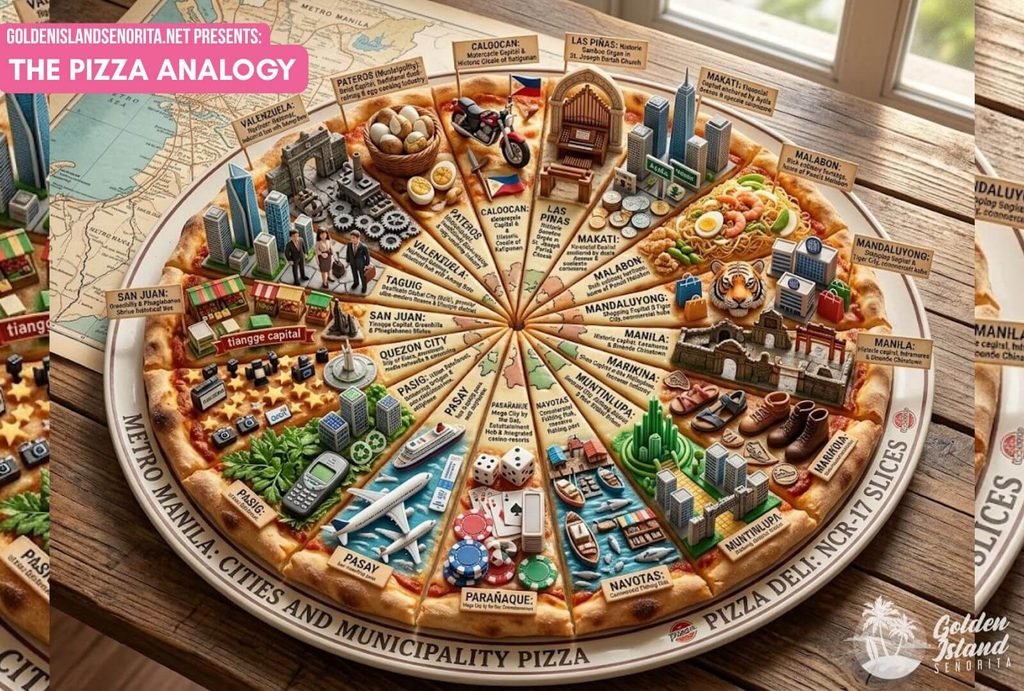
A Handy Way to Remember It: The Pizza Analogy
Here’s the simplest explanation ever invented, and we’re proud of it.
Imagine a giant pizza with 17 slices. That whole pizza is Metro Manila. One of those slices, the oldest, cheesiest, most historic slice, is Manila. It’s got the best toppings (history), the most crowded corner of the box (population density), and the crust everyone fights over (Intramuros).
The other 16 slices each have their own flavor: Makati is the fancy truffle slice, Quezon City is the big supreme with everything on it, Taguig is the trendy slice with arugula, and Pateros is the tiny, mysterious slice with a duck egg on top.
When someone says “I ate pizza in Manila,” they might mean the whole pizza or only one slice. Context is everything. Ask a follow-up question, and you’ll be fine.
What This Means for Your Trip (Practical Tips for Real Humans)
Okay, enough theory. Let’s get practical, because understanding this difference can save you time, money, and several sighs from your Grab driver.
1. Always know which city your hotel is actually in. Don’t just say “Manila.” Say “Makati,” “BGC in Taguig,” “Ortigas in Pasig,” or “Ermita in Manila.” This is the single most useful habit you can build. Travel times between areas can differ wildly, and “close on the map” does not mean “close in real life.”
2. Traffic is not measured in kilometers. Two places that look ten minutes apart on a map may be 90 minutes apart at rush hour. Locals joke that distance in Metro Manila is measured in time, not kilometers, and in emotional damage, not minutes. Always check traffic apps, and give yourself a generous buffer, especially for flights.
3. Use the trains wisely. Metro Manila has several rail lines: LRT-1, LRT-2, and MRT-3, with more under construction. They can be a great way to dodge traffic, especially during peak hours, though they can get crowded. Bring patience, a small bag, and the confidence of someone who has been to a concert in the front row.
4. Embrace the ride-hailing apps. Grab and similar apps are widely used and make navigation easier all over Metro Manila, because you can drop a pin rather than explain “Manila or Manila?” to a driver at midnight.
5. Plan by neighborhood, not by “Manila.” Want history? Base yourself near Intramuros and Ermita in the City of Manila. Want business and modern comforts? Look at Makati or BGC. Want foodie heaven? Try Quezon City’s Maginhawa Street or Pasig’s Kapitolyo. Want beaches and big malls? Head toward Pasay’s Mall of Asia and the bayside. Metro Manila is simply too big to treat as one destination, and thinking in neighborhoods makes the whole trip smoother.
6. Watch out for the coding scheme. Metro Manila has a number-coding rule that restricts certain vehicles from major roads on certain days based on their license plate numbers. If you’re renting a car with a driver, they’ll already know. If you’re driving yourself (brave soul), do your homework.
A Quick Language Lesson: How Filipinos Actually Talk About This
Want to sound like a local? Here’s a tiny vocabulary pack.
- “Taga-Maynila” means “from Manila.” Locals use it casually, often for anyone from the big city area.
- “Taga-Makati,” “taga-QC,” “taga-Pasig” means from the specific city. Filipinos are often proud of their specific city, and a little friendly rivalry is part of the fun.
- “Metro” is the casual shorthand for Metro Manila, the whole urban region. If someone says, “Ang traffic sa metro,” they mean the traffic across the whole region, and yes, they are exhausted.
Common Mistakes (And How to Avoid Embarrassment)
Let’s gently go through the classic blunders so you can skip them.
Mistake #1: Assuming Makati is “in Manila.” It’s in Metro Manila, but it’s its own city. Technically, you’re in Makati, not Manila. Casually calling it “Manila” is fine in conversation, but for addresses and rides, be specific.
Mistake #2: Thinking the airport is in the city of Manila. It’s in Pasay and Parañaque, both part of Metro Manila but neither one the capital. If you’re staying in Intramuros, remember that the ride to the airport takes time, and it may be longer than you’d expect.
Mistake #3: Believing “Manila” and “NCR” are different things. They’re not, in everyday speech. When Filipinos say NCR, they mean Metro Manila. The City of Manila is just one part.
Final Thoughts: Welcome to the Beautiful Mess
Here’s the secret that locals know and tourists slowly discover: the confusion is part of the charm. Metro Manila is not a tidy, perfectly labeled place. It’s loud, warm, crowded, creative, delicious, chaotic, and full of people who will absolutely feed you if you look even slightly hungry. It has sunsets over Manila Bay that rival any postcard, food that will rewrite your definition of comfort, and a spirit of resilience you’ll carry home with you.
So next time someone asks, “Wait, what’s the difference between Manila and Metro Manila?” you can lean back, smile, and say: “One is a city. The other is a city’s very large, very ambitious family reunion.”
And if your Grab driver asks, “Manila… or Manila?” you now have a better answer than “Uh… yes?” You’ll say the actual name of your neighborhood. And the driver, finally relieved, will nod and say, “Okay, sir/ma’am,” and the adventure will begin.
Welcome to the Philippines. Bring an umbrella, an appetite, and a sense of humor. You’ll need all three, and you’ll love every minute of it.
Sources and Credits
The facts and figures in this article were checked against the sources below (accessed October 12, 2026).
Population, cities, and size
- Philippine Statistics Authority: 2020 Census results for the National Capital Region. Source for the 13,484,462 population, Quezon City (2,960,048) and Manila (1,846,513) as the biggest cities, and Pateros as the only municipality.
- PSA Regional Office, NCR: Highlights of the NCR Population. Source for the 16 cities plus one municipality and for population density by city.
- Wikipedia: the National Capital Region article. Source for the 636 sq. km area and the full list of cities. PSA’s 2013 land survey gives 619.54 sq. km, so published area figures vary slightly.
History of Manila, and the region (Metro Manila)
- Encyclopaedia Britannica: History of Manila. Source for the Muslim settlement on the Pasig River, the 1571 Spanish arrival, Intramuros, and Manila becoming the capital of the independent Republic in 1946.
- Wikipedia: Manila and Wikipedia: Intramuros. Source for Legazpi’s 1571 founding of the walled city and the origin of the city’s name.
- Philippine Daily Inquirer: “Binondo: Oldest Chinatown in the world” and Wikipedia: Binondo. Source for Binondo’s 1594 founding.
- Wikipedia: Metropolitan Manila Development Authority. Source for Presidential Decree No. 824 (November 7, 1975), Presidential Decree No. 940 (1976), which restored the City of Manila as the capital, and Republic Act No. 7924 (1995).
- Philippine Daily Inquirer: “Did You Know: MMDA history” and PIDS: “What exactly does the MMDA do?”. Source for how the MMDA was created and what it handles, such as traffic, flood control, and sewerage.
Notes
- The “may-nilad” (place of the nilad plant) story is the popular explanation of the name “Manila.” Some historians argue it may instead come from nilà, the indigo plant, so treat it as a well-loved tradition rather than settled fact.
- Light-hearted details such as local food, festivals, and neighborhood descriptions are general knowledge and are not individually sourced. Check current train lines, number-coding rules, and travel advisories with the MMDA and your carrier before you go.

Polly Amora
Polly Amora is the señorita behind GoldenIslandSenorita.Net. A corporate warrior by day, and a perpetual explorer by heart. She is a lifelong learner who is very outgoing, speaks four languages, loud & outspoken, and loves to have adventures in the mountains, on the beach, and in the city. You can throw her anywhere, and she'll handle it like a pro. Ice cream and bourbon are two of her weaknesses.

You May Also Like
Ultimate San Juan City Guide: Must-See Attractions, Best Eats & Top Shopping Spots!

Takashi Japanese Cuisine at Pioneer Center, Pasig City : An Honest & Complete Review
