
My Favorite Filipino Food: 15 Ultimate Dishes That Will Make You Want to Book a Ticket to Manila ASAP
Let me tell you something about my relationship with food: it’s complicated, it’s passionate, and it involves a lot of rice. Growing up Filipino means growing up in a household where “Have you eaten yet?” is practically a love language, and where the answer to every problem — heartbreak, bad grades, a bad day at work — is a steaming pot of something that smells like heaven and tastes even better.
So when someone asks me to rank my favorite Filipino food, I don’t just answer. I feel it. I feel it in my soul, my stomach, and sometimes my cholesterol levels. But no regrets — every bite is worth it.
From braised oxtail swimming in peanut sauce to a plastic bag full of fish balls eaten on a street corner at 2 PM, my list of favorite Filipino food is as diverse, loud, and deeply sentimental as the culture itself. And honestly? If you’ve never experienced favorite Filipino food in all its colorful, salty, sour, spicy, and sweet glory, you are missing a profound chapter in world cuisine. So buckle up, grab your rice (always extra rice), and let’s talk about the 15 dishes that have my whole heart.
Table of Contents
🍖 MAINS & ULAM: The Stars of the Dinner Table
These are the dishes that make you scoop rice three times and feel zero shame about it. My favorite Filipino food in this category is basically my love language.

1. Kare-Kare
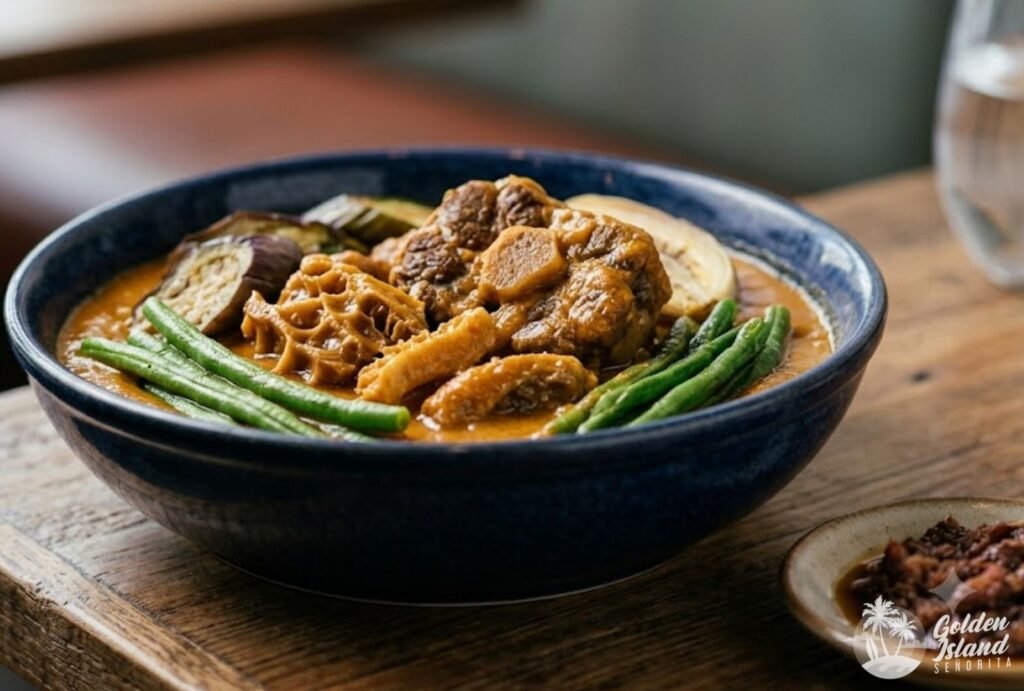
If there’s one dish that screams special occasion in Filipino households, it’s Kare-Kare — and rightfully so, because it’s one of the most iconic favorite Filipino food dishes you’ll ever encounter. This rich, golden stew is made from oxtail (sometimes tripe or beef shanks), slow-cooked until fall-off-the-bone tender, and bathed in a luxuriously thick peanut sauce that’s nutty, savory, and slightly sweet all at once. The sauce gets its beautiful golden color from ground toasted peanuts and annatto, giving it that unmistakable sunset hue.
Originating from the Pampanga region — widely considered the culinary capital of the Philippines — Kare-Kare is a Kapampangan masterpiece. It’s served alongside bagoong (fermented shrimp paste), which is the salty, punchy counterpart to all that richness. The contrast is unreal.
Why do I love it? Because Kare-Kare is the dish my lola makes when she wants to say “I love you” without saying it. It takes hours of patience to get right, and every time I eat it, I feel that love in every single bite. Among my favorite Filipino food, Kare-Kare holds a permanent place of honor.
2. Bistek Tagalog
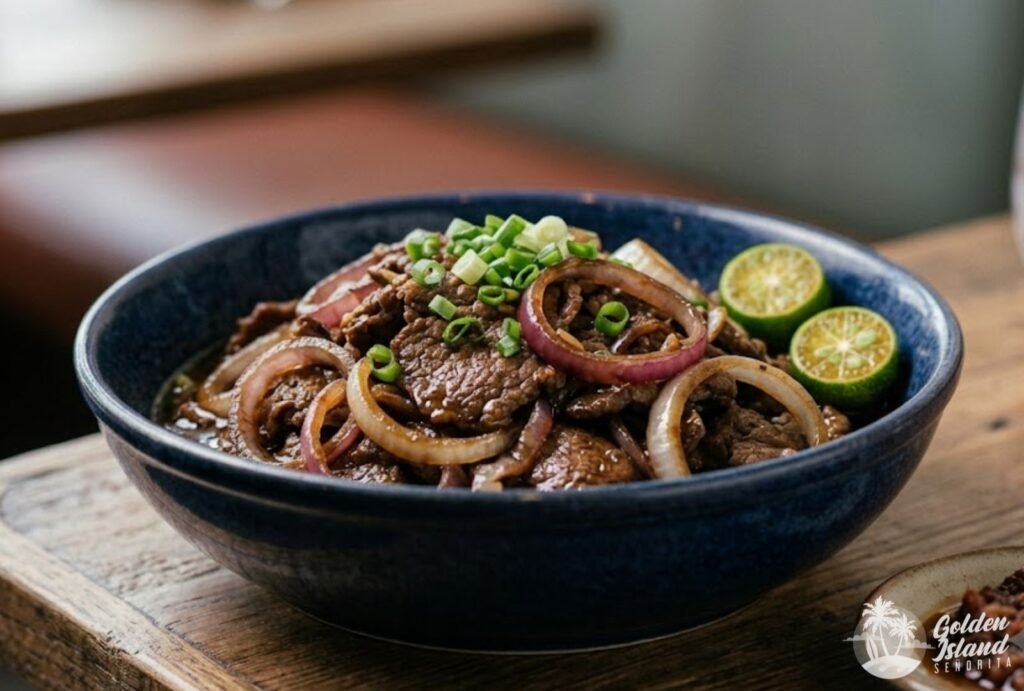
Don’t let the simple ingredients fool you. Bistek Tagalog — thinly sliced beef marinated and braised in calamansi juice and soy sauce, topped with caramelized onion rings — is one of the most quietly brilliant dishes in Filipino cuisine.
This is essentially the Philippines’ answer to a beef steak, but with a distinctly local twist: that bright, citrusy marinade made from calamansi (our local lime) does something magical to the beef, tenderizing it while adding a tartness that perfectly balances the salty soy sauce. The onions, softened and slightly sweet from the braising liquid, complete the whole picture.
Bistek Tagalog, as the name suggests, originates from the Tagalog-speaking regions of Luzon. It’s a humble, everyday dish — the kind you eat over white rice on a Tuesday when you want something comforting but not too heavy.
I love it because it’s proof that simple things done well are always enough. Bistek Tagalog is one of my favorite Filipino food dishes precisely because it never tries too hard, yet it always delivers. It’s the kind of quiet greatness that reminds you why favorite Filipino food is truly something special.
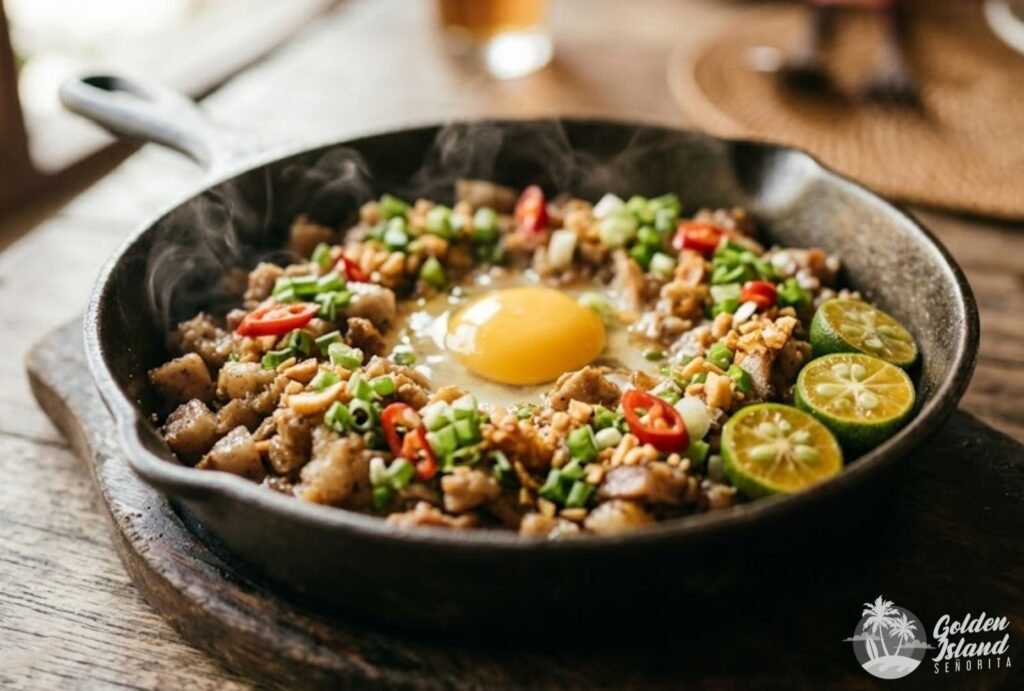
3. Sizzling Sisig
Tsssssss. That sound. If you know, you know.
Sisig arrives at your table on a screaming hot cast-iron skillet, crackling and spitting with oil and flavor, and the whole restaurant turns to look. Made from chopped pork face and ears (yes, really — stay with me), chicken liver, calamansi, chili, and onions, Sisig is the kind of dish that makes non-adventurous eaters nervous and adventurous eaters extremely happy.
The original Sisig was actually a cold, sour salad — a Kapampangan delicacy — but it was Chef Lucia Cunanan of Angeles City, Pampanga, who reinvented it into the sizzling pork version we know and love today. She gets full credit for one of the greatest culinary glow-ups in history.
Sisig is one of my all-time favorite Filipino food dishes because it’s dramatic, flavorful, and pairs dangerously well with cold beer. If I had to eat one thing for the rest of my life, Sisig would be in serious contention. It’s crispy, savory, tangy, and deeply satisfying in a way that few things in this world are.
🌶️ MAINS & ULAM: BICOL & BEYOND – The Spicy Ones
For those of us who believe that flavor and fire are best friends, these dishes hit different. My favorite Filipino food from this corner of the country brings the heat — and I’m not just talking about temperature.
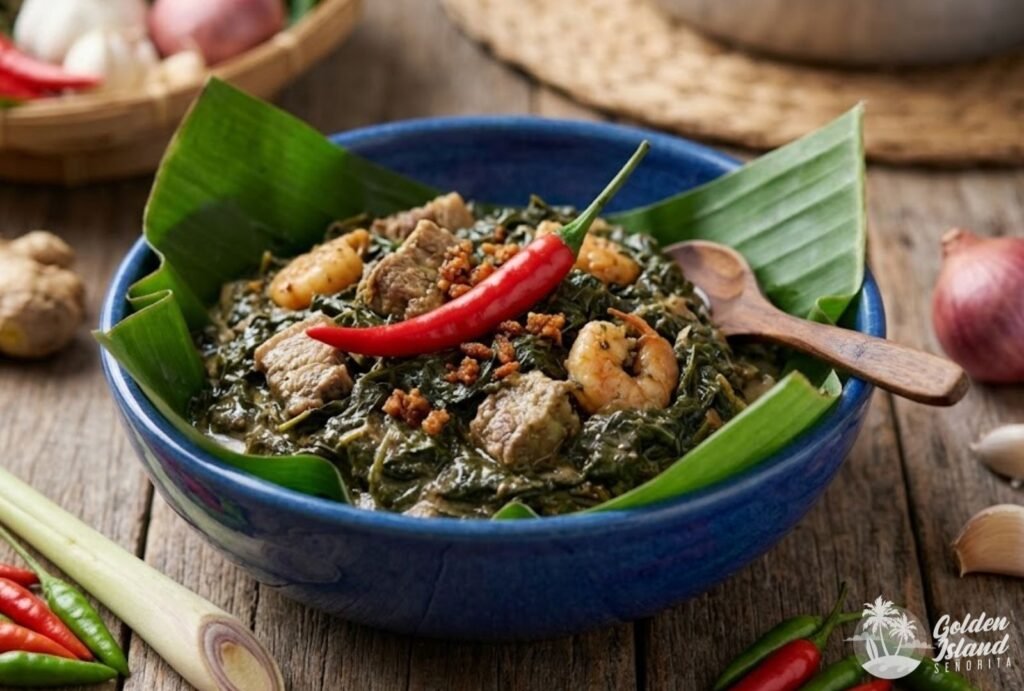
4. Laing
Laing is what happens when the Bicolanos — a people famous for their love of chili — take dried taro leaves and braise them low and slow in coconut milk with lots and lots of chili. The result is a deeply rich, slightly smoky, fiery dish that is absolutely addictive.
Hailing from the Bicol region in southern Luzon, Laing is one of those dishes that gets better the longer it sits. The dried taro leaves rehydrate in the coconut milk, absorbing all that spicy, creamy goodness until they’re impossibly silky. It’s usually cooked with pork, shrimp paste, and enough chili to make your forehead sweat — which in favorite Filipino food culture is actually a sign that you’re eating something great.
Laing holds a special place among my favorite Filipino food because it tastes like adventure. Every bite is a bold, unapologetic flavor experience, and I respect that deeply.
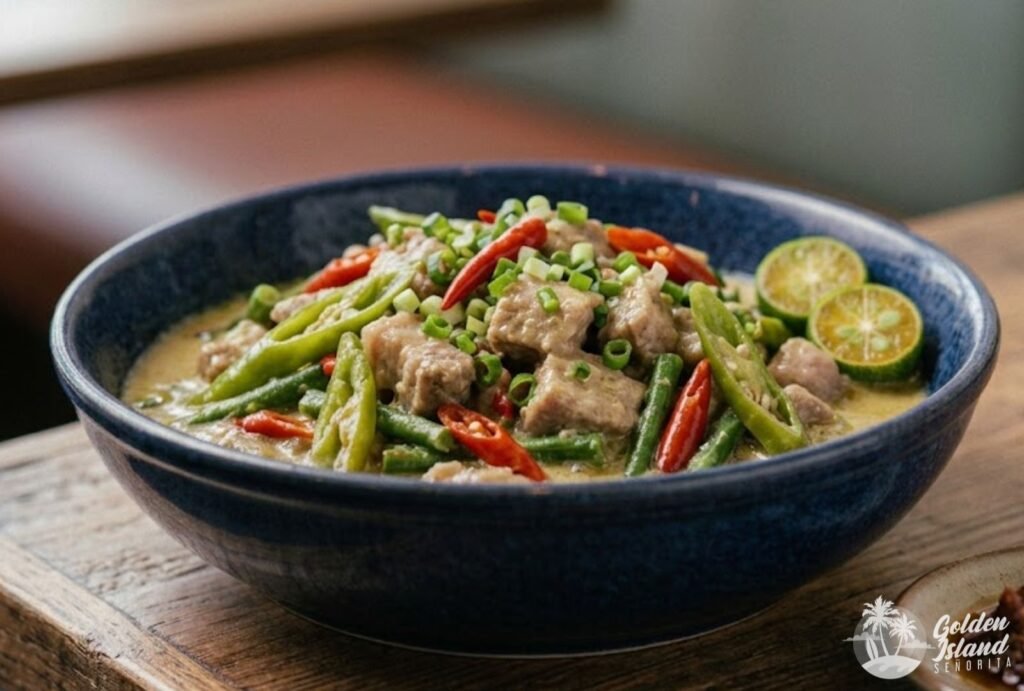
5. Bicol Express
More Bicolano magic, because clearly one dish wasn’t enough to represent that region’s genius. Bicol Express is a stew of pork, shrimp paste, and a truly aggressive amount of chili peppers, all simmered in creamy coconut milk until thick and fragrant.
The name “Bicol Express” is actually a nod to a train that used to run from Manila to the Bicol region — the dish was apparently named after it by a Manila restaurant that popularized it. But the flavors? Those are 100% Bicolano soul.
What separates Bicol Express from Laing is the texture — here, you get tender chunks of pork and whole chili peppers in that rich, spiced coconut sauce. It’s creamy, spicy, savory, and deeply comforting all at once.
As a lover of all things coconut-milk-based, Bicol Express is absolutely one of my favorite Filipino food dishes. It makes plain white rice taste like a five-star meal, and that’s the highest compliment I can give anything.
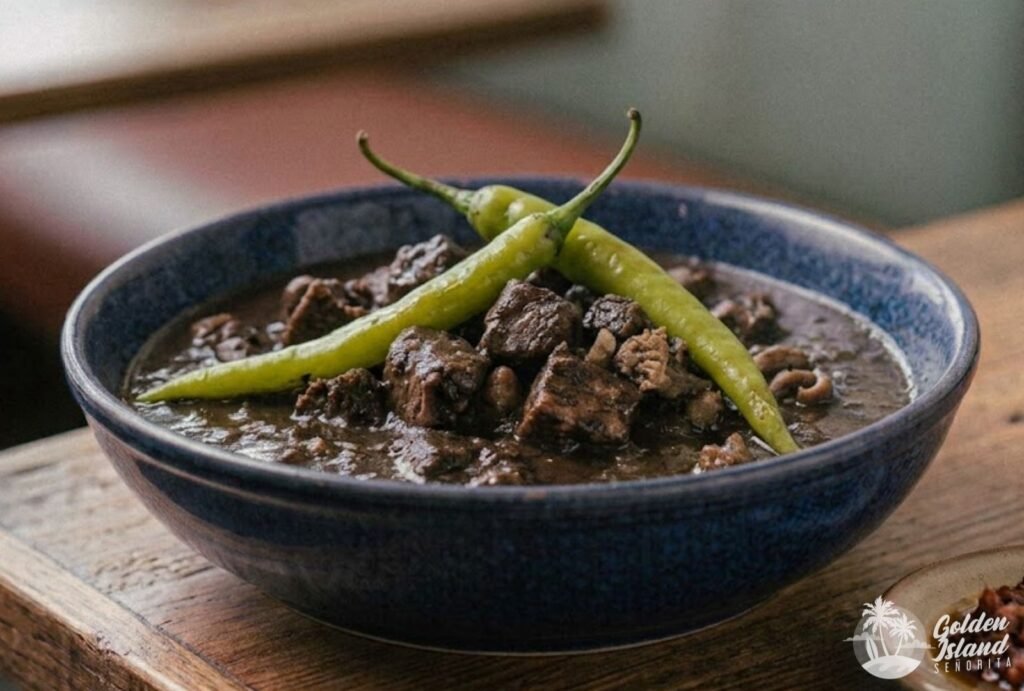
6. Dinuguan
Okay, brave hearts, this one’s for you. Dinuguan is a savory pork blood stew — yes, blood stew — simmered with pork innards, garlic, vinegar, and chili until it’s dark, glossy, and deeply flavorful. It looks intimidating. It smells incredible.
The dish goes by many colorful nicknames in Filipino culture: “chocolate meat” (for obvious visual reasons), or in Pampanga, tidtad. Dinuguan is eaten all over the Philippines, though versions vary by region — some are tangier, some are spicier, and some are smoother than others.
Why is Dinuguan on my list of favorite Filipino food? Because once you get past the concept, you discover a dish that’s truly extraordinary. The blood gives it a rich, iron-y depth that no other ingredient can replicate, and the vinegar brightens everything up. Eat it with puto (white rice cakes) on the side, and you’ve got a combination so good it practically transcends reality.
🫕 SOUPS & BRAISES: The Comfort Food Category
These are the dishes you want when life gets hard, when you’re sick, when it’s raining, or when you just need your soul refilled. The warmest corner of my favorite Filipino food list lives right here.
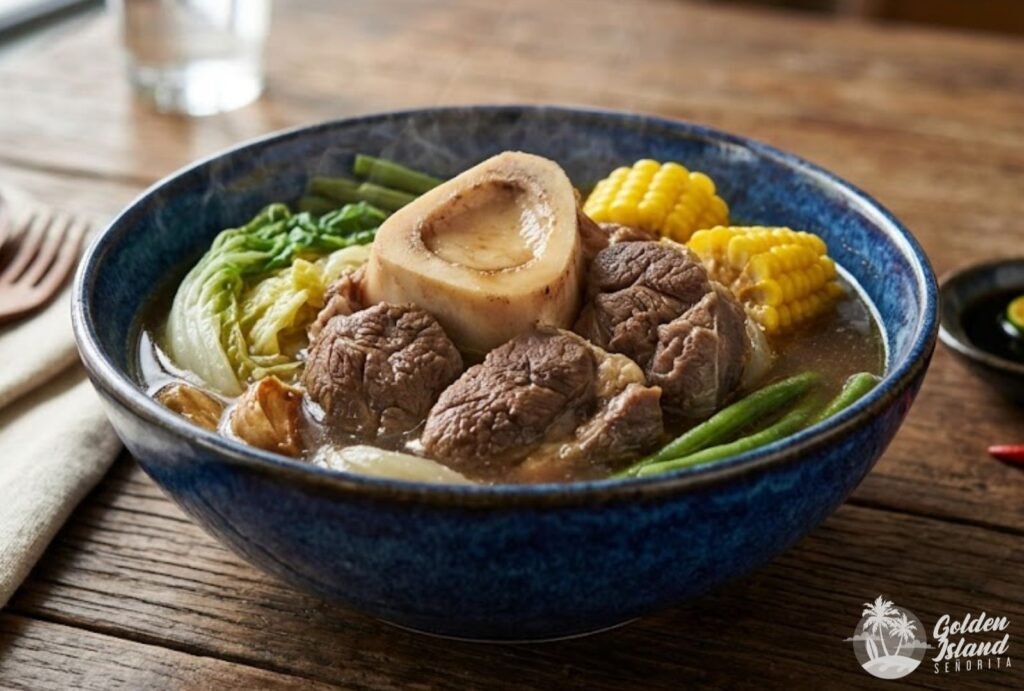
7. Bulalo
Bulalo is a bone marrow and beef shank soup cooked so long and lovingly that the marrow melts right out of the bone and turns the broth into something almost criminally rich. It’s a clear, golden soup that tastes like it took someone’s grandmother eight hours to make — because it probably did. As favorite Filipino food goes, Bulalo is the one that truly warms you from the inside out.
This dish is most associated with Batangas province in Southern Tagalog, where it’s eaten as a warming meal against cooler highland temperatures. The soup is typically loaded with corn, cabbage, and pechay (Chinese cabbage), making it a hearty, complete meal in a bowl.
Here’s what I love about Bulalo: that bone marrow. Scooping out the soft, buttery marrow, spreading it on crusty bread (or just eating it straight off the bone like the dignified person I am), and finishing it with a squeeze of calamansi — that ritual is one of the purest joys in my favorite Filipino food experience.
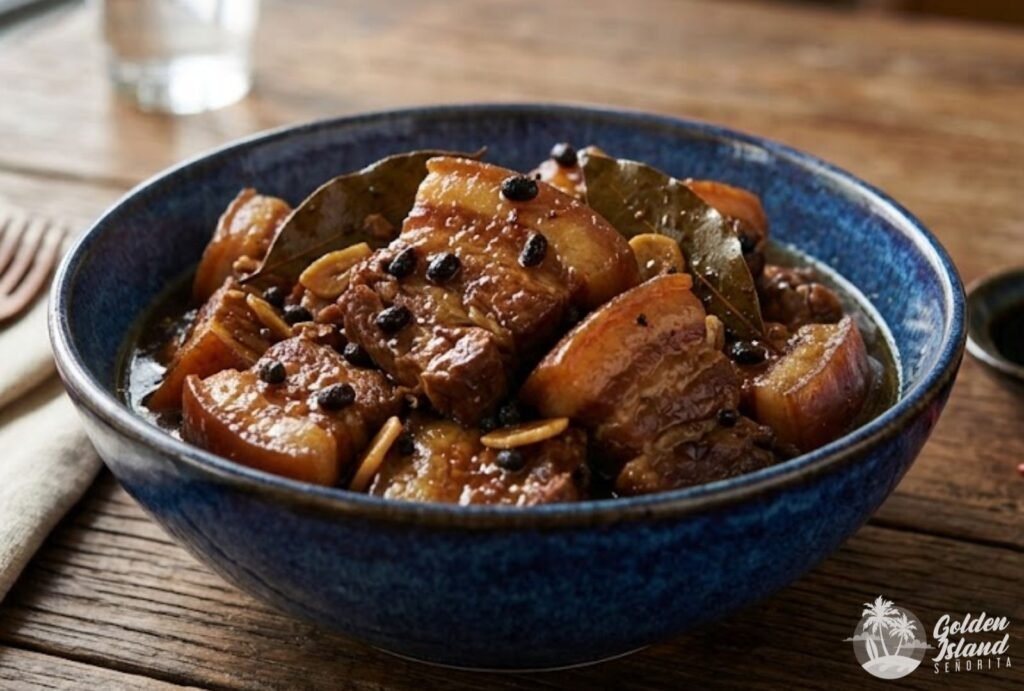
8. Humba
Humba is the Visayan cousin of the more famous adobo, and honestly, it deserves its own spotlight. This braised pork dish is slow-cooked in vinegar, soy sauce, sugar, banana blossoms, and black beans — the result is a sticky, sweet-savory masterpiece that makes you want to pour the braising sauce directly on your rice (don’t judge me; you’d do it too).
Originating from the Visayas region, particularly Cebu and the surrounding islands, Humba reflects the distinct flavor philosophy of southern Filipino cooking — sweeter, more aromatic, and deeply layered. The banana blossoms add a slight floral note, and the black beans contribute a creamy depth that’s unlike anything you’ll find in the northern versions of braised pork. It’s one of those favorite Filipino food dishes that makes you realize how gloriously regional this cuisine really is.
Humba earns its place among my favorite Filipino food because it’s the underdog that consistently outperforms expectations. Every time I eat it, I wonder why it doesn’t get more national recognition. The answer, of course, is that people from Cebu already know they have something special, and they’re not sharing.
🍌 STREET FOOD & MERIENDA: The Snacks That Raised Me
There’s a whole category of my favorite Filipino food that exists outside the dining table — in carts, on skewers, in plastic bags tied with rubber bands. Ask any Filipino to name their most nostalgic favorite Filipino food moment and at least half of them will describe standing at a street cart, skewering fish balls with friends. These are the snacks of my childhood, my weekday afternoons, and my nostalgia.
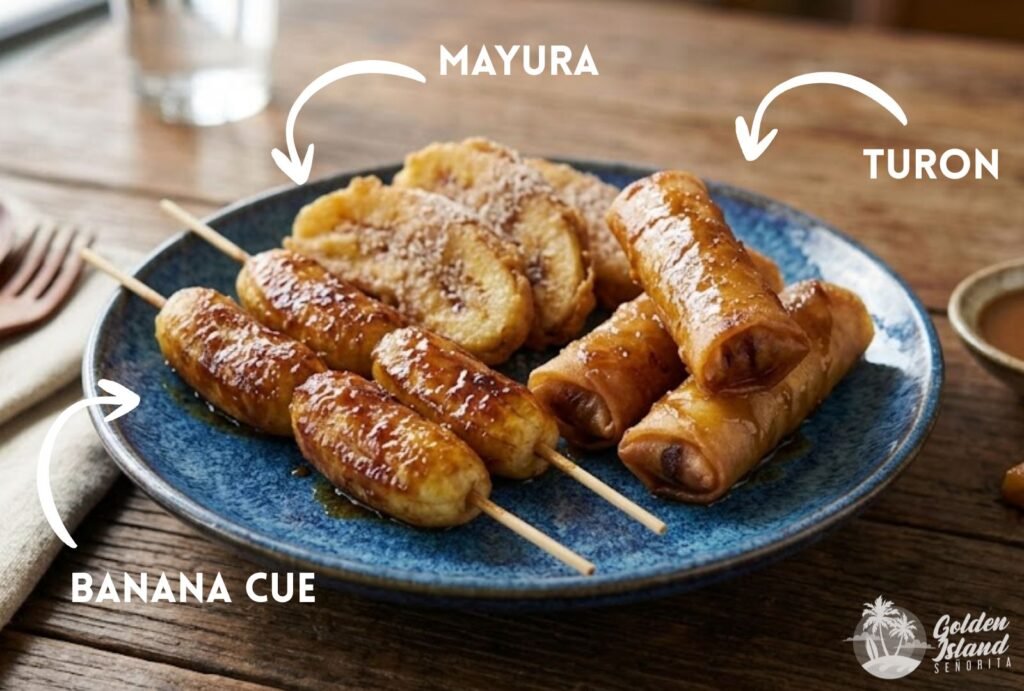
9. Banana Cue, Maruya & Turon
Let’s talk about the holy trinity of banana-based merienda. These three snacks deserve to be mentioned together because they are the ultimate expression of what Filipinos can do with a single fruit and a frying pan.
Banana Cue is skewered saba banana, deep-fried and coated in caramelized brown sugar until it’s sticky and crisp on the outside and soft on the inside. It’s sold on bamboo skewers at practically every street corner in the country.
Maruya is banana fritter magic — saba bananas sliced thinly, fanned out, dipped in batter, and fried until golden and crispy. It’s the version you eat warm, dusted with sugar, usually around 3 PM.
Turon is the wrapped cousin — saba banana (and often jackfruit) rolled in a lumpia wrapper with brown sugar and fried until shatteringly crisp and golden. The caramelized sugar seeps out and creates these lacy, crunchy edges that are absolutely irresistible.
All three of these are in my favorite Filipino food hall of fame, and if you disagree, I’ll eat yours too.
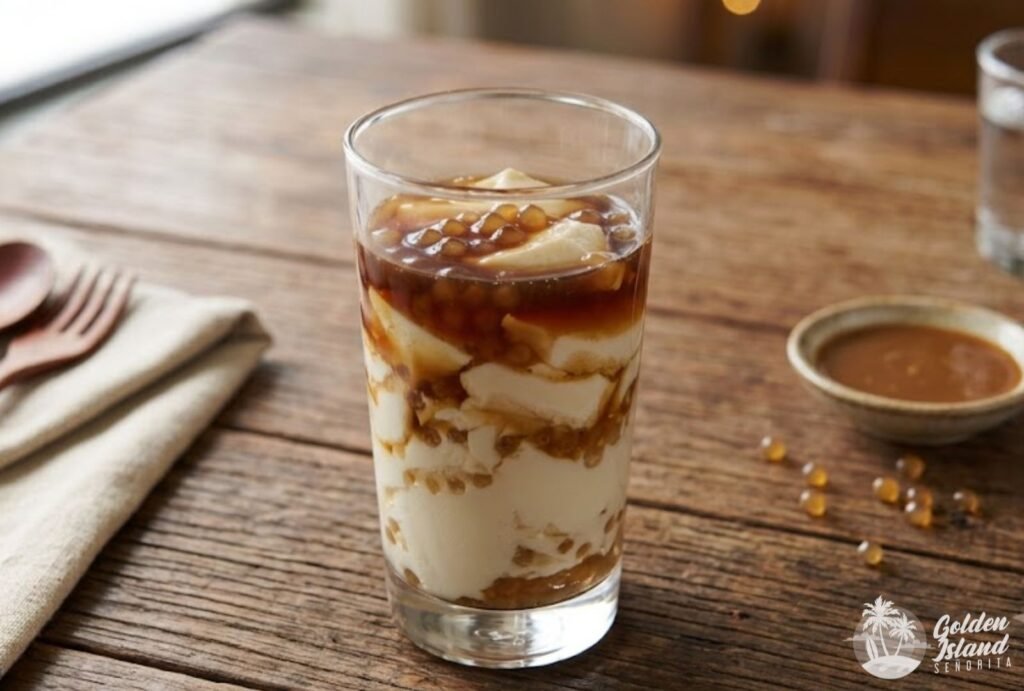
10. Taho
“Tahooooo!” — the call of the magtataho, who walks your neighborhood every morning with two huge silver buckets and a ladle, is one of the most universally Filipino sounds in existence.
Taho is silken tofu topped with arnibal (a warm brown sugar and vanilla syrup) and sago (tapioca pearls). It’s sweet, warm, wobbly, and somehow both filling and delicate at the same time.
This beloved breakfast and morning snack has roots in Chinese-Filipino culture, adapted over centuries into the distinctly Filipino version we know today. As a piece of favorite Filipino food history, it’s a beautiful example of how Filipino cuisine absorbs outside influences and transforms them into something entirely its own. Regional variations exist — in Baguio, you’ll find strawberry taho made with local strawberries, which is an upgrade I didn’t know I needed until I had it.
Taho is one of the most emotionally resonant entries in my favorite Filipino food list. Because taho isn’t just a snack. It’s a childhood. It’s Sunday mornings. It’s running to the gate in your pajamas with a cup in hand.
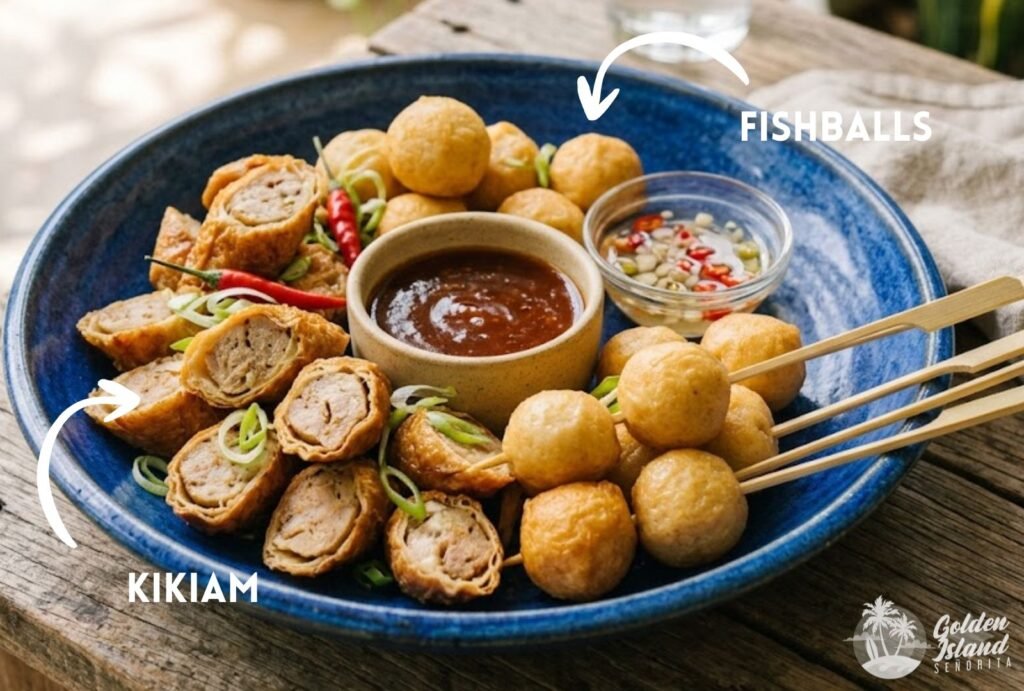
11. Fish Balls & Kikiam
Now we enter the sacred territory of street food — and nothing is more street food than fish balls and kikiam.
Fish balls are deep-fried balls made from fish paste, sold on skewers from rolling carts on every busy street in the Philippines. The ritual: skewer as many as you want, fry them in the communal oil, and dip them in your sauce of choice — sweet sauce, vinegar sauce, or the ultimate combo of both.
Kikiam (or que-kiam) is a Chinese-inspired meat roll made from ground pork and vegetables wrapped in tofu skin and fried. It’s sliced into pieces and also dipped in those same magical sauces.
The best part of the fish ball experience, honestly, is the communal dipping bowl. Everyone dipping into the same sauce, standing around the cart like it’s a perfectly natural activity — that’s Filipino street culture at its finest.
These are in my favorite Filipino food canon not because they’re sophisticated, but because they’re real. Fish balls and kikiam are democracy on a stick.
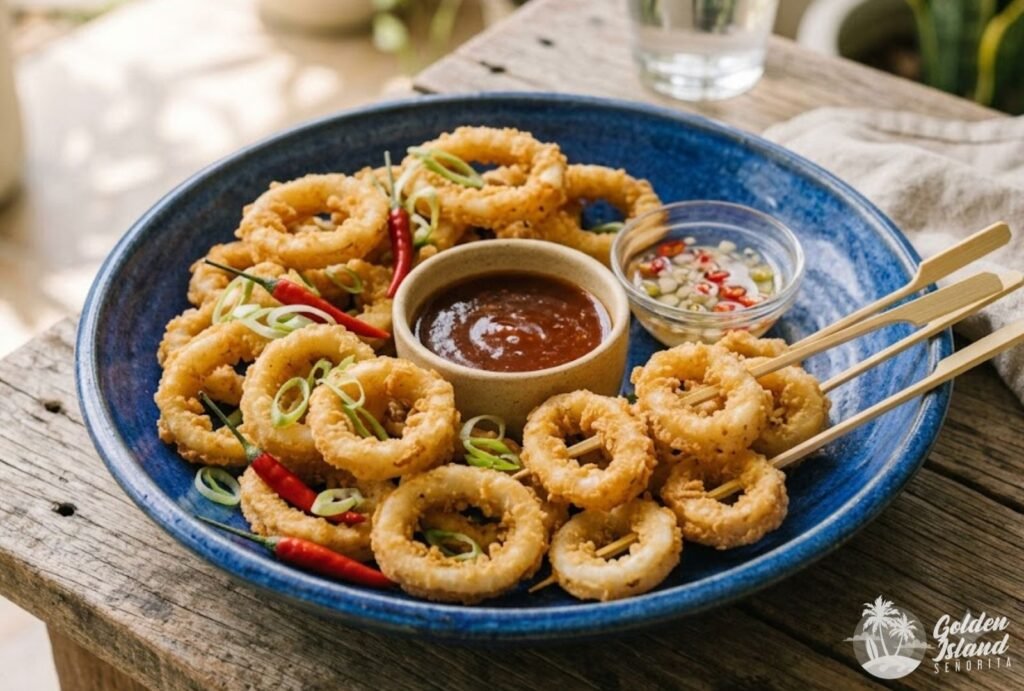
12. Calamares
Yes, technically calamares (calamari / fried squid rings) is international, but Filipinos have made it their own — and the Filipino version is something truly special.
In Filipino cooking, calamares are marinated before frying, often with calamansi juice and a touch of seasoning, then dredged in a light batter that fries up incredibly crispy without being heavy. The squid itself stays tender inside. It’s served with a spiced vinegar dip or a garlic aioli, and it disappears from the plate in approximately 45 seconds.
Found at everything from seaside restaurants to birthday parties to beer-and-pulutan nights, Calamares is one of those favorite Filipino food staples that bridges the gap between fancy and casual. You can serve it as a bar snack at a videoke night or as an appetizer at a sit-down dinner, and it works every single time.
🍮 SWEETS & DESSERTS: The Grand Finale
No list of favorite Filipino food is complete without dessert — and Filipino desserts are a whole universe unto themselves. When people talk about favorite Filipino food, they often focus on the savory side, but I’m here to tell you: the sweets are just as extraordinary. Creamy, sweet, colorful, and deeply tropical, these are the dishes that make ending a meal feel like a reward.
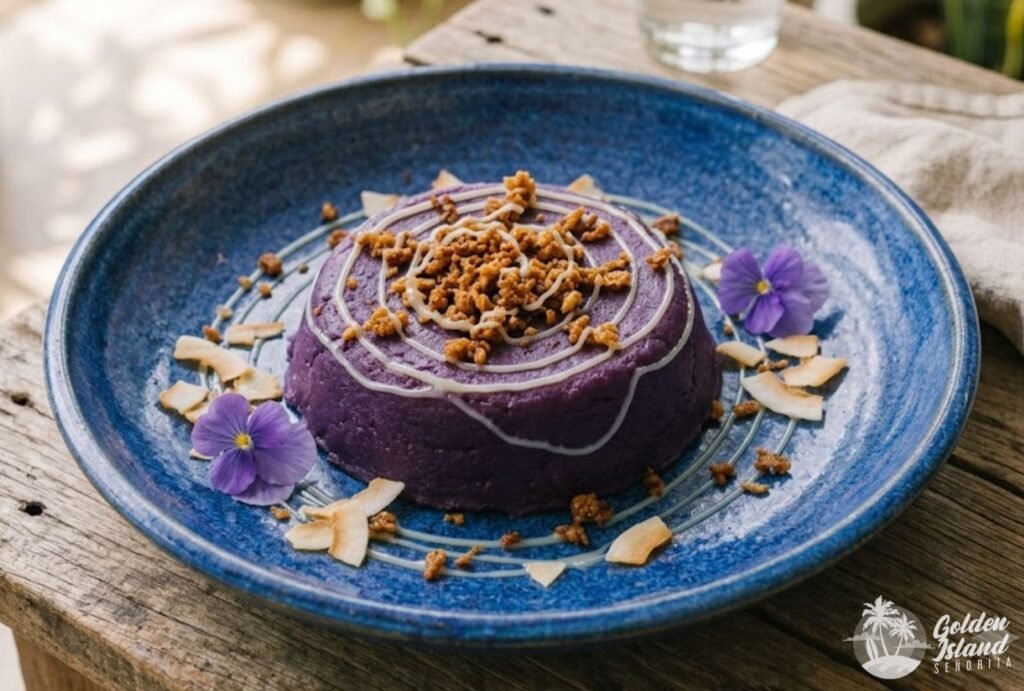
13. Ube Halaya
Before ube went global and started appearing in lattes and croissants at Brooklyn coffee shops, Ube Halaya was quietly winning hearts in every Filipino household, fiesta table, and pasalubong box.
Ube Halaya is a jam made from purple yam — boiled, mashed, and cooked with coconut milk, butter, and condensed milk until thick, glossy, and deeply purple. The color is naturally that stunning violet-indigo hue; no food coloring needed.
The flavor is hard to describe to someone who hasn’t tried it: it’s creamy, slightly earthy, subtly sweet, and unmistakably tropical. It tastes like a dessert that’s been dreamed up specifically to be both beautiful and satisfying.
Ube Halaya is one of my most beloved favorite Filipino food sweets because it’s ours. Before the rest of the world discovered ube, we were already eating it at birthday parties in little cups with coconut cream on top. We knew what we had.
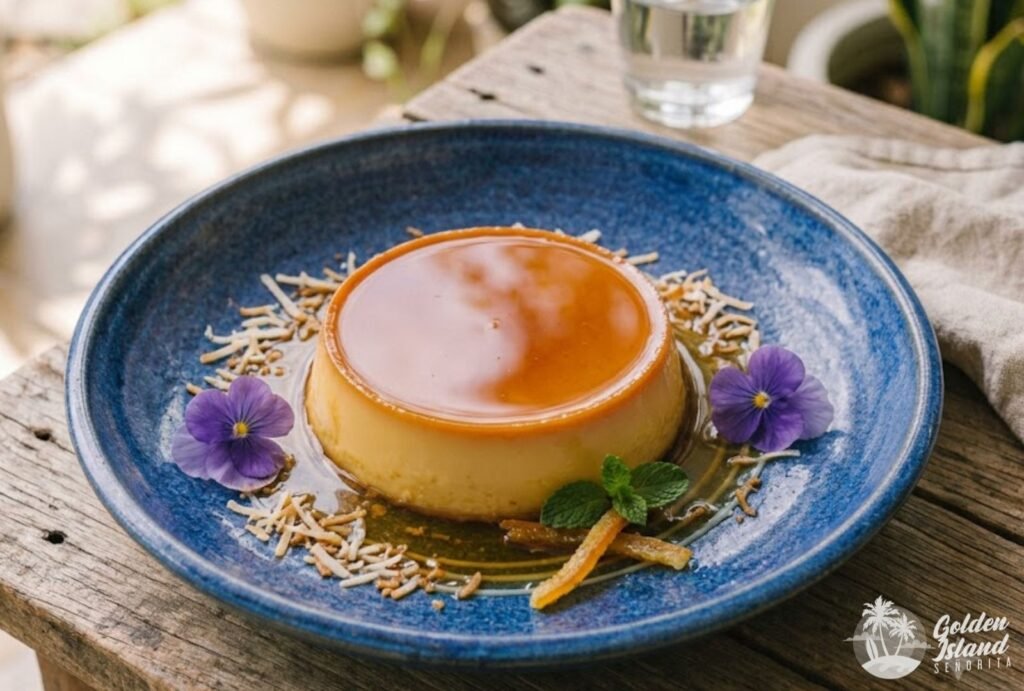
14. Leche Flan
If Leche Flan were a person, it would be the elegant aunt who shows up to family reunions in a silk blouse and somehow outshines everyone without even trying.
Filipino Leche Flan is a custard dessert made from egg yolks, condensed milk, and evaporated milk, steamed in an oval llanera mold until it’s silky smooth, then unmolded to reveal a golden caramel glaze that runs down the sides like liquid amber. It’s denser and richer than Spanish flan, with more yolks and a more concentrated sweetness — because Filipinos don’t do things halfway.
Leche Flan is found at every fiesta, every family gathering, every handaan from Batanes to Tawi-Tawi. It’s the dessert that says “we’re celebrating,” even when the celebration is just a regular Saturday. No other favorite Filipino food dessert commands the same reverence at the table — the moment the llanera is unmolded, everyone leans in.
A staple in my roster of favorite Filipino food desserts, Leche Flan is the one dish where I abandon all self-control and simply eat as much as humanly possible. No regrets. Never.
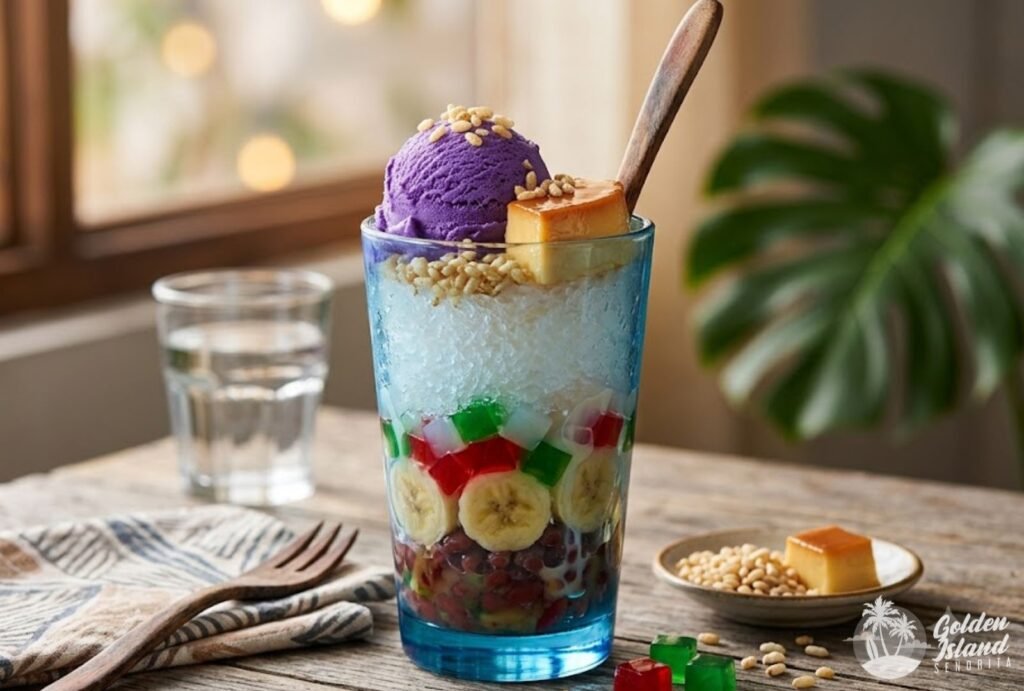
15. Halo-Halo
We end on the greatest dessert the Philippines has ever produced. Halo-Halo — which literally means “mix-mix” — is the beautiful, chaotic, magnificent expression of Filipino creativity in a tall glass.
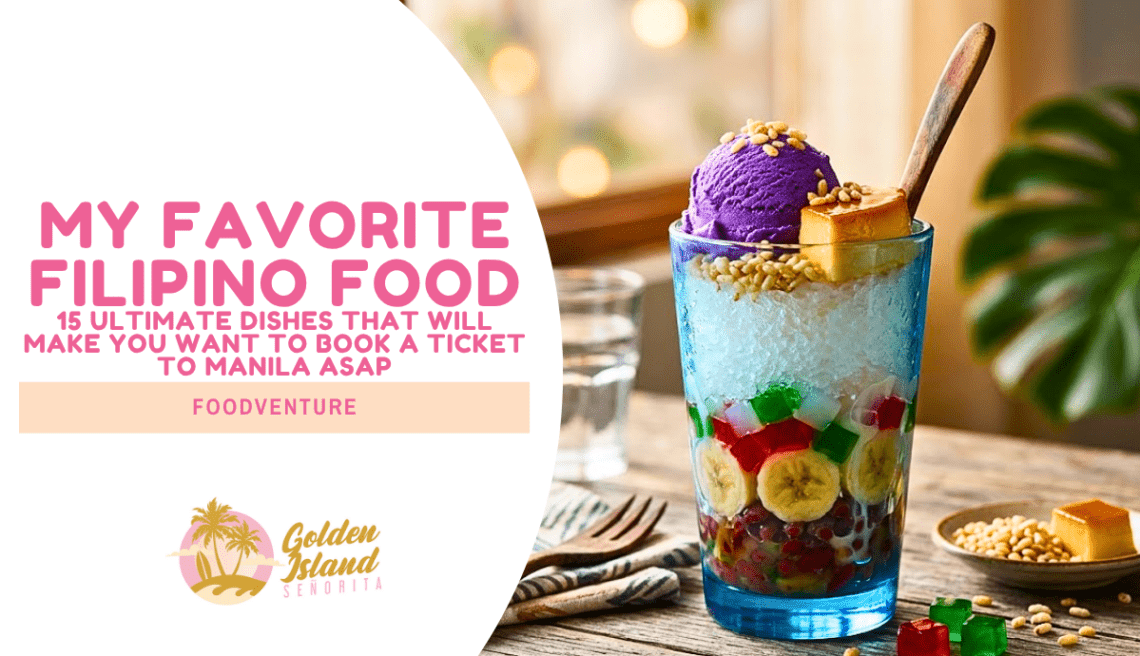
Here’s what’s in it: shaved ice, evaporated milk, ube halaya (look, it shows up again), Leche Flan (there it is!), sweetened beans, nata de coco, kaong (sugar palm fruit), sweetened plantains, gulaman (agar jelly), sweet corn, and — traditionally — a scoop of ube ice cream on top. Sometimes there’s pinipig (toasted rice crispies) for crunch. It’s a lot. It’s supposed to be.
The art of Halo-Halo is in the mixing: you get the perfect bite only when you’ve stirred all the layers together into a gloriously cold, creamy, multi-textured mess. It looks like a party. It tastes like summer.
Halo-Halo is, without question, the crown jewel of my favorite Filipino food list. It’s the dessert that perfectly encapsulates what Filipino food culture is about: abundance, generosity, creativity, and the firm belief that more is always better. If you want to understand favorite Filipino food in a single bowl, this is it.
Final Thoughts
Here’s the thing about my favorite Filipino food that this list barely scratches the surface of: every single dish tells a story. Kare-Kare speaks of family gatherings and lola’s patience. Sisig speaks of Kapampangan ingenuity. Street food — the fish balls, the banana cue, the taho — speaks of the Philippines’ extraordinary ability to find joy and community in the simplest, most accessible things.
My favorite Filipino food isn’t just fuel. It’s identity. It’s memory. It’s love served on a banana leaf or in a plastic bag or on a sizzling skillet. And every time I eat any of these dishes, I’m not just eating — I’m coming home. That’s the magic that makes favorite Filipino food unlike anything else in the world.
So whether you’re Filipino and you’re nodding along to every single item on this list, or you’re a non-Filipino who’s now wildly curious about what this food scene has to offer — welcome. The table is always set. There’s always more rice. And there is always, always something delicious waiting for you.
Kain na! (Let’s eat!)
What is your favorite Filipino food? Tell me in the comments — though fair warning, if you say Adobo, we’re going to need a whole separate article.


Polly Amora
Polly Amora is the señorita behind GoldenIslandSenorita.Net. A corporate warrior by day, and a perpetual explorer by heart. She is a lifelong learner who is very outgoing, speaks four languages, loud & outspoken, and loves to have adventures in the mountains, on the beach, and in the city. You can throw her anywhere, and she'll handle it like a pro. Ice cream and bourbon are two of her weaknesses.


You May Also Like


Em Hà Nội Restaurant: A Detailed Review

Takashi Japanese Cuisine at Pioneer Center, Pasig City : An Honest & Complete Review