


CAPERNAUM, ISRAEL: A Comprehensive Travel Guide
I’ll be honest with you before we go any further: Capernaum is small. You could speed-walk the entire archaeological site in fifteen minutes flat. But Capernaum isn’t a place you rush — it’s a place you sit down in. This little fishing village on the northern shore of the Sea of Galilee was, according to the Gospels, the actual home base of Jesus’s ministry, the place he lived after leaving Nazareth, the place where he called his first disciples off their fishing boats, and the place where some of the best-known miracles in the New Testament are set.
Table of Contents
Best Time to Visit Capernaum, Israel
Layer onto that nearly two thousand years of Jewish, Byzantine, and Franciscan history, a genuinely stunning setting on turquoise water, and a synagogue so old it makes you go quiet, and you start to understand why Capernaum has been called one of the most important 25 square meters in the story of Christianity.
What makes Capernaum different from Israel’s bigger, louder attractions is exactly that hush. There’s no ticket line snaking around a block, no souvenir stalls shouting over each other. Capernaum is contemplative by nature. You’ll want a full travel guide for Capernaum precisely because it rewards slow, well-informed visitors — the kind who know when the light hits the black basalt just right, which gate to use, and which nearby fish restaurant is actually worth the shekels.
Getting Acquainted with Capernaum, Israel
🐟 Brief History
Capernaum — Kfar Nahum in Hebrew, meaning “village of Nahum” — began life in the 2nd century BC as an ordinary Galilean fishing settlement, home to perhaps 1,500 people at its peak in the 1st century AD. It sat directly on the Via Maris, the ancient trade route linking Egypt to Damascus, which is why Capernaum had its own tax collector — a man named Levi, who the Gospels say became the disciple Matthew. According to the New Testament, Jesus relocated to Capernaum after leaving Nazareth, making it the operational center of his Galilean ministry and the hometown of several of his disciples, including Peter and Andrew.
Capernaum’s synagogue, its lakeshore, and the house believed to belong to Peter all appear repeatedly across the Gospels as settings for teaching and healing. After the era of Jesus, Capernaum carried on as a modest but stable Jewish fishing town, later becoming a magnet for Byzantine Christian pilgrims, before a long, slow decline saw Capernaum abandoned entirely by around the 11th century. It lay buried and half-forgotten until 19th-century explorers matched its ruins to the site of Tel Hum, and Franciscan archaeologists began serious excavation in 1905 — work that, remarkably, continues in phases today.
🌊 Geography and Landscape
Capernaum sits directly on the northwestern shore of the Sea of Galilee (also called Lake Kinneret), a freshwater lake that lies more than 200 meters below sea level — one reason the whole Galilee basin feels noticeably warmer than Jerusalem or Tel Aviv. The landscape around Capernaum is a gentle mix of lakeshore reeds, olive and banana groves, and low green hills rolling back from the water. The site itself is built from two contrasting stones that define its whole visual identity: dark, almost black basalt (the everyday building material of the original village) and pale imported limestone (used for the grander synagogue), a contrast that makes Capernaum genuinely photogenic even before you learn its history.
🕊️ Culture and Local Lifestyle
There is no residential town called “Capernaum” today — the site is an archaeological park and pilgrimage destination, not a place with a Main Street or a school run. The “local lifestyle” you’ll encounter belongs instead to the small Franciscan and Greek Orthodox religious communities who steward the two halves of the site, and to the nearby towns of Tiberias, Migdal, and Ginosar, where the actual day-to-day rhythm of Galilee life plays out: fishing families, kibbutz agriculture, and a steady flow of pilgrims and tourists that shapes the local economy.
👥 Demographics and Atmosphere
Modern Capernaum has essentially zero permanent residents — it’s staffed rather than inhabited, by clergy, archaeologists, and national park rangers. The atmosphere is hushed and reverent rather than commercial, a distinct contrast to some of Israel’s busier holy sites. Visitors range widely: Christian pilgrim groups on organized coach tours, independent history buffs, archaeology students, and travelers looping the Sea of Galilee by car or bike.
🗣️ Language and Communication
Hebrew and Arabic are Israel’s official languages, and English is very widely spoken and signposted throughout the Galilee tourist circuit, including at Capernaum itself, where information panels are trilingual. Franciscan guides and Greek Orthodox caretakers on-site frequently speak English, Italian, or Spanish as well, given the international makeup of pilgrim groups.
🌿 Economy and Local Specialties
The economy around Capernaum runs on three legs: religious tourism, fishing (the local tilapia is marketed to visitors as “St. Peter’s fish”), and agriculture, especially olives, dates, and citrus grown in the fertile strip along the lake. Nearby kibbutzim also produce wine, honey, and boutique olive oil that make lovely, lightweight souvenirs from your Capernaum trip.
🏛️ Key Attractions Preview
Within Capernaum’s compact footprint, three things draw the eye: the gleaming white 4th–5th century synagogue built over the black basalt foundations of an earlier one; the modern octagonal-inspired church suspended on pillars over the excavated remains traditionally identified as the House of St. Peter, complete with a glass floor so you can look straight down into the 1st-century ruins; and the red-domed Greek Orthodox Church of the Twelve Apostles, right on the water. We’ll walk through all of it, plus the neighboring National Park section, in the “Explore Capernaum” section below.
Best Time to Visit Capernaum, Israel
Capernaum sits in a Mediterranean climate that runs mild and green in spring and autumn, and properly hot in summer, since the Sea of Galilee basin is below sea level and traps heat.
- Spring (March–May) and autumn (October–November) are, for most travelers, the sweet spot for a Capernaum visit: daytime temperatures sit comfortably between 18–26°C (64–79°F), wildflowers bloom across the Galilee hills in spring, and the site is far less crowded than during peak Christian holiday season.
- Summer (June–August) at Capernaum can be genuinely brutal by midday, often climbing past 35°C (95°F) with high humidity off the lake, so plan an early-morning or late-afternoon visit and bring serious sun protection.
- Winter (December–February) is mild and occasionally rainy, with cool evenings — very manageable, and a quiet, contemplative time to see Capernaum with minimal crowds.
Golden rule: whatever season you land on, aim to arrive at Capernaum right when the gates open. The light on the basalt ruins is gorgeous in early morning, the heat hasn’t built up yet, and you’ll often have the synagogue almost entirely to yourself.
📅 Seasonal Event Calendar
Israel runs on both the civil and Hebrew calendars, and several holidays directly affect whether Capernaum, its surrounding towns, and transport links are open. Here’s a month-by-month cheat sheet for 2026:
| Month | What’s Happening |
|---|---|
| January | Quiet season; Tu B’Shvat (the “New Year for Trees”) is marked with tree-planting across Galilee’s groves. |
| February–March | Purim brings costumes and street parties to Tiberias and nearby towns. |
| April | Passover (Pesach), April 2–9 — a major domestic travel week, so Galilee sites and roads get busy; Yom HaAtzmaut (Independence Day) on April 22 brings fireworks and barbecues nationwide. |
| May | Shavuot (around May 21–22); Lag BaOmer bonfires light up the north a few weeks earlier. |
| June–August | Peak pilgrim and summer-holiday season around the Sea of Galilee; expect the fullest parking lots and warmest weather of the year at Capernaum. |
| September | Rosh Hashanah (Sept 12–13) and Yom Kippur (Sept 21) — the whole country, Capernaum included, effectively pauses (see warning below). |
| Late Sept–October | Sukkot (Sept 26–Oct 3) brings families camping and touring the Galilee in a festive, holiday mood. |
| December | Hanukkah candle-lighting and, in Nazareth and Bethlehem, Christmas pilgrimage season — a lovely, atmospheric time to combine with a Capernaum visit. |
Public holiday warning: On Yom Kippur (September 21, 2026), Israel essentially shuts down entirely — no public transport, no shops, no flights in or out of Ben Gurion, and even most roads go quiet as driving is avoided nationwide. Capernaum’s religious sites and national park may also close or run reduced hours. Every Friday afternoon through Saturday evening (Shabbat), expect buses and trains to stop running and many businesses to close, though car rental and taxis still operate. Build this into your Capernaum itinerary so you’re not stranded.
Logistics and Infrastructure
🛂 Do You Need a Visa to Travel to Israel?
Most Western travelers — including citizens of the US, UK, EU countries, Canada, and Australia — don’t need a traditional visa for tourism stays of up to 90 days. However, since January 2025, Israel requires nearly all visa-exempt visitors to apply for an ETA-IL (Electronic Travel Authorization) online before flying, ideally at least 72 hours ahead.
It costs around 25 ILS (roughly $7 USD), is usually approved within hours to a couple of days, and stays valid for up to two years for multiple visits. Travelers from countries without visa-exempt status must apply for a B/2 visa at an Israeli consulate in advance. Whichever route applies to you, make sure your passport has at least 3–6 months of validity left before you fly toward Capernaum and the rest of the Galilee.
✈️ Book the Flight (Getting There)
There’s no airport anywhere near Capernaum itself — nearly everyone arrives via Ben Gurion International Airport (TLV) near Tel Aviv, which handles the vast majority of international flights into Israel. From there, Capernaum is roughly a 2–2.5 hour drive north via Route 6 and Route 77, passing through the lower Galilee. If you’d rather skip driving on arrival, take a train or bus to Tiberias and connect locally from there — Egged bus lines run north along Route 90 and stop close to the Kfar Nahum Junction, a short walk from the Capernaum site. Many travelers combine a Capernaum visit with an organized day tour out of Tel Aviv, Jerusalem, or Tiberias, which handles all this logistics for you.
🚗 Getting Around
A rental car is genuinely the most flexible way to see Capernaum and the wider Galilee — the roads are well-paved, Route 90 hugs the lakeshore, and free parking is available right at the Capernaum site. If you’re not driving, local buses (mainly Egged-operated) connect Tiberias to Capernaum, Tabgha, and other lakeside sites, though Saturday (Shabbat) service is suspended almost everywhere except a few mixed cities. Taxis and app-based ride bookings work well for shorter hops between Tiberias and Capernaum.
Transportation micro-tip — booking windows: Israel Railways and inter-city buses (Egged, Nateev Express) rarely need advance booking for standard routes — you can usually buy at the station or via the Moovit or Israel Railways apps same-day. The exception is peak holiday weeks (Passover, Sukkot), when it’s worth booking a day or two ahead.
Transit apps worth downloading: Moovit (real-time buses and route planning nationwide), Gett and Yango (ride-hailing, widely used in Israel), and Waze (built by Israelis, and the default for driving directions around the Galilee).
💰 Budgeting for Capernaum & the Galilee
Capernaum itself is refreshingly cheap to visit — it’s the surrounding logistics (car rental, meals, lodging in Tiberias) that add up. Here’s a realistic daily estimate for a solo traveler:
| Expense | Budget | Mid-range | Comfort |
|---|---|---|---|
| Accommodation (Tiberias area) | $30–45 | $70–110 | $150+ |
| Meals (3 per day) | $20–25 | $40–55 | $70+ |
| Local transport / car rental share | $15–20 | $30–45 | $60+ |
| Capernaum entrance fee | ~10 ILS (~$3) at the Franciscan site; the national park section is separate and low-cost | ||
| Extra activities (boat ride, museum, guide) | $0–10 | $20–40 | $50+ |
| Estimated daily total (individual) | $65–100 | $160–250 | $330+ |
The Israeli New Shekel (ILS/₪) is the currency you’ll need; ATMs are plentiful and credit cards are accepted almost everywhere, though it’s smart to carry some cash for the Capernaum entrance fee and small kiosks.
Get Travel Insurance Before You Go
I say this as a genuine, firm reminder and not a throwaway line: get travel insurance before you fly toward Capernaum. Israeli private healthcare is excellent but expensive for foreigners without local coverage, and northern Israel’s regional security situation can shift with real speed — flights get delayed, itineraries get rerouted, and border-adjacent zones open and close on short notice.
A policy like SafetyWing’s Nomad Insurance is built exactly for this kind of trip: it’s affordable, works well for multi-stop itineraries (handy if Capernaum is one stop on a longer Israel or Middle East route), covers emergency medical treatment and evacuation, and — crucially for a region where plans sometimes change overnight — it’s flexible enough to extend or adjust from the road. Don’t let an unlucky ankle-twist on Capernaum’s uneven basalt stones (they really are uneven!) turn into a financial headache on top of a physical one.
Explore Capernaum, Israel
Capernaum divides neatly into three walkable sections, and understanding this layout before you arrive will save you real confusion at the gate.
🗺️ Orientation Map

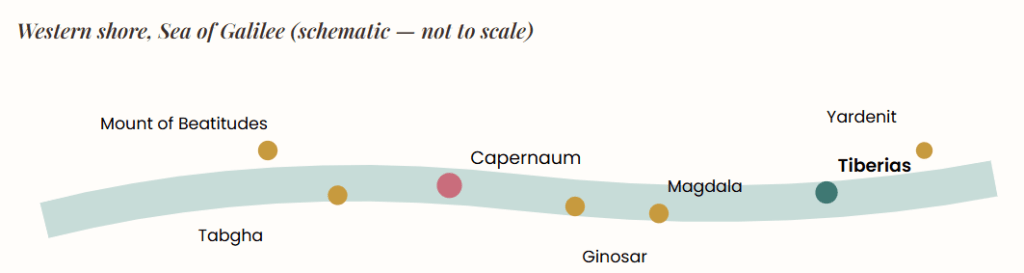
A rough visual layout of the western shore — for turn-by-turn directions, use Waze or Google Maps and search “Kfar Nahum National Park.”
📍 Places to Visit in Capernaum
The White Synagogue
A 4th–5th century limestone synagogue, one of the largest and best-preserved in Israel, built directly over the black basalt foundations of a 1st-century synagogue — very possibly the one mentioned in the Gospels.
House of St. Peter
A striking modern church, suspended on pillars over excavated 1st-century house remains long venerated as Peter’s home. Look down through the glass floor to the ruins below.
Church of the Twelve Apostles
The Greek Orthodox section’s red-domed, lakeside church, with painted interiors and a genuinely peaceful garden shaded by tall trees (and the odd wandering peacock).
Kfar Nahum National Park
The newer, INPA-run section just outside the ancient site, with a shoreline promenade, a small dock for boat departures, and shaded picnic spots.
💎 Hidden Gems
- The lakeside promenade connecting Capernaum toward Tabgha — a quiet 3.5km walking path most tour buses never use.
- The basalt house clusters behind the main synagogue, where you can trace the outlines of ordinary 1st-century Galilean homes without a single other visitor in sight.
- Early morning light — arriving at opening time transforms Capernaum from “quick photo stop” into something genuinely moving.
🗓️ Sample One-Day Itinerary: Capernaum & Around
Food to Try near Capernaum, Israel
There’s no restaurant scene inside Capernaum itself — it’s an archaeological and religious site, not a dining district — but the lakeshore around it is full of good, honest Galilean food.
🍽️ Meal Structure
Israeli meals near the Sea of Galilee tend to follow a generous, shareable rhythm: a spread of small salads and dips arrives first (think hummus, tahini, chopped Israeli salad, pickles), followed by a main, and often finished with strong Arabic-style coffee and fresh dates or fruit. Lunch is typically the largest meal of the day for tour groups passing Capernaum, since dinner in Tiberias tends to be lighter and later.
🐠 Regional Specialties
- St. Peter’s fish — actually tilapia, pulled straight from the Sea of Galilee and traditionally fried or grilled whole, head and all. It’s the single most iconic dish near Capernaum and worth ordering at least once.
- Fresh hummus and pita — the salad buffet that arrives before your main is often the best part of the meal.
- Local olive oil and dates — the groves surrounding Capernaum produce some genuinely excellent oil and date syrup (silan), both good souvenirs.
- Falafel — the reliable, cheap option in Tiberias if you want a $3–5 meal instead of a sit-down lunch.
Insider tip: restaurants immediately next to major pilgrimage stops (including near Capernaum) are built for tour-bus turnover, so prices run high and quality is inconsistent. Driving five extra minutes into Tiberias proper or Ginosar usually gets you better food for less.
Insider Tips, Recommendations & Honest Truths
A little “know before you go” honesty, since I’d rather you trust this Capernaum guide than feel sold to.
⚠️ Common Scams & Tourist Traps
- Unofficial “guides” occasionally linger near parking areas at Galilee sites offering tours — Capernaum itself is run by the Franciscans and the national park authority, and legitimate guides are booked in advance or hired through licensed agencies, not approached in a lot.
- Group-lunch restaurants right next to tourist stops sometimes upsell drinks and extras aggressively — always ask for a written price before ordering.
- Currency exchange at tourist hotspots tends to offer worse rates than a bank or ATM withdrawal — withdraw shekels from an ATM instead when possible.
🌿 Over-Tourism & Alternatives
Capernaum rarely feels overcrowded compared to Jerusalem’s Old City, but tour-bus season (especially around Easter and Christmas) can still bring a crush around 10 AM–1 PM. If the main synagogue area feels packed, the quieter national park promenade nearby, or a walk toward Tabgha along the shore, offers the same lakeside atmosphere with a fraction of the people. Magdala, a few minutes south, is also a wonderful, less-visited alternative with its own excavated 1st-century synagogue.
Day Trips from Capernaum, Israel
Tabgha
2.5km away — the Church of the Multiplication and Church of the Beatitudes, both gorgeous and easy to combine with Capernaum in a single morning.
Mount of Beatitudes
The traditional site of the Sermon on the Mount, with the best panoramic view of the entire Sea of Galilee.
Magdala
Mary Magdalene’s hometown, with an excavated ancient synagogue and harbor — a genuinely underrated stop.
Tiberias
The Galilee’s main town, roughly 15km south, good for hotels, restaurants, hot springs, and evening lakeside strolls.
Nazareth
About 40km away — Jesus’s hometown, with the Basilica of the Annunciation and a lively Old City market.
Yardenit / Jordan River
A popular baptismal site on the Jordan River, near where it exits the Sea of Galilee.
Practical Essentials for Your Capernaum Trip
🛡️ Safety and Health
Israel’s core tourist circuit — including Tel Aviv, Jerusalem, the Dead Sea, and the Galilee around Capernaum — is generally described by tour operators as calm and well-run day to day, and personal crime rates are low by international standards. That said, the regional security picture can and does shift; several governments (including the US) have issued “reconsider travel” advisories for Israel at points in 2026, with specific caution around areas close to the Lebanon and Syria borders in northern Israel, which lie a meaningful distance north of Capernaum itself but are worth being aware of if your route extends further north into the Golan or Upper Galilee.
Check your government’s official travel advisory close to your departure date, download the Home Front Command app if you’re a longer-stay visitor, and always have travel insurance in place (see above).
🎒 Packing List
- Modest clothing that covers shoulders and knees — required for entering Capernaum’s churches and synagogue
- Comfortable, closed-toe walking shoes (the basalt stones underfoot are uneven and can be slippery)
- A wide-brim hat, sunglasses, and high-SPF sunscreen — the sun over the Sea of Galilee is intense nearly year-round
- A refillable water bottle (Capernaum has very little shade)
- A lightweight scarf, useful for both sun coverage and as a quick head or shoulder cover at religious sites
- A universal power adapter (see below)
📶 Internet & SIM Cards
Israel’s mobile networks (Partner, Cellcom, Pelephone, Hot Mobile) offer strong 4G/5G coverage across the entire Galilee tourist circuit, Capernaum included. Most travelers now buy an eSIM online before departure so they land already connected — this skips the SIM-shop line at Ben Gurion. If your phone isn’t eSIM-compatible, physical prepaid SIMs are available at the airport arrivals hall and at phone shops in Tiberias (bring your passport for registration).
🔌 Power & Electricity
Israel uses Type H power sockets (which also generally accept the two-round-pin C and F style plugs), running on 230V at 50Hz. Bring a universal adapter if you’re coming from the US, UK, or most of Asia.
Useful Hebrew Phrases for Travelers
(A quick correction to save you confusion: you’ll want Hebrew here, not Italian — Capernaum is in Israel’s Galilee region, not Italy! Here are a few basics that go a long way.)
Shalom
Hello / peace / goodbye
Todah (rabah)
Thank you (very much)
Bevakasha
Please / you’re welcome
Slicha
Excuse me / sorry
Ken / Lo
Yes / No
Eifo ha-sherutim?
Where is the restroom?
Kama zeh oleh?
How much does this cost?
Ani lo mevin/a
I don’t understand
Where to Stay near Capernaum, Israel
There’s no lodging at Capernaum itself, so nearly everyone bases in Tiberias, about 15km (20 minutes) south — it has the widest range of hotels, guesthouses, and lakeside restaurants in the region. Budget travelers often pick hostels with lake access; mid-range visitors do well at the many hotel chains lining Tiberias’s waterfront; and travelers wanting a quieter, more scenic base sometimes choose a kibbutz guesthouse in Ginosar or Migdal, both a short drive from Capernaum.
🎉 More Activities near Capernaum
- Sail the Sea of Galilee on a wooden replica boat from Tiberias, Ein Gev, or Capernaum’s own small dock.
- Visit the Ancient Galilee Boat (“Jesus Boat”) at Ginosar’s Yigal Alon Museum, a genuine 1st-century fishing vessel pulled from the lakebed.
- Soak in Tiberias’s hot springs (Hamei Tiberias), a relaxing end to a long day of walking Capernaum’s ruins.
- Hike a stretch of the Jesus Trail, the long-distance walking route linking Nazareth to Capernaum.
- Kayak or paddleboard on the Sea of Galilee from Ginosar in warmer months.
Final Thoughts
Capernaum won’t overwhelm you with size, and it isn’t trying to. What it offers instead is concentration — of history, of quiet, of that particular Galilee light on old stone and older water. Go slow, go early, dress modestly, bring good shoes and better sunscreen, and let Capernaum be the still point in a busier Israel itinerary. I hope this guide gets you there prepared, curious, and ready to sit by that lake for a while longer than you planned to.


Polly Amora
Polly Amora is the señorita behind GoldenIslandSenorita.Net. A corporate warrior by day, and a perpetual explorer by heart. She is a lifelong learner who is very outgoing, speaks four languages, loud & outspoken, and loves to have adventures in the mountains, on the beach, and in the city. You can throw her anywhere, and she'll handle it like a pro. Ice cream and bourbon are two of her weaknesses.



30 Comments
Retirestyle Travel
Those are amazing pictures to accompany this great information to provide travel inspiration. Thanks
Louise
Somewhere definitely on my bucket list!
My Passport Abroad (@passportabroad)
Wow, it looks like such a cute place to visit, I’ll book mark this for a future trip!
Alyssa
As a Christian, Israel is definitely on my bucket list! I would love to explore and experience firsthand being in a place where Jesus has been. What a beautiful country!
Neil Alvin Nicerio
Oh my Gee!!! Nakapunta ka na pala sa Israel!!! Dream destination ko yan.
Kakaingit! Imagine napuntahan mo ung mga isa sa mga biblical places.
Kumusta naman pala ung safety? Yung mga nababasa ko kasi sa news parang everyday raw may conflict ang mga Israeli at Palestinians.
Anyway, thank you for this article nainspire ako – at naingit hahaha. More power to you Dude! 🙂